

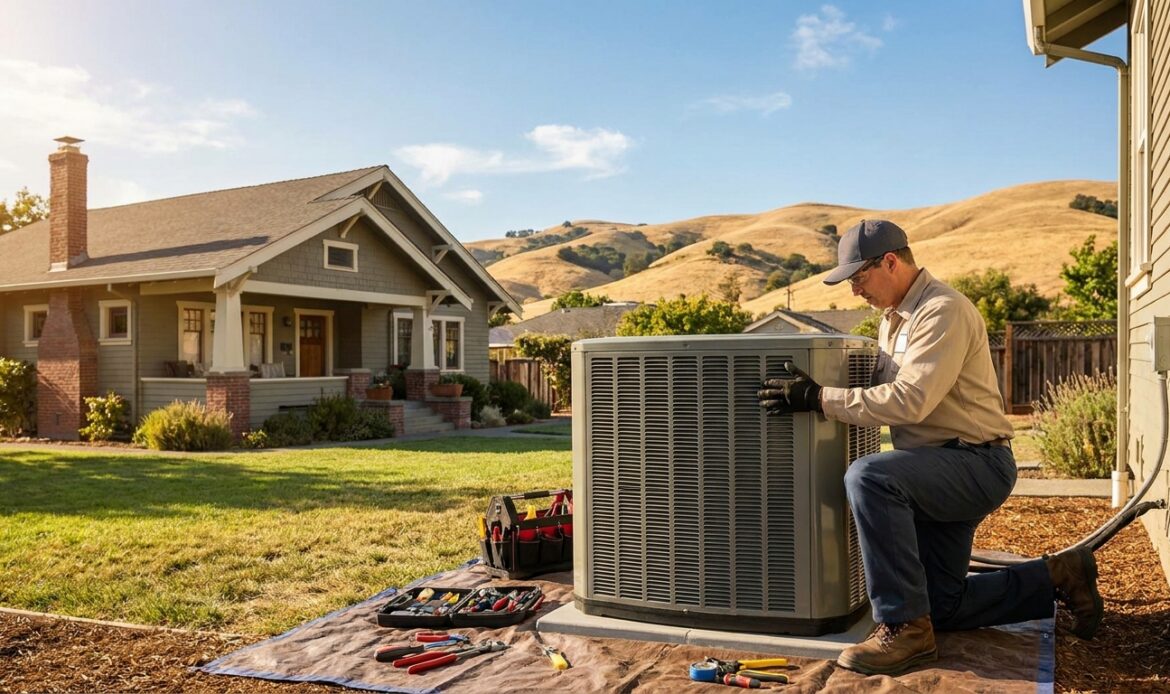
Petaluma summers push into the mid-90s, and the right AC installation makes the difference between a livable home and an expensive mistake you're stuck with for 15 years.
- AC installation in Petaluma runs $3,500–$7,500 for most residential central air systems in 2026
- Heat pumps add rebate eligibility that can cut net cost by $1,000–$3,000
- Comfort Factor handles sizing, permits, and commissioning across Sonoma County
- The right system depends on square footage, existing ductwork, and cooling-only vs year-round heat pump
Why AC Installation in Petaluma Is Different From the Rest of the Bay Area
Petaluma sits in a thermal pocket that funnels warm air off the Petaluma River valley. Coastal fog from the west and dry east-county heat create temperature swings that catch undersized systems off guard. A 2,000 sq ft home here can see indoor temps spike 20°F in four hours on a July afternoon. That means proper Manual J load calculation isn't optional — it's the single factor that determines whether your new system runs efficiently or short-cycles into an early grave.
Sonoma County also requires permits for new AC installations, and inspections can add 2–3 weeks to a project timeline if not scheduled proactively. Any contractor who skips the permit conversation is a red flag.
Who This Guide Is For
This guide is written for Petaluma homeowners and small commercial property owners making a first-time central AC purchase or replacing a system that's 12+ years old. If you're comparing a straight cooling system against a heat pump, or trying to figure out what questions to ask a contractor before signing anything, you're in the right place.
What to Look for in AC Installation for Petaluma Properties
Proper Load Calculation (Manual J)
Every legitimate AC installation in Petaluma starts with a Manual J load calculation — a room-by-room heat gain analysis that accounts for insulation, window orientation, ceiling height, and local climate data. Without it, contractors guess on system size. Oversized systems cool fast but don't dehumidify; undersized systems run constantly and fail early. Ask any contractor upfront whether they perform Manual J before quoting equipment.
SEER2 Rating and Long-Term Efficiency
As of 2026, California requires new residential AC systems to meet a minimum SEER2 of 15.2 for split systems. Systems rated SEER2 16–18 add $300–$700 to upfront cost but typically recover that in utility savings within 3–5 years at PG&E rates. The jump from 14 SEER (older federal standard) to 16 SEER2 cuts cooling energy use by roughly 14% annually.
Ductwork Condition and Compatibility
Petaluma homes built before 1985 often have undersized or deteriorating duct systems. Installing a new AC unit on a leaky duct system wastes 20–30% of conditioned air before it reaches living spaces. A contractor who prices ductwork sealing or replacement separately — and shows you the duct leakage test results — is one you can trust. One who ignores ducts entirely is setting you up for poor performance and callbacks.
Heat Pump vs. Cooling-Only Split System
In Petaluma's climate zone (CEC Climate Zone 2), heat pumps make financial sense for most properties replacing both heating and cooling equipment at the same time. The federal heat pump tax credit in 2026 covers 30% of installed cost up to $2,000, and TECH Clean California rebates add up to $3,000 for qualifying low- and moderate-income households. If your furnace has 5+ years left, a cooling-only system is reasonable. If your furnace is aging, the rebate math often favors going heat pump now.
Contractor Licensing and Sonoma County Permit Handling
California requires HVAC contractors to hold a C-20 license. Verify your contractor's license number on the CSLB website before signing any contract. Comfort Factor carries full C-20 licensing and pulls Sonoma County permits directly — the homeowner never has to manage the permit process separately.
Brand and Parts Availability
Petaluma isn't a major metro, which means parts availability matters more than it does in San Jose or Oakland. Stick with brands that have strong Northern California distributor networks: Carrier, Lennox, Trane, and Daikin all have distribution within 30 miles of Petaluma. Boutique or gray-market equipment saves nothing if a compressor takes 3 weeks to source mid-August.
Top Picks for Petaluma AC Installation in 2026
The Safe Pick — Central Split System, SEER2 16–17
Hook: Reliable, rebate-eligible, works on existing ductwork.
Spec that matters: SEER2 16 on a 3-ton unit cuts annual cooling costs to roughly $180–$220 at current PG&E E-1 rates for a 1,800 sq ft home.
Concrete number: Installed cost range $4,200–$6,000 in 2026 for a 2.5–3.5 ton system.
Verdict: Buy — for any Petaluma homeowner with intact ductwork and a working furnace. This is the lowest-risk path to comfortable summers.
Get a free quote from Comfort Factor
The Upgrade Pick — Ducted Heat Pump System
Hook: Replaces heating and cooling in one unit, qualifies for the most rebates.
Spec that matters: A 3-ton heat pump at SEER2 18 / HSPF2 10 handles both summer cooling and Petaluma's mild winters down to 17°F without backup heat kicking in.
Concrete number: Installed cost $6,500–$9,500 before rebates; after federal tax credit and TECH Clean California rebate, effective cost drops to $3,500–$6,500 for many households.
Verdict: Buy — if your furnace is 10+ years old or you want to reduce gas dependency. The 2026 rebate window makes this the best time to move.
The Targeted Pick — Ductless Mini-Split, Single Zone
Hook: Ideal for additions, converted garages, or one problem room that the central system never reaches.
Spec that matters: A 12,000 BTU (1-ton) ductless unit covers up to 550 sq ft with no duct runs required.
Concrete number: Installed cost $2,800–$4,200 for single-zone; multi-zone systems with 3 heads run $7,000–$11,000 installed.
Verdict: Consider — if your main house already has central air and you need to address one unconditioned space. Not the right call as a whole-home solution unless ductwork installation is cost-prohibitive.
What to Avoid
- Skipping the load calculation to save time. A contractor who sizes by square footage rule-of-thumb alone will likely oversize your system. Oversized AC in Petaluma's climate means short-cycling, high humidity, and a compressor that fails 4–6 years early.
- Choosing the lowest bid without seeing the scope of work. If two quotes differ by $1,500 and one doesn't mention duct testing, permit fees, or startup commissioning — that's where the savings came from. Confirm line items match before comparing prices.
- Installing a cooling-only system when the furnace is already past 15 years. You'll pay a second installation cost within 2–3 years. In 2026, with rebates still active, combining the replacement into one project almost always pencils out cheaper.
Verdict Comparison Table
| System Type | Installed Cost (2026) | SEER2 | Rebate Eligible | Best For |
|---|---|---|---|---|
| Central Split, SEER2 16–17 | $4,200–$6,000 | 16–17 | Limited | Homes with good ductwork, working furnace |
| Ducted Heat Pump | $6,500–$9,500 (pre-rebate) | 17–18 | Yes — up to $5,000 | Replacing aging furnace + AC together |
| Ductless Mini-Split (1 zone) | $2,800–$4,200 | 18–22 | Partial | Additions, garages, problem rooms |
| Ductless Mini-Split (3 zone) | $7,000–$11,000 | 18–22 | Yes | Homes without existing ductwork |
FAQ
What does AC installation cost in Petaluma, CA in 2026?
Most residential central AC installations in Petaluma run $3,500–$7,500 in 2026, depending on system size, ductwork condition, and whether you choose a heat pump or cooling-only unit. Ductless mini-splits for a single zone start around $2,800 installed.
How long does AC installation take in Petaluma?
A straightforward central AC replacement on existing ductwork takes 1–2 days for installation. Add 2–3 weeks if you need to schedule a Sonoma County permit inspection. New ductwork adds 1–3 additional days depending on home size.
Do I need a permit for AC installation in Petaluma?
Yes. Sonoma County requires a mechanical permit for new AC and heat pump installations. Your contractor should pull this permit — if they suggest skipping it, walk away. Unpermitted HVAC work creates problems at resale and voids most manufacturer warranties.
Is a heat pump better than a traditional AC in Petaluma?
For most Petaluma homes in 2026, yes — especially if you’re also replacing a furnace. Heat pumps cover both heating and cooling, qualify for federal tax credits and TECH Clean California rebates, and handle Petaluma’s climate zone comfortably. If your furnace is newer, a standard AC is a reasonable choice.
What size AC do I need for a Petaluma home?
Size depends on a Manual J load calculation, not just square footage. A rough starting point: 1.5–2 tons for homes under 1,200 sq ft, 2.5–3 tons for 1,200–2,000 sq ft, 3.5–4 tons for 2,000–2,800 sq ft. Petaluma’s local climate data must be factored in — national rule-of-thumb charts are not sufficient.
How do I find a licensed AC contractor in Petaluma?
Verify any contractor’s C-20 license on the California Contractors State License Board (CSLB) website before signing. Comfort Factor holds full C-20 licensing and serves Petaluma and all of Sonoma County.
What SEER2 rating should I look for in 2026?
California’s 2026 minimum is SEER2 15.2 for residential split systems. Aim for SEER2 16–18 for meaningful utility savings at PG&E rates — the payback period on the efficiency premium is typically 3–5 years.
One Last Thing
Petaluma is in CEC Climate Zone 2 — one of California's most favorable zones for heat pump performance. Unlike coastal zones where ambient temps stay cool or inland zones that hit 110°F, Petaluma's range sits almost perfectly within the operating envelope where modern heat pumps run most efficiently. That's a genuine mechanical advantage, not a talking point. If you're on the fence about a heat pump in 2026, Petaluma's climate is actually one of the stronger arguments for it.