

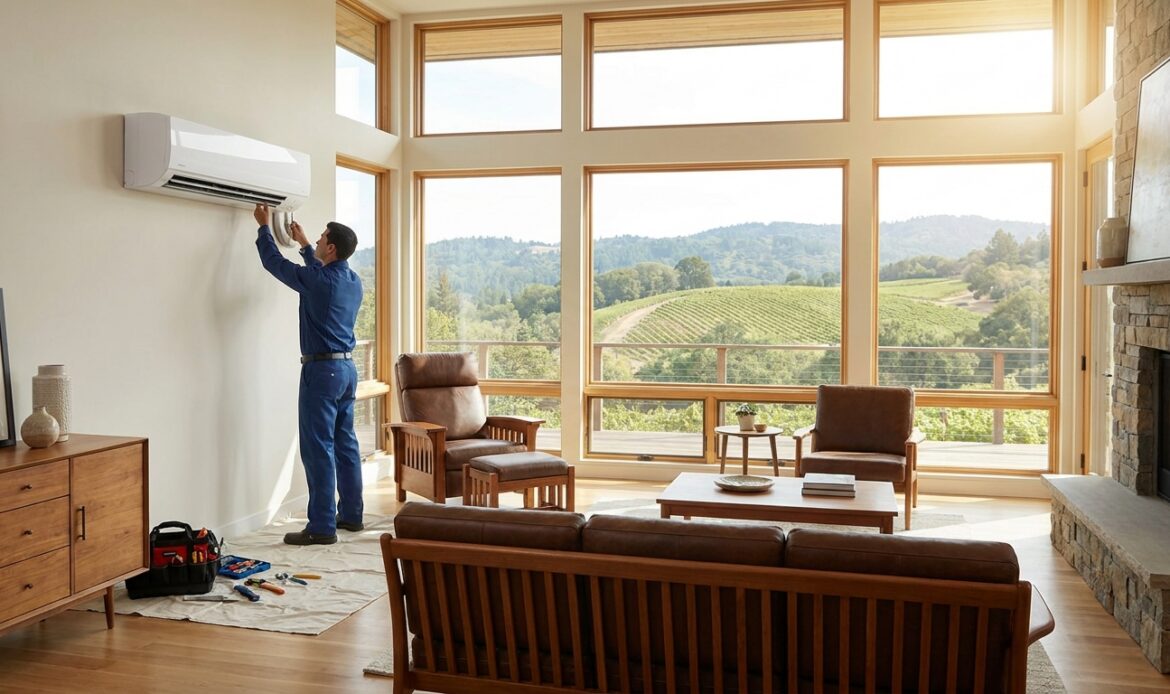
Ductless mini-split installation in Sonoma County solves a problem central ducting never fixes: uneven comfort in older ranch homes, additions, and ADUs from Petaluma to Glen Ellen. This guide breaks down what actually matters when you're buying, not just installing, a mini-split system in 2026.
TL;DR
Ductless mini-split installation in Sonoma County makes the most sense for homes with no existing ductwork, room additions, ADUs, or anyone dealing with wildfire smoke season and wanting filtered, zoned comfort. A multi-zone inverter-driven system is the Buy for most Sonoma County houses built before 1980, while a single-zone unit is the Consider for one-room fixes like a garage conversion or bonus room. Skip any contractor quoting a mini-split without a Manual J load calculation — undersizing or oversizing kills efficiency and comfort. Comfort Factor handles mini-split installation across Sonoma County as part of its broader HVAC services in Sonoma County coverage.
Why this matters
Sonoma County's housing stock is a mix of 1960s-70s ranch homes without ductwork, newer builds with central systems already stretched thin, and a growing number of ADUs added since 2020. Ductless mini-splits fit all three situations differently, and the wrong configuration means paying twice — once for the wrong system, once to fix it.
Wildfire smoke season adds a local wrinkle most national buying guides skip entirely. A mini-split with a MERV-rated filter and sealed indoor unit keeps smoke out during Sonoma and Napa fire events in a way an open window or a single box fan never will. That's not a minor add-on here — it's close to a core requirement.
Who this is for
This guide is for Sonoma County homeowners weighing ductless mini-split installation for a room addition, an ADU, a home without existing ductwork, or a whole-house retrofit away from an aging central system. If you're comparing a single unit for a converted garage against a four-zone system for a 1968 ranch house, the criteria below apply either way.
What to look for in mini-split installation for Sonoma County homes
Zoning capacity matched to your floor plan
A single outdoor condenser can run one indoor head or up to eight, depending on the manufacturer and BTU load. Sonoma County homes with open-concept additions often need just one or two zones, while older homes with closed-off bedrooms and a detached office need three or four to avoid hot and cold spots. Get the zone count wrong and you'll be running the system at full blast in one room while another sits uncomfortable.
Cold-climate heat pump performance
Sonoma County winters dip into the high 30s overnight in Santa Rosa and Sonoma Valley, and a mini-split rated as a true cold-climate heat pump keeps delivering heat down to 5°F outdoor temps without switching to inefficient backup strip heat. Standard heat pump mini-splits start losing capacity below 25-30°F, which matters more in Glen Ellen and the hills than in flatter Petaluma.
Filtration for wildfire smoke season
Look for indoor units with washable or MERV 8+ filters and a sealed cabinet design — this is the difference between a smoke-blocked room and one that just recirculates ash particulate. During peak fire season, this single spec matters more to Sonoma County buyers than SEER rating.
Sound levels for tight lot lines
Outdoor condensers rated above 55 decibels get noticeable fast on Sonoma County's tighter urban lots in Petaluma and Rohnert Park. Units in the high-30 to mid-40 decibel range run close to background noise, which matters if your condenser sits near a bedroom window or a neighbor's fence line.
Permit and inspection requirements
Every Sonoma County jurisdiction requires an electrical and mechanical permit for mini-split installation, and skipping this step creates problems at resale. A contractor who pulls permits as a matter of course is telling you something about how the rest of the job gets handled.
Line set length and routing
Longer refrigerant line runs between outdoor and indoor units reduce system efficiency and can void manufacturer warranties past certain lengths, typically 50-100 feet depending on the model. Homes with the condenser far from the indoor head — common with detached ADUs — need this checked before installation day, not after.
Top picks by use case
Single-zone system — the one-room fix. Best for a garage conversion, home office, or single bonus room needing 9,000-12,000 BTU of capacity. One indoor head, one outdoor condenser, straightforward electrical run. Buy for isolated additions where the rest of the house already has working HVAC.
Multi-zone (2-4 head) system — the whole-home retrofit. Fits older Sonoma County homes without ductwork, tying bedrooms, living areas, and a converted attic into one outdoor unit running up to four indoor heads. Buy for houses built before 1985 that never had central air.
Ducted (concealed) mini-split — the no-visible-unit pick. Uses short duct runs hidden above a ceiling or in a crawlspace, so no wall-mounted head is visible in the finished room. Costs more in labor than a standard wall-mount head. Consider for owners who don't want indoor units on display, especially in a renovated kitchen or dining space.
Cold-climate inverter heat pump — the hill-country pick. Rated to maintain heating capacity down to 5°F outdoor temperature, relevant for Glen Ellen, Kenwood, and higher-elevation Sonoma Valley properties that see colder overnight lows than Petaluma or Santa Rosa proper. Buy for anyone above roughly 500 feet elevation in the county.
Entry-level non-inverter single unit — the shortcut. Cycles on and off rather than modulating output, which means bigger temperature swings and higher noise on startup. Skip unless it's a rarely-used space like a workshop where comfort tolerance is low anyway.
What to avoid
- An undersized single unit trying to cool an entire open floor plan. It looks like the budget-friendly option but runs constantly and never reaches setpoint on hot Sonoma County afternoons.
- A contractor skipping the Manual J load calculation. Eyeballing square footage instead of calculating actual heat gain and loss leads to oversized systems that short-cycle and undersized ones that never keep up.
- DIY or online-kit mini-splits without a licensed electrical hookup. These often skip the vacuum and charge process that keeps refrigerant lines leak-free, and they void any manufacturer warranty tied to professional installation.
Verdict comparison
| System type | Best for | Zones | Cold-weather rating | Verdict |
|---|---|---|---|---|
| Single-zone | One room / addition | 1 | Standard | Buy (isolated use) |
| Multi-zone (2-4 head) | Whole home, no ductwork | 2-4 | Standard to cold-climate | Buy (older homes) |
| Ducted concealed | Hidden install, finished spaces | 1-2 | Standard | Consider |
| Cold-climate inverter | Hill / elevation properties | 1-4 | Rated to 5°F | Buy (hillside) |
| Entry-level non-inverter | Low-use spaces only | 1 | Standard | Skip (most homes) |
FAQ
What's the best ductless mini-split installation for a Sonoma County ranch home?
A multi-zone inverter-driven system with 2-4 indoor heads fits most 1960s-70s Sonoma County ranch homes without existing ductwork, tying bedrooms and living space into one outdoor condenser.
Is ductless mini-split installation better than central AC for older Sonoma County homes?
For homes without existing ductwork, yes — running new ducts through finished walls and attics costs more in labor and demolition than a zoned mini-split system in most 2026 installations.
How much does mini-split installation cost in Sonoma County?
Cost depends on zone count, line set length, and electrical panel capacity, so get a site visit and written quote rather than relying on a national average that doesn't account for local labor and permit fees.
Do I need a permit for mini-split installation in Sonoma County?
Yes — every jurisdiction in the county requires electrical and mechanical permits for mini-split installation, and skipping this step can create problems during a future home sale.
Can a mini-split handle Sonoma County's wildfire smoke season?
A mini-split with a MERV 8 or higher filter and sealed indoor cabinet reduces smoke infiltration significantly better than open windows or portable fans, though it's not a substitute for a dedicated whole-home air purifier in heavy smoke events.
How long does mini-split installation take?
A single-zone install typically takes one day; multi-zone systems with 3-4 indoor heads often run two days depending on line set routing and electrical work needed.
Are heat pump rebates available for mini-split installation in 2026?
Utility and state rebate programs for heat pump installations change year to year, so check current program details before budgeting a project around a specific rebate amount.
What size mini-split do I need for a 400 square foot addition?
A Manual J load calculation is the only reliable way to size a unit — square footage alone ignores insulation, window count, and orientation, all of which shift the actual BTU requirement.
One last thing
The detail most homeowners miss: line set length quietly kills efficiency on ADU installs. A condenser placed 80 feet from an indoor head loses real capacity compared to a 15-foot run, even on paper-identical equipment — plan condenser placement before you plan the rest of the install, not after.