

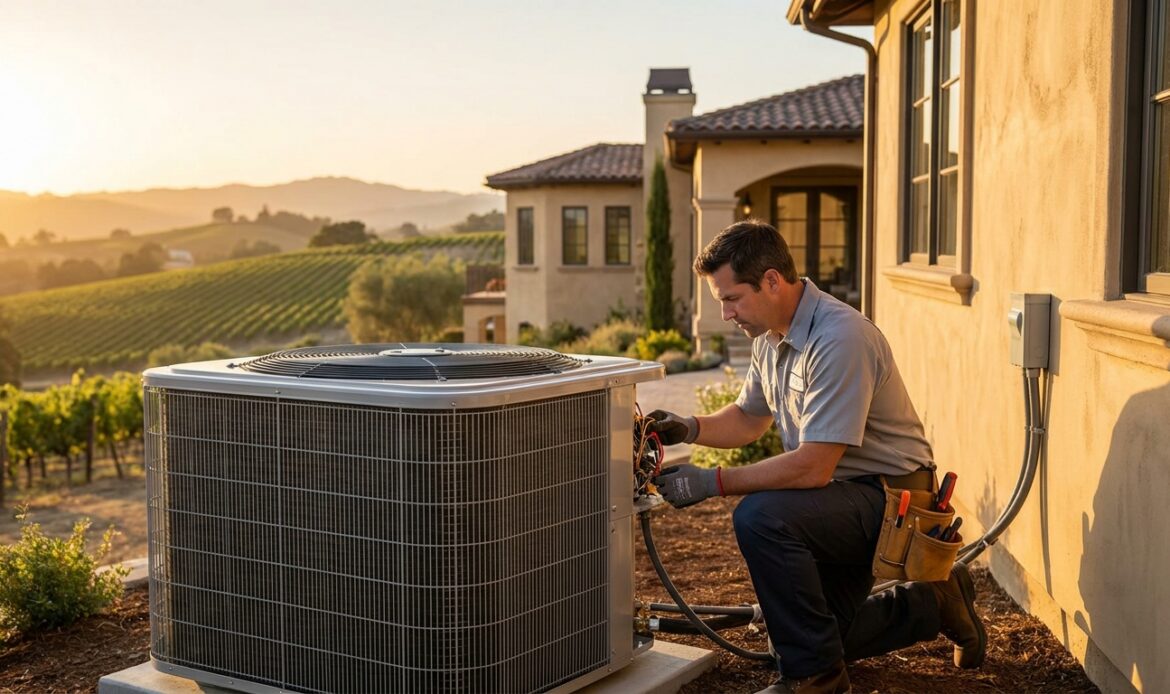
Napa summers push past 95°F on plenty of July and August afternoons, and a central air conditioning installation done wrong means a hot house through wine country's peak tourist season. This guide breaks down what actually matters when you're sizing, choosing, and signing off on a central AC install for a Napa home in 2026.
TL;DR
Central air conditioning installation in Napa comes down to three decisions: correct sizing for your square footage and duct condition, SEER2 efficiency rating, and whether your home even has ductwork worth reusing. For most single-family homes in Napa built before 2000, a two-stage 16-18 SEER2 system is the Buy — it handles the valley's heat spikes without the utility bill shock of an oversized single-stage unit. Homes with no existing ducts or awkward additions should skip central AC entirely and go ductless. Comfort Factor installs both across Napa, and the right call depends on your home's bones, not the brochure.
Why this matters
A central AC system sized for a Petaluma bungalow will underperform in a Napa home that sits exposed on a hillside with west-facing glass. Contractors who quote off square footage alone without a load calculation set homeowners up for short-cycling units, humidity problems, and 12-15 year systems that fail in year 7. Napa's mix of century-old farmhouses, 1970s ranch homes, and newer builds near American Canyon means there's no single spec that fits every install — the criteria below are what separate a system that lasts through 2040 from one you're replacing in 2032.
Who this is for
This guide is built for Napa County homeowners replacing an aging or failed central AC system, or adding cooling to a home that's never had it — whether that's a downtown Napa Craftsman, a hillside property off Silverado Trail, or a newer build in American Canuse without existing central air. If you're weighing central AC against a ductless mini-split for a single room addition, the criteria still apply, but see the "what to avoid" section below before you commit to full ductwork.
What to look for in central AC installation for Napa homes
Correct load calculation, not a square-footage guess
A Manual J load calculation accounts for insulation, window orientation, and ceiling height — not just square feet. Napa homes with south- or west-facing glass on Highway 29 corridor lots run hotter than the same square footage in a shaded Yountville neighborhood. Any installer who skips this step and quotes a tonnage off a tape measure is setting you up for an oversized, short-cycling system.
SEER2 rating appropriate for valley heat
Federal minimum efficiency for split-system central air conditioners has sat at 14.3 SEER2 since 2023, but Napa's extended hot season makes the efficiency math pay off faster than in cooler Bay Area counties. A jump from 14.3 to 17 SEER2 typically cuts cooling costs by roughly 15-18% over a full Napa summer, and that gap widens on the 100°F+ days that hit the valley floor most Julys.
Ductwork condition, not just the condenser
Many Napa homes built before 1985 still run original ductwork that leaks 20-30% of conditioned air into attics and crawlspaces. Installing a new high-efficiency condenser on leaky old ducts wastes the upgrade — sealing or replacing ducts should be part of the install quote, not an upsell added later.
Two-stage or variable-speed compressor for humidity and heat spikes
Single-stage systems run at one speed: full blast or off. Two-stage and variable-speed compressors modulate output, which matters in Napa because the valley swings from cool mornings to sharp afternoon heat — a system that can throttle down keeps humidity and temperature more even instead of cycling hard all afternoon.
Permit and inspection handling
Napa County requires permits for central AC installation, and skipping this step creates problems at resale. Confirm the installer pulls the permit and schedules the county inspection as part of the job, not as a homeowner task left for later.
Warranty terms tied to professional installation
Most manufacturer warranties on compressors and coils require documented professional installation to stay valid. Ask for the specific warranty length in writing before the crew shows up — verbal promises don't hold up if a compressor fails in year 6.
Top picks for Napa central AC installation
The standard replacement — two-stage 16-18 SEER2 system. This is the safe pick for most Napa single-family homes with existing, sound ductwork. Expect a 15-18% cooling cost reduction over baseline 14.3 SEER2 units and a typical install timeline of one to two days. Buy for straightforward replacements where ducts test tight.
The efficiency upgrade — variable-speed system, 18+ SEER2. The higher price point pays back faster in Napa than in shadier Bay Area counties because the cooling season runs longer and hotter. Variable-speed compressors also run quieter — a real factor if your condenser sits near a patio or outdoor entertaining space. Consider if you're staying in the home 10+ years and want the lowest possible summer utility bills.
The retrofit workaround — ductless mini-split. Homes with no existing ductwork, additions, or detached structures like a wine cave office or ADU are poor candidates for running new ducts. Ductless AC installation in Napa skips the ductwork problem entirely and installs faster — often in a single day per zone. Buy for additions, ADUs, and homes without existing ducts.
The oversized unit sold on "bigger is better." Some quotes push a larger tonnage than the load calculation supports, arguing it cools faster. It doesn't — it short-cycles, wastes energy, and strips humidity control. Skip any quote that skips the Manual J and just upsizes.
The bare-minimum builder-grade swap. Matching a failed 20-year-old single-stage system with another single-stage unit at 14.3 SEER2 keeps upfront cost low but locks in higher bills for another 15-year lifespan. Hold off unless budget is the only constraint — the efficiency gap compounds every summer you own the system.
What to avoid
- A quote with no load calculation. If the estimate is based purely on square footage, get a second opinion before signing.
- Reusing leaky original ductwork without testing it. A duct blower test costs little compared to the energy lost through unsealed joints for the next 15 years.
- Confusing residential and commercial-grade equipment. Home wineries and tasting rooms attached to a residence sometimes need commercial-spec equipment — that's a different scope than a home comfort install, and commercial AC installation in Napa covers that case separately from standard residential work.
Verdict comparison
| System type | Best for | SEER2 range | Verdict |
|---|---|---|---|
| Two-stage standard | Homes with sound ductwork | 16-18 | Buy |
| Variable-speed | Long-term owners, hillside homes | 18+ | Consider |
| Ductless mini-split | No ducts, additions, ADUs | Varies by unit | Buy |
| Oversized single-stage | No one — avoid | N/A | Skip |
| Builder-grade single-stage | Tight budget, short-term hold | 14.3 | Hold |
FAQ
What's the best central AC system for a Napa home?
A two-stage or variable-speed system rated 16 SEER2 or higher is the best fit for most Napa homes with existing ductwork, given the valley's extended hot season. Homes without ducts do better with a ductless mini-split instead of forcing new ductwork into the budget.
Is central AC installation in Napa different from other Bay Area counties?
The equipment and process are similar, but Napa's longer, hotter cooling season shifts the efficiency math — higher SEER2 systems pay back faster here than in cooler Marin or Sonoma coastal areas. Sizing also needs to account for exposed hillside lots common in Napa.
How long does a central AC installation take?
Most single-system replacements with existing ductwork take one to two days. Jobs that include duct sealing, replacement, or new electrical work run longer, often three to four days depending on scope.
Does central AC installation in Napa require a permit?
Yes. Napa County requires a permit and inspection for central air conditioning installation, and a licensed contractor should handle both as part of the job.
Are rebates available for central AC installation in Napa in 2026?
Utility and regional rebate programs periodically offer incentives for high-efficiency HVAC upgrades — check current program terms directly, since availability and amounts change year to year.
Should I repair or replace my central AC system?
A system past 12-15 years old, especially one with a failed compressor, is usually cheaper to replace than repair once you factor in the efficiency gap against current SEER2 minimums. Younger systems with a single failed part are often worth repairing.
Can I add central AC to a Napa home that never had it?
Yes, but only if the home has (or can accommodate) ductwork with reasonable modification. Homes without a practical path to ducts are better served by a ductless system instead of retrofitting ducts into tight attic or crawl spaces.
What size AC unit does a typical Napa home need?
There's no universal number — a Manual J load calculation based on square footage, insulation, window exposure, and ceiling height determines correct tonnage. Guessing by square footage alone is the most common cause of an oversized, inefficient system.
One last thing
The detail most homeowners skip is duct testing before the new condenser goes in. A system rated at 18 SEER2 connected to ducts leaking 25% of conditioned air performs closer to a 13-14 SEER2 system in practice — the efficiency upgrade you paid for never reaches the living room.