

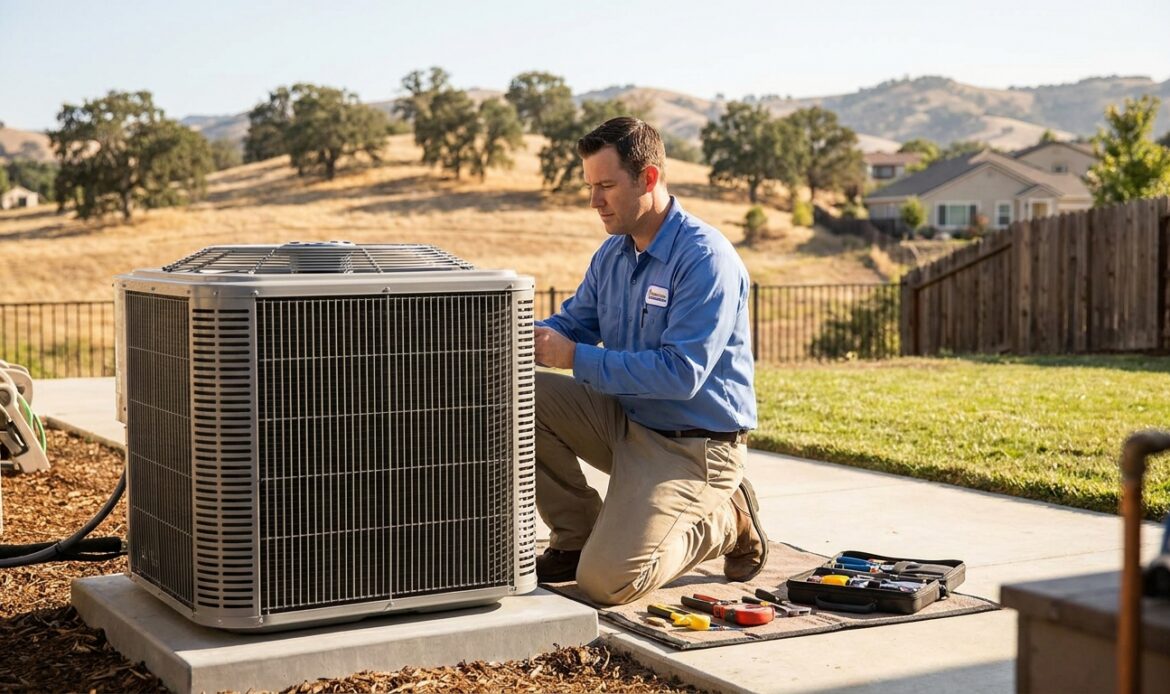
Contra Costa County runs two climates at once: Richmond and El Cerrito stay fog-cooled most of the summer while Concord, Antioch, and Brentwood push past 100°F for weeks at a stretch — and that split changes which AC installation actually holds up in your house through 2026 and beyond.
- Central AC installation in Contra Costa County needs sizing matched to inland heat — undersized units fail on 100°F days in Concord and Antioch.
- Ductless mini-splits are the buy for older Walnut Creek and Danville homes with no existing ductwork.
- SEER2 13.4 is the 2026 federal minimum efficiency rating — nothing lower is legal to install new.
- Skip any installer quoting AC installation sight-unseen; a load calculation is non-negotiable given the county’s microclimates.
Why this matters
A system sized for Richmond's marine layer will short-cycle and struggle in Antioch's dry heat, and a unit built for inland extremes is often oversized and inefficient near the bay. Contra Costa County's terrain — bay shoreline, valley floor, foothill communities — means the "right" AC installation depends entirely on where your house sits, not just its square footage. Getting sizing and system type wrong costs homeowners in comfort and utility bills for the next 15 to 20 years, which is the typical service life of a central AC unit.
Who this is for
This guide is built for homeowners in Contra Costa County — Walnut Creek, Concord, Danville, Pleasant Hill, San Ramon, Martinez, and Antioch — who are replacing a failing AC unit or adding cooling to a home that's never had it. It also applies if you're weighing central air against a ductless system for an older home without existing ductwork. HVAC services in Contra Costa County cover both scenarios, and the criteria below apply whether you're near the bay or fifteen miles inland.
What to look for in AC installation for Contra Costa County homes
Sizing matched to your microclimate
A load calculation, not a square-footage rule of thumb, determines the right tonnage for your house. Homes in Antioch and Brentwood need capacity for sustained 100°F+ days, while Richmond and El Cerrito properties often need less cooling capacity than their square footage suggests. An oversized unit short-cycles and leaves humidity in the air; an undersized one runs constantly and still can't keep up on the hottest days of 2026's cooling season.
SEER2 rating and Title 24 compliance
California enforces the federal SEER2 minimum of 13.4 for new split-system air conditioners, and Title 24 energy code adds state-specific requirements on top of that. Any installer quoting equipment below 13.4 SEER2 for a new install is quoting something you legally can't put in. Higher SEER2 ratings — 16, 18, 20 — cost more up front but cut cooling bills on the inland side of the county where AC runs longest.
Existing ductwork condition
Many homes built before the 1990s across Walnut Creek and Pleasant Hill have ductwork that's undersized, leaky, or laid out for a smaller furnace than today's systems need. Installing a new high-efficiency AC onto old, leaky ducts wastes a meaningful share of the cooling you're paying for. If ducts are compromised, ductless or ducted-mini-split options deserve a real look before you commit to central air.
Contractor licensing and local permit experience
Contra Costa County and its cities each require permits and inspections for AC installation, and an installer who skips this step leaves you exposed if you sell the house or file an insurance claim later. A licensed contractor who pulls permits routinely in your specific city moves faster through inspection than one unfamiliar with local requirements.
Compressor staging
Single-stage compressors run at one speed: full blast or off. Two-stage and variable-speed compressors modulate output, which matters more in Contra Costa's swing climate than in a county with one steady weather pattern. Variable-speed units hold temperature more evenly during the shoulder-season days that are common near the bay.
Top picks for Contra Costa County AC installation
The straightforward pick — ducted central AC for homes with intact ductwork. A two-stage central system rated at 16 SEER2 or higher is the default for Danville and San Ramon homes with ductwork installed in the last 20 years. Expect a compressor and coil swap plus a load-verified thermostat setup. Verdict: Buy if your ducts pass a sealing inspection.
The condo and townhome pick. Space-constrained units in Walnut Creek with HOA restrictions on outdoor equipment need a compact condenser footprint and a plan for condensate drainage that doesn't cross common areas. The AC installation guide for condos in Walnut Creek walks through the equipment and permitting angle specific to multi-unit buildings. Verdict: Consider — confirm HOA sign-off before ordering equipment.
The wildcard — heat pump doing double duty. A heat pump system installed for cooling also covers winter heating, which matters in a county where Concord and Antioch see cold snaps most homeowners don't expect from the Bay Area. The heat pump installation guide for Contra Costa County covers sizing this correctly for both seasons. Verdict: Buy if you're replacing an aging furnace and AC at the same time.
The budget trap — window and portable units for whole-home cooling. Window units and portable ACs handle one room adequately but can't keep pace with a 100°F day across a full house, and running several at once often costs more monthly than a right-sized central system. Verdict: Skip for anything beyond a single room or a stopgap measure.
Get an AC installation quote
Comfort Factor sizes systems for your exact Contra Costa County microclimate.
What to avoid
- Sight-unseen quotes. Any installer who gives a firm AC installation price without walking your attic, ductwork, and electrical panel is guessing, and guesses run high or low in ways that cost you later.
- Single-stage units on inland properties. A single-stage compressor in Antioch or Brentwood runs at full output constantly through summer, which shortens equipment life and spikes electric bills.
- Skipping the permit to save time. An unpermitted AC installation can complicate a home sale in Contra Costa County and may void manufacturer warranty coverage entirely.
Verdict comparison
| Profile | System type | SEER2 | Verdict |
|---|---|---|---|
| Danville / San Ramon, existing ducts | Two-stage central AC | 16+ | Buy |
| Walnut Creek condo, HOA restrictions | Compact ductless | 18+ | Consider |
| Concord / Antioch, replacing furnace too | Heat pump | 15+ | Buy |
| Any home, single-room cooling only | Window/portable unit | N/A | Skip |
FAQ
What does AC installation cost in Contra Costa County in 2026?
Cost depends on system size, SEER2 rating, and whether existing ductwork needs repair or replacement. Get a site visit and load calculation before comparing quotes line by line.
Is a heat pump better than central AC in Contra Costa County?
A heat pump covers both heating and cooling in one system, which suits homes replacing an aging furnace alongside AC. Straight central AC still makes sense if your furnace is newer and only cooling needs replacing.
Do I need a permit for AC installation in Contra Costa County?
Yes, cities across Contra Costa County require permits and inspections for new AC installation. Skipping this step can complicate a future home sale or void manufacturer warranty coverage.
How long does AC installation take?
A straightforward swap onto existing ductwork typically completes in a single day. Ductless installs or projects requiring ductwork repair take longer depending on scope.
What SEER2 rating do I need in California in 2026?
13.4 SEER2 is the federal minimum for new split-system air conditioners in 2026. Inland Contra Costa homes running AC most of the year benefit from 16 SEER2 or higher on utility costs.
Can I install ductless mini-splits without existing ductwork?
Yes, ductless mini-splits are built specifically for homes without ductwork or with ductwork too compromised to reuse. They’re common in older Walnut Creek and Danville homes for this reason.
Does the same AC system work in Richmond and Antioch?
Not ideally. Richmond’s fog-cooled climate needs less cooling capacity than Antioch’s inland heat, so sizing should reflect each property’s specific microclimate rather than a county-wide default.
How hot does Contra Costa County get in summer?
Inland cities like Antioch, Brentwood, and Concord regularly hit the high 90s to low 100s in July and August. Bay-adjacent cities like Richmond stay noticeably cooler due to marine fog.
One last thing
The same county can require two completely different AC installations ten miles apart — a Richmond home and an Antioch home of identical square footage often need different tonnage entirely because of the marine layer's cooling effect near the bay. Get the load calculation done for your specific address, not your zip code's average.
Related guides
- How much does AC installation cost in the Bay Area
- How to choose the right AC size for a Bay Area home