

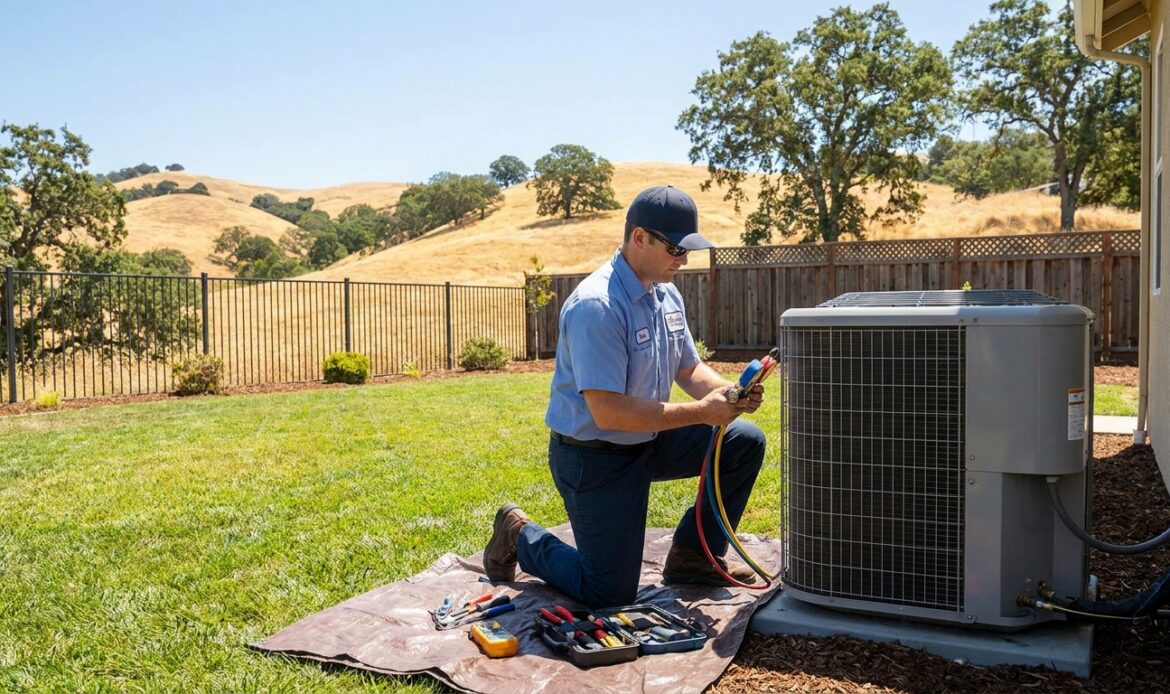
AC repair in Contra Costa County means racing against Diablo Valley heat that regularly pushes past 95°F in July and August, and picking a contractor who won't pad the invoice while your compressor sits dead in the driveway.
- Same-day response matters most for ac repair contra costa county homeowners once inland highs hit 95-100°F.
- A failed capacitor runs $150-$400 to fix and is often mistaken for a dead compressor – get a diagnosis first.
- Compressors older than 12-15 years often cost 60-70% of full replacement to repair – Comfort Factor calls that a replace decision, not a repair one.
- Skip any quote that skips the diagnostic – flat ‘too good to be true’ pricing usually means upsells later.
Why this matters
Contra Costa County spans inland furnace towns like Concord and Antioch and cooler bay-adjacent pockets near Richmond, and that temperature swing changes what "AC repair" actually looks like. A system that limps along fine in Martinez in June can fail hard in Walnut Creek by August. Getting the diagnosis right the first time saves a callback, and getting the urgency right saves a week without cooling during peak heat season.
Comfort Factor handles AC repair in Contra Costa County across both ends of that climate range, which is the reason technician experience with older R-22 units and newer heat pump systems matters more here than in a single-climate market.
Who this is for
This guide is for homeowners in Contra Costa County – Walnut Creek, Concord, Antioch, Danville, Pittsburg, Richmond – who have a system that's blowing warm air, short-cycling, or making noises it didn't make last summer. It's built for the person who wants a straight answer on repair versus replace, not a sales pitch dressed up as a diagnosis. If your system is under 8 years old and just needs a fix, this is your playbook. If it's pushing 15 years, the math below will tell you when repair stops making sense.
What to look for in AC repair for Contra Costa County homeowners
Same-day or emergency response
Inland Contra Costa County doesn't give you a grace period once the mercury clears 95°F. A contractor that can't get a technician out same-day during a July heat spike isn't built for this county's climate. Ask about actual response windows before you're desperate, not after.
Multi-era system experience
A meaningful share of homes in this county still run systems installed before 2010, many on R-22 refrigerant that's been phased out of production. A technician who's comfortable with both a 15-year-old R-22 unit and a 2026-installed heat pump gives you options a single-era specialist can't.
Transparent, itemized pricing before work starts
You want a written diagnostic finding and a line-item quote before any part gets replaced, not a lump-sum number that leaves you guessing what you paid for. Contractors who skip this step are the ones who upsell mid-repair.
Licensing and EPA refrigerant certification
Anyone touching refrigerant in California needs EPA Section 608 certification, and the company itself needs a valid C-20 HVAC contractor license. This isn't optional paperwork – unlicensed refrigerant handling is illegal and it's also the fastest way to void what's left of your system's manufacturer coverage.
Heat pump and hybrid fluency
As more Contra Costa County homes add or convert to heat pumps, a repair tech who only knows straight-cooling AC compressors is going to misdiagnose reversing valve and defrost-cycle issues on hybrid systems. Ask directly whether the company installs and repairs heat pumps, not just central AC – Comfort Factor's heat pump installation in Contra Costa County work means the same techs handling your AC repair also know hybrid systems inside out.
Top repair scenarios and what they mean for your system
The Friday afternoon no-cool call. Symptom: the system runs, but the air coming out is 10 or more degrees warmer than the return air. This is almost always a refrigerant charge issue, sometimes a slow leak that's been building for months. Verdict: Call today – a low charge left unaddressed can strand the compressor.
The rattling outdoor unit. Symptom: the condenser hums or clicks but the fan doesn't spin, or it spins slowly and stalls. This is usually a failed run capacitor or a seized fan motor, and it's a $150-$400 fix, not a compressor replacement, even though it sounds catastrophic. Verdict: Schedule this week – ignoring it risks taking the compressor down with it.
The 15-year-old compressor. Symptom: the system short-cycles, trips the breaker, or won't start at all, and the unit's been in service since before 2014. Once a compressor is past 12-15 years, repair often runs 60-70% of what a full system replacement costs. Verdict: Get a second opinion before repairing – this is the scenario where a repair quote and a replacement quote need to sit side by side.
The one that just needs a filter. Symptom: weak airflow, ice on the indoor coil, or a system that runs constantly without reaching the thermostat setpoint. Nine times out of ten this traces back to a clogged filter or a dirty evaporator coil restricting airflow. Verdict: Check the filter first, call if it persists – this is the cheapest fix on the list and the easiest to rule out yourself.
What to avoid
- Flat-rate quotes that skip the diagnostic. If a company gives you a fixed repair price over the phone before anyone's looked at the system, that number is a placeholder for upsells once the tech is on-site.
- DIY refrigerant recharge. Buying refrigerant without EPA 608 certification is illegal in California, and a mis-charged system can damage the compressor faster than the low charge that started the problem.
- Ignoring a failing capacitor because "it's still running." A weak run capacitor can pull the compressor into a hard-start condition for weeks before it finally fails, turning a $200 fix into a $2,000+ one.
Verdict comparison table
| Scenario | Symptom | Typical Fix Cost | Verdict |
|---|---|---|---|
| Low refrigerant charge | Warm air, system runs | Recharge + leak repair | Call today |
| Capacitor/fan motor failure | Rattling, stalled outdoor fan | $150-$400 | Schedule this week |
| Compressor near end of life | Short-cycling, tripped breaker, 12-15+ yrs old | 60-70% of replacement cost | Second opinion first |
| Restricted airflow | Weak airflow, iced coil | Filter/coil cleaning | DIY check first |
FAQ
What does AC repair cost in Contra Costa County in 2026?
Common repairs like capacitor or fan motor replacement typically run $150 to $400 in 2026, while refrigerant leak repairs and recharges cost more depending on leak location. Compressor replacement is the most expensive repair and often runs 60-70% of a full system replacement.
How fast can I get emergency AC repair in Walnut Creek or Concord?
Same-day service is standard practice for AC failures during peak summer heat in inland Contra Costa County, since a delay of even one day can mean living without cooling through a 95-100°F stretch. Confirm response windows with your contractor before you need one.
Is it worth repairing a 15-year-old AC compressor?
Usually not – compressor repair on a unit past 12-15 years old often costs 60-70% of full system replacement, and you’re paying that much to extend the life of every other aging component too. A second opinion comparing repair versus replacement quotes is the right move at this age.
Do I need a permit for AC repair in Contra Costa County?
Straightforward component repairs like capacitors, motors, or refrigerant recharges typically don’t require a permit, but full system replacement does under California building code. A licensed contractor will tell you which category your job falls into.
What’s the difference between AC repair and AC replacement?
Repair fixes a specific failed component – a capacitor, motor, or refrigerant leak – while replacement swaps the entire system. The dividing line is usually compressor age and cost: once a compressor repair approaches two-thirds the cost of replacement, replacement wins on value.
How long does an AC repair visit take?
Most single-component repairs like a capacitor or motor swap take one visit and a few hours, while refrigerant leak diagnosis can take longer if the leak isn’t obvious. Compressor-level problems may require a follow-up visit to confirm the repair-versus-replace decision.
Can heat pumps be repaired the same way as traditional AC units?
No – heat pumps have a reversing valve and defrost cycle that traditional AC-only systems don’t, so a technician needs specific heat pump experience to diagnose them correctly. A tech who only services straight-cooling AC can misdiagnose a heat pump issue as a compressor failure when it’s actually a reversing valve fault.
What’s the average summer temperature in Contra Costa County and how does it affect AC systems?
Inland cities like Concord, Antioch, and Walnut Creek regularly see highs of 95-100°F in July and August 2026, and that sustained heat pushes aging systems past their limit faster than in milder Bay Area climates. Systems that run marginally in June often fail outright once that heat arrives.
One last thing
The scenario homeowners get wrong most often is the rattling outdoor unit – it sounds like a dying compressor, but it's usually a $150-$400 capacitor or fan motor fix. Get the diagnosis before you approve a compressor-level repair quote; the difference between those two outcomes is often a factor of five in cost.
Related guides
- AC repair in Concord
- AC installation for a condo in Walnut Creek
- Heat pump installation in Contra Costa County