

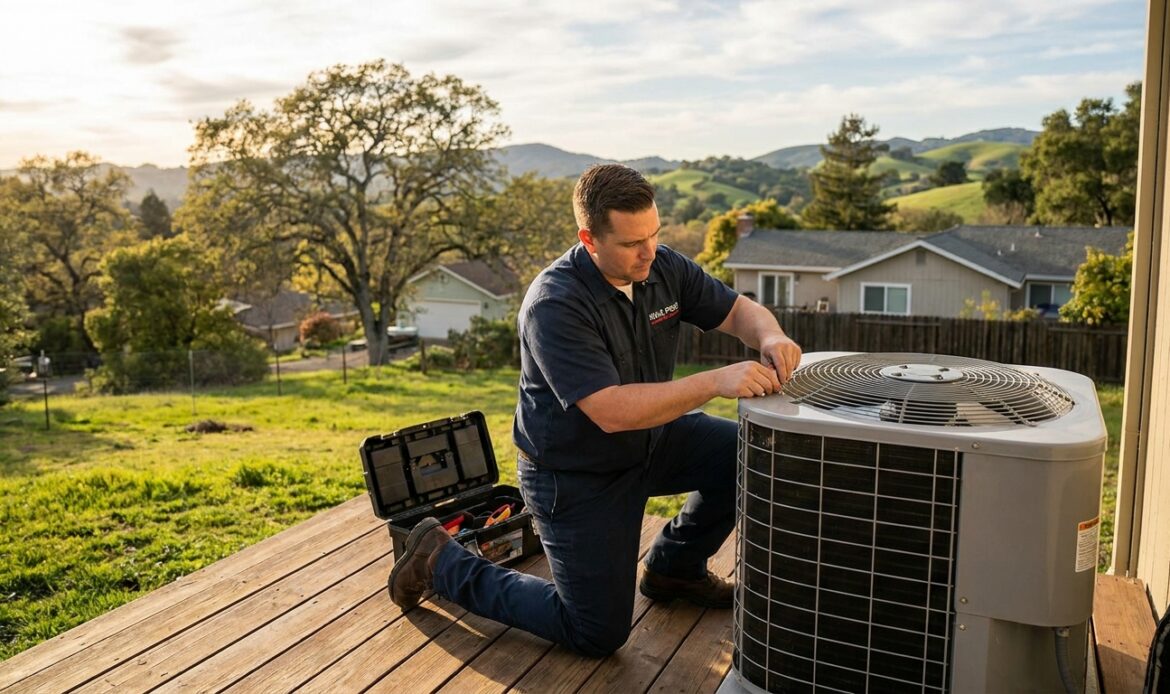
AC repair in Marin County means dealing with coastal fog, salt air drifting off the bay, and houses that run their systems in short bursts instead of constant cycles — all of which change what breaks first and how fast.
- AC repair in Marin County usually starts with a compressor or refrigerant issue, not a full system failure.
- A unit under 10 years old with one failed part: repair it, the math favors staying put.
- A system past 12-15 years with repeat breakdowns: skip another repair and budget for replacement instead.
- Coastal fog and salt air corrode coils faster in Marin than inland Sonoma or Napa, so annual tune-ups matter more here.
- Same-day diagnostic visits are the standard to expect during a Marin County heat spike, not a luxury.
Who this is for
This guide is for Marin County homeowners staring at a warm house, a dead thermostat, or a unit that's been cycling on and off all summer. It's written for people in Novato, San Rafael, Mill Valley, Larkspur, and the smaller towns along Highway 101 who need a straight answer: repair it, or start planning for something new. If your AC is under warranty or under 10 years old, most of this applies directly to you. If it's older and this is the third service call in two years, skip to the replacement section.
Why this matters
Marin's coastal climate is deceptively hard on AC units. Fog and salt air corrode outdoor coils faster than the dry heat inland counties like Napa or Solano see, and that corrosion shows up as refrigerant leaks and weak cooling years before a comparable inland system would fail. A HVAC maintenance plan catches most of this early, but plenty of homeowners only find out their coil is corroded when the system stops cooling on the first 90-degree day of 2026. Knowing what's actually wrong before you call someone saves you from paying for a diagnostic you could've skipped.
What to look for in AC repair for Marin County homes
Local response time
A contractor two counties away can't reach a failed AC in Mill Valley the same afternoon it dies. Marin's narrow roads and limited east-west routes mean response time depends heavily on whether a company already has trucks working the county. Ask directly how fast they can get someone out during a heat spike, not just what their general service area is.
Coastal corrosion experience
Coils and condensers near the bay corrode differently than units in Petaluma or inland Sonoma. A technician who mostly services drier climates may misdiagnose a corrosion-driven refrigerant leak as a simple recharge issue, and that recharge won't hold. Ask if they've worked specifically on Marin or Sausalito-area systems recently.
Diagnostic transparency
A repair estimate should tell you exactly which part failed — compressor, capacitor, coil, refrigerant line — not just that it's not cooling. Vague diagnostics are how homeowners end up paying for repairs that don't fix the actual problem.
Refrigerant type and availability
Older Marin County systems still running on R-22 face a real supply problem: it's no longer produced domestically, and prices climb every year it stays scarce. Systems on R-410A face their own tightening supply under the EPA's ongoing HFC phase-down, which is starting to push repair costs up compared to a few years ago. Ask what refrigerant your system uses before you commit to a repair.
Warranty on the repair itself
A repair without a written warranty on parts and labor is a gamble. Reputable contractors back their work for a defined period — if a company won't commit to anything in writing, that's a signal to keep looking.
Whether they'll give you a straight replace-or-repair recommendation
Some contractors default to repair because it's the easier sell in the moment. The ones worth hiring will tell you when a repair doesn't make sense, even if it costs them the smaller job today.
Top picks: matching the repair to your situation
The compressor call — diagnose before you assume the worst.
A failing compressor is the single most expensive AC repair most Marin homeowners face, and it's also the most commonly misdiagnosed. Warm air, a humming outdoor unit that won't kick on, or a breaker that trips repeatedly are the classic signs. If your system is under 10 years old, a compressor repair is usually worth it; older than that, the labor cost of swapping a compressor often rivals a large chunk of a new system's price. Check the signs against how to tell if your AC compressor is failing before you approve any quote. Buy the repair if the system is under 10 years old.
The refrigerant leak — the coastal special.
Refrigerant doesn't get used up in a healthy system; if levels are low, something is leaking, and in Marin that's frequently a corroded coil from years of salt air exposure. A slow leak can mean weak cooling for months before full failure. Confirm what you're dealing with using how to tell if your AC refrigerant is low. A single leak repair and recharge is usually reasonable; a coil that's leaked twice in two years signals it's time to stop patching it. Buy the repair once, consider replacement if it recurs.
The capacitor or contactor swap — the cheap, fast fix.
Capacitors and contactors are small parts that fail often and cost far less than a compressor or coil repair. If your AC won't start at all but the breaker hasn't tripped, this is frequently the culprit, and a same-day fix is realistic. Buy — this is the lowest-risk repair on the list.
The 12-15 year system with a new problem every summer — stop repairing.
If your unit is old enough that it's had a capacitor, then a refrigerant recharge, then a compressor scare, you're past the point where repair makes financial sense. Compare your system's age and repair history against the criteria in how to know when to replace your HVAC system. Skip the next repair and get a replacement quote instead.
What to avoid
- A recharge with no leak search. Refrigerant doesn't disappear on its own — if a technician just tops it off without finding the leak, you'll be paying for the same recharge again within a year.
- A flat replacement verdict with no diagnostic. Some contractors push replacement on any system over 8 years old regardless of what's actually wrong. Get the specific failed part named before you agree to a full system swap.
- DIY refrigerant handling. Refrigerant work requires EPA certification by law — a homeowner recharging a system themselves is both illegal and a good way to damage the compressor.
Get an AC repair diagnosis in Marin
Fast scheduling and a straight repair-or-replace answer, no guesswork.
Verdict comparison table
| Situation | System age | Typical fix | Verdict |
|---|---|---|---|
| Weak cooling, humming outdoor unit | Under 10 years | Compressor diagnosis/repair | Buy |
| Slow-cooling, refrigerant low | Any age | Leak repair + recharge | Buy once |
| No start, breaker fine | Any age | Capacitor/contactor swap | Buy |
| Repeat leaks, second recharge in 2 years | 8+ years | Coil replacement | Consider replacement |
| Multiple failures per year | 12-15+ years | Full system | Skip repair, replace |
FAQ
How much does AC repair cost in Marin County?
Cost depends entirely on which part failed — a capacitor swap is far cheaper than a compressor or coil repair. Get a diagnostic first so you’re quoted for the actual problem, not a guess.
Is it cheaper to repair or replace an AC unit in Marin County?
Repair is usually cheaper for systems under 10 years old with a single failed part. Past 12-15 years or with repeat failures, replacement typically costs less over time than another round of repairs.
How long does AC repair take in Marin County?
Simple fixes like a capacitor or contactor swap are often same-day. Compressor repairs or coil replacements can take longer depending on parts availability, especially for older R-22 systems.
What is the most common AC repair issue in Marin County homes?
Refrigerant leaks from coastal fog and salt air corrosion are the most common issue in Marin specifically, more so than in inland counties like Napa or Solano.
Do older Marin homes need special ductless mini-split repair?
Older homes without existing ductwork often run on ductless mini-splits, which have different failure points than central AC, mainly around the refrigerant lines and indoor unit sensors.
Is emergency AC repair available in Marin County?
Same-day and emergency response is standard practice for Marin County AC repair during heat spikes, given how quickly indoor temperatures rise in homes without backup cooling.
How often should I service my AC to avoid repairs in Marin County?
An annual tune-up before summer catches refrigerant leaks and coil corrosion early, which matters more in Marin’s coastal climate than in drier inland areas.
Does salt air affect AC lifespan in Marin County?
Yes — salt air accelerates coil corrosion, which shortens the effective lifespan of outdoor units compared to systems running in Napa or inland Sonoma County.
One last thing
The repair call that actually saves Marin homeowners money isn't the emergency one — it's the pre-summer tune-up that catches a slow refrigerant leak before it turns into a dead compressor in July 2026. If your system hasn't been serviced since last year, that's the call to make before the heat, not after.
Related guides