

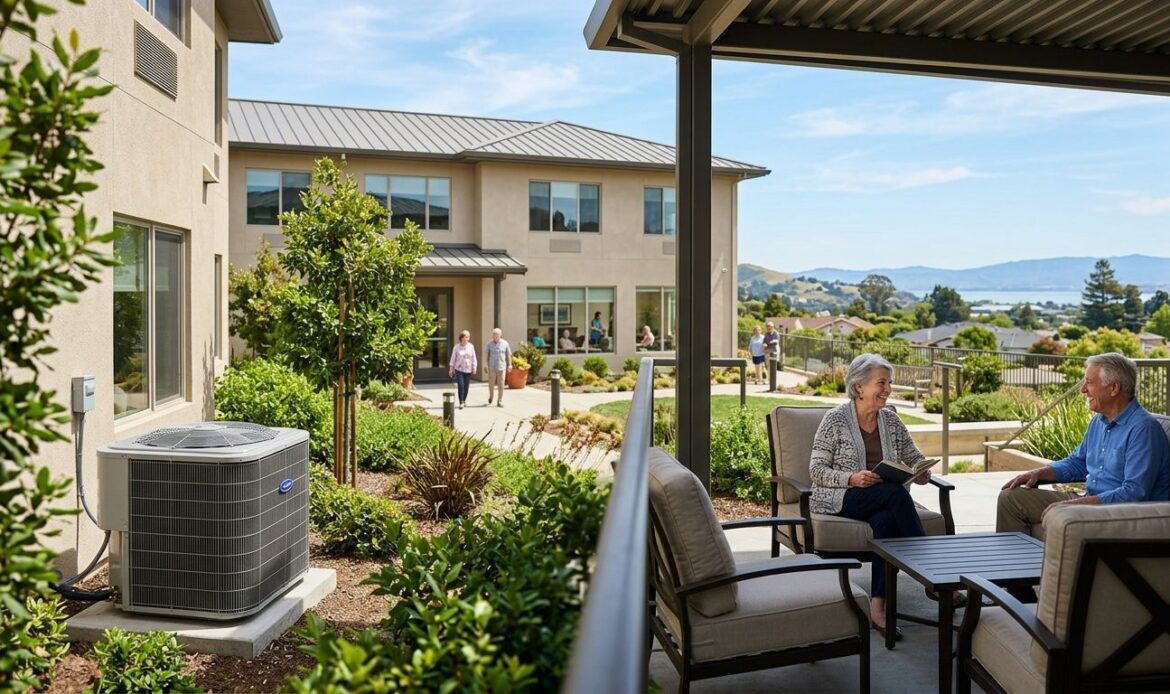
Assisted living facility HVAC in the Bay Area means running heating, cooling, and filtration around the clock for residents who can't tolerate temperature swings, wildfire smoke, or an unplanned system outage. A rooftop unit that fails on a 100°F afternoon in Napa or Solano County isn't a maintenance ticket for a senior care community — it's a resident safety event, and the equipment, redundancy, and service schedule all have to reflect that.
- HVAC for assisted living facilities in the Bay Area needs redundancy, MERV-13 filtration, and quiet units near resident rooms.
- Comfort Factor services assisted living HVAC systems across Sonoma, Marin, Napa, Solano, and Contra Costa counties.
- Ductless mini-split zoning beats a single rooftop unit when resident temperature needs vary wing to wing.
- Skip ad-hoc filter swaps — commercial maintenance contracts catch failures before residents feel a temperature shift.
Why HVAC matters for assisted living facilities
Older adults regulate body temperature less efficiently than younger residents, and many take medications that blunt the body's response to heat or cold. That's why a 2-3 degree swing that a healthy office worker shrugs off can put a frail resident at real risk, and why licensed care facilities can't treat HVAC downtime the way a retail store or restaurant does.
Wildfire smoke adds a layer specific to Sonoma, Napa, and Marin counties. A facility needs a system that seals outdoor air intrusion and filters particulates without shutting ventilation down entirely — residents still need fresh air circulation during a smoke event, just filtered air, not none.
Facilities running on aging rooftop package units built without redundancy carry the highest failure risk in exactly the conditions residents need heating or cooling the most. Vetting a contractor who understands occupied, licensed-facility work — not just general commercial HVAC — starts with choosing an HVAC contractor in the Bay Area who can speak to infection control, after-hours service, and redundancy planning specifically.
Comfort Factor's verdict: assisted living HVAC in 2026 needs zoned, redundant equipment and a maintenance contract built around 24/7 occupancy — not a system sized like a standard office suite.
1. Audit your current system against resident occupancy patterns
Start by mapping what you have against how the building is actually used, not how it was designed a decade ago.
- Check zoning coverage wing by wing — memory care wings often run warmer setpoints than common areas
- Confirm whether any single unit failure could take out an entire wing
- Log run-time hours on compressors; most rooftop package units are rated for 15-20 years of service
- Review the current filtration rating against MERV-13 or higher
- Flag any combustion appliances located near rooms with oxygen-use residents
2. Match equipment to resident safety requirements
Equipment selection for a senior care community isn't just tonnage and SEER rating — sound levels and temperature stability matter as much as efficiency.
- Prioritize condenser units rated for lower decibel output near resident bedrooms
- Choose zoning that holds setpoints within a tight range rather than wide swings between cycles
- Avoid combustion-based units in or adjacent to oxygen-use rooms
- Confirm equipment can run on backup power during an outage
3. Build a maintenance schedule around 24/7 occupancy
A facility running at full occupancy every hour of every day can't schedule HVAC service the way a 9-to-5 office does.
- Check filters every 60-90 days instead of waiting for seasonal reminders
- Schedule refrigerant and coil inspections during low-traffic overnight windows
- Put failure alerts on a system that notifies staff immediately, not at the next scheduled visit
- Move from reactive repair calls to a standing commercial HVAC maintenance contract that covers all units under one schedule
4. Upgrade indoor air quality for immunocompromised residents
Many assisted living residents have compromised respiratory systems, which makes filtration a health decision, not a comfort upgrade.
- Move to MERV-13 filtration where the system's static pressure allows it
- Add supplemental filtration in common areas during wildfire smoke season
- Pair filtration upgrades with a review of wildfire smoke filtration systems built for California's fire season, not generic residential filters
- Monitor CO2 and particulate levels in high-occupancy common rooms
5. Plan for redundancy and backup heating and cooling
A single-unit failure should never mean zero heating or cooling for an entire wing of residents.
- Install dual compressor units or split loads across multiple smaller systems instead of one large unit
- Keep a portable backup unit on-site for emergency deployment
- Confirm HVAC equipment is compatible with the facility's backup generator
- Stagger replacement schedules so multiple units don't age out in the same year
6. Budget for compliance-driven upgrades
HVAC upgrades at a licensed facility usually get triggered by inspection findings or capital planning cycles rather than comfort complaints — budget for that reality instead of waiting for a failure.
- Separate HVAC capital planning from general building maintenance budgets
- Track available incentives for efficiency upgrades before a system fails, not after
- Get replacement quotes annually so pricing isn't a surprise during an emergency swap
- Review financing options for larger multi-unit replacements
7. Choose a contractor experienced with occupied-facility work
Not every commercial HVAC contractor is comfortable working in a building full of residents around the clock.
- Confirm California contractor licensing and ask for references from senior care or medical clients specifically
- Ask how the crew handles infection control protocols during a service visit
- Confirm availability for overnight or off-hours work so service doesn't disrupt residents
- Verify insurance coverage appropriate for work in occupied, medical-adjacent spaces
Comparing HVAC options for assisted living facilities
| Option | Best for | Key limitation | Verdict |
|---|---|---|---|
| Rooftop packaged units | Single-story facilities with uniform layouts | One failure can knock out an entire wing | Consider |
| Ductless mini-split zoning | Facilities with varied resident temperature needs | More units means more filters to track | Buy |
| VRF (variable refrigerant flow) | Larger, multi-wing communities needing simultaneous heating and cooling | Requires specialized service technicians | Consider |
| Dual-fuel heat pump systems | Facilities wanting efficient heating without losing backup heat in a cold snap | More complex install than a single-fuel system | Consider |
Ductless mini-split zoning wins for most Bay Area assisted living facilities in 2026 because it isolates failures to a single room or pod instead of an entire wing, and it holds tighter temperature control than one large rooftop unit trying to serve a whole building.
Get an HVAC assessment for your facility
Comfort Factor services assisted living HVAC across five Bay Area counties.
Common mistakes assisted living facilities make
- Treating HVAC like a standard commercial build-out. Redundancy planning gets skipped because it wasn't required for a retail buildout the contractor did last month.
- Scheduling maintenance around business hours. A 24/7 building needs a 24/7 maintenance mindset, not a Monday-through-Friday visit schedule.
- Installing loud condenser units too close to bedrooms. Sound levels that pass for an office parking lot are disruptive next to a resident's window.
- Waiting for a smoke advisory to check filtration. By the time smoke rolls in from a Sonoma or Napa County wildfire, it's too late to source and install upgraded filtration.
- Bundling HVAC upgrades into general capital planning. Incentive windows and inspection deadlines get missed when HVAC isn't tracked as its own line item.
FAQ
What’s the best HVAC system for an assisted living facility in the Bay Area?
Ductless mini-split zoning is generally the best fit for Bay Area assisted living facilities in 2026 because it isolates equipment failures to one room instead of an entire wing and holds tighter temperature control per zone.
How often should HVAC systems in senior care facilities be serviced?
Filters should be checked every 60-90 days in a 24/7 occupied facility, with full system inspections on a standing maintenance contract rather than reactive repair calls.
Is a heat pump good for assisted living facilities?
Yes, heat pumps work well for assisted living facilities when paired with dual-fuel backup or redundant units, since they handle both heating and cooling efficiently but need a backup plan for extreme cold snaps.
How much noise is acceptable from HVAC units near resident rooms?
Lower-decibel condenser units are worth the upgrade near bedrooms; noise levels acceptable in an office parking lot are often disruptive next to a resident’s window.
Do assisted living facilities need special air filtration?
Yes, MERV-13 filtration or higher is recommended for facilities housing immunocompromised or respiratory-sensitive residents, especially during Bay Area wildfire smoke season.
What happens if HVAC fails in an assisted living facility?
Without redundancy, an HVAC failure can leave an entire wing without heating or cooling, which is why facilities need backup units and generator-compatible equipment built in from the start.
Are there incentives for commercial HVAC upgrades in senior care facilities?
Incentive programs for efficiency upgrades change year to year, so check current program details before budgeting a replacement rather than relying on last year’s figures.
Does HVAC service differ between Sonoma and Marin County assisted living facilities?
The core requirements are the same across Bay Area counties, but Sonoma and Napa facilities should prioritize wildfire smoke filtration more heavily given local fire season exposure.
One last thing
The facilities that get through Bay Area wildfire season without an HVAC emergency in 2026 aren't the ones with the newest equipment — they're the ones with redundancy built in and a filtration upgrade already installed before the first smoke advisory hits, not after.
Related guides