

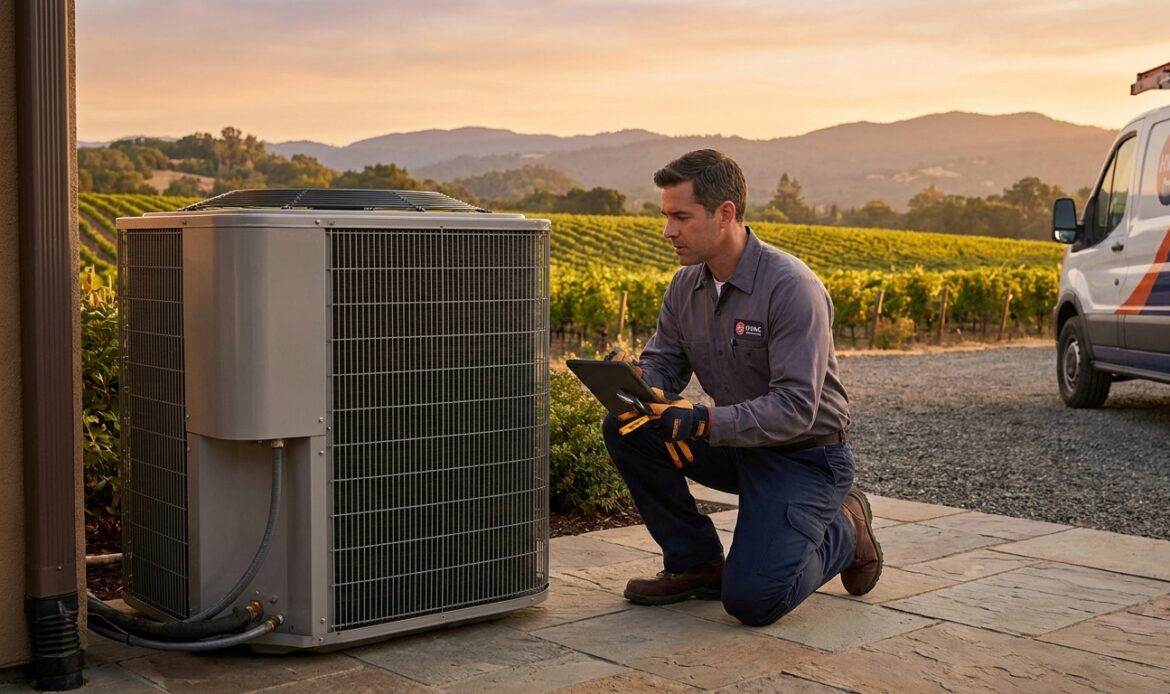
Napa summers hit harder than most people expect — valley heat regularly pushes into the 90s and 100s by July, and an AC unit that skipped its annual tune-up is the one that fails on the hottest day. This guide covers what Napa homeowners and business owners should look for when choosing an AC maintenance provider, what the service actually includes, and how to avoid the traps that cost more money down the road.
TL;DR: AC maintenance in Napa means finding a contractor who understands valley climate conditions, not just generic service checklists. Comfort Factor serves Napa County with heating, cooling, and maintenance for residential and commercial properties. A proper tune-up in 2026 covers coil cleaning, refrigerant checks, electrical inspection, and airflow testing — skip any of those and you're paying for half a service. Book before May to avoid peak-season scheduling delays.
Why AC Maintenance in Napa Is Different
Napa's climate is not the same as the Bay Area coast. Summer temperatures regularly exceed 95°F in the valley floor while Marin and San Francisco stay in the 60s. That thermal load stresses compressors, condenser coils collect dust from dry summer winds, and the seasonal swing from cool winters to hot summers puts extra strain on refrigerant lines and electrical contacts. An AC unit that gets one proper maintenance visit per year in Napa will typically last 2–4 years longer than one that goes without, based on standard industry service-life data.
Beyond the climate, Napa has a mix of older ranch homes, newer hillside builds, and commercial wine-industry facilities — each with different duct configurations and equipment ages. A maintenance provider who knows local installation patterns can spot problems faster than one parachuting in from a national call center.
Who This Guide Is For
This guide is written for Napa County homeowners who want their AC running reliably through summer, and for commercial property managers — offices, tasting rooms, retail — who cannot afford a system failure during peak business hours. If you're deciding between one-time service versus a maintenance plan, or trying to figure out whether a contractor is quoting you fairly, this guide gives you the framework to evaluate your options.
What to Look for in AC Maintenance in Napa
Local Knowledge and Service Area
A contractor based in or regularly serving Napa County will know which equipment brands are most common locally, typical duct configurations in valley homes, and how quickly they can dispatch for a follow-up if something surfaces during the tune-up. Response time matters in summer — a contractor 90 minutes away is a different proposition than one 20 minutes out. Comfort Factor operates across Napa County as part of its Bay Area service territory, which includes Sonoma, Marin, Solano, and Contra Costa counties.
What the Tune-Up Actually Covers
Not all maintenance visits are equal. A credible AC tune-up in 2026 should include at minimum:
- Condenser coil cleaning (outdoor unit)
- Evaporator coil inspection (indoor unit)
- Refrigerant level check and leak inspection
- Electrical connection tightening and amperage draw test
- Thermostat calibration
- Air filter inspection or replacement
- Blower motor and belt inspection
- Condensate drain flush
If a quote doesn't mention at least 6 of these 8 items, ask specifically what is and isn't included. A "tune-up" that only cleans the filter and checks the thermostat is not a tune-up.
Licensing and Insurance
California requires HVAC contractors to hold a C-20 (Warm-Air Heating, Ventilating and Air-Conditioning) license from the Contractors State License Board. Verify the license number before any work starts — it takes 30 seconds on the CSLB website. An unlicensed technician working on your refrigerant lines creates liability you don't want.
Transparent Pricing Before the Visit
A flat-rate or clearly scoped quote before the technician arrives means no surprises on the invoice. Ask whether the quoted price covers the full checklist or whether coil cleaning or refrigerant top-offs are billed separately. In Napa in 2026, a standard residential AC tune-up from a licensed contractor typically runs $89–$175 depending on system size and access — anything substantially below that range often signals a cut checklist or upsell pressure.
Maintenance Plans vs. One-Time Service
For homeowners who rely on AC from May through October, an annual maintenance plan reduces per-visit cost and puts you at the front of the scheduling queue in peak season. For commercial operators, a plan also creates documentation that's useful for warranty claims and equipment financing. One-time visits make sense if you've recently purchased a property and want a condition assessment before committing to a contract.
Communication and Follow-Through
The best indicator of a reliable contractor is whether they send a written summary after the visit — what was checked, what was found, and what (if anything) needs attention. A technician who leaves without a report is one whose work you cannot verify or reference later. Ask before booking whether a service report is standard.
Top Picks for AC Maintenance in Napa
Comfort Factor — The Local Expert Pick
Comfort Factor is a Bay Area HVAC contractor with an explicit service territory covering Napa County alongside Sonoma, Marin, Solano, and Contra Costa. The company handles residential and commercial AC maintenance, repair, and installation — meaning a maintenance visit that uncovers a repair need doesn't require a second contractor. For Napa commercial properties, Comfort Factor also offers AC installation in Napa for businesses upgrading aging systems.
Verdict: Buy — licensed Bay Area contractor, multi-county coverage, handles maintenance through to full replacement without a handoff.
Full-Service Regional HVAC Companies
Several larger regional HVAC companies serve the North Bay and include Napa in their territory. They typically have more technicians available, which helps with scheduling in July and August. The tradeoff is less familiarity with individual neighborhoods and equipment configurations, and sales pressure toward replacement is more common when a technician is incentivized on new-install revenue.
Verdict: Consider — suitable if your primary concern is scheduling availability and you're willing to get a second opinion on any replacement recommendations.
National Home Warranty / Home Service Plans
Home warranty plans that include HVAC coverage are tempting but frequently disappoint on AC maintenance specifically. Most cover repair or replacement of failed components — they do not cover preventive maintenance visits. Read the policy before assuming your warranty handles the annual tune-up.
Verdict: Skip for maintenance — use for repair insurance if you want, but do not rely on it for annual AC tune-ups.
What to Avoid
- "Free tune-up" offers from HVAC companies you didn't contact. These are almost always door-in-the-door sales calls that end with a high-pressure repair or replacement quote. A real maintenance visit has real labor cost.
- Contractors who can't provide a CSLB license number on request. This is a non-starter in California regardless of how good their Yelp reviews look.
- Skipping maintenance entirely because the system "seems fine." AC systems degrade silently. Refrigerant levels drop slowly, coils accumulate a thin film of dust that reduces efficiency by 10–15% over 2–3 years, and electrical contacts corrode without visible signs. The failure is always a surprise; the warning signs were there.
Comparison Table
| Criteria | Comfort Factor | Regional HVAC Co. | Home Warranty Plan |
|---|---|---|---|
| Napa County coverage | Yes | Varies | Varies |
| Residential + Commercial | Yes | Usually | No |
| Preventive maintenance | Yes | Yes | No |
| Handles repair + install | Yes | Yes | Repair only |
| Local expertise | High | Medium | Low |
| Verdict | Buy | Consider | Skip for maintenance |
FAQ
How often should I schedule AC maintenance in Napa?
Once per year is the standard recommendation for residential systems. Schedule in late March or April — before valley temperatures climb — so any issues found are repaired before peak demand hits in June.
What does AC maintenance cost in Napa in 2026?
A standard residential tune-up from a licensed contractor typically runs $89–$175. Commercial systems with multiple units or complex ductwork cost more. Any quote below $80 usually means a shortened checklist.
Is AC maintenance required to keep my warranty valid?
Most manufacturer warranties require documented annual maintenance to remain valid. Keep the service report from every visit — this is the proof you'll need if you ever file a warranty claim.
What's the difference between AC maintenance and AC repair?
Maintenance is preventive — cleaning, inspecting, and tuning a system that's running. Repair addresses a specific failure or malfunction. A maintenance visit can identify repair needs before they become failures.
Can I do AC maintenance myself?
You can change the air filter yourself — and you should, every 1–3 months. Everything else on the maintenance checklist requires refrigerant handling certification (EPA 608) and specialized equipment. DIY coil cleaning with the wrong product can damage fins and void warranty coverage.
How long does an AC tune-up take?
A thorough residential tune-up takes 60–90 minutes. If a technician is done in 20 minutes, they didn't complete the full checklist.
Does Comfort Factor serve both residential and commercial properties in Napa?
Yes. Comfort Factor serves residential and commercial customers across Napa County, including heating, cooling, maintenance, and installation services.
What happens if the technician finds a problem during maintenance?
A good contractor provides a written report of findings and quotes any repair work separately before starting it. You are never obligated to approve same-day repairs — a reputable contractor will schedule them on your timeline.
One Last Thing
AC systems in Napa's climate are typically cooling-dominant — they run hard from late May through October, then sit idle through the wet season. That idle period is when corrosion, pest intrusion into electrical panels, and refrigerant micro-leaks do their quiet damage. Spring is the highest-value time to schedule a tune-up, not fall. The contractors with open May slots in 2026 are booking them in March — waiting until it's already hot means waiting in line.