

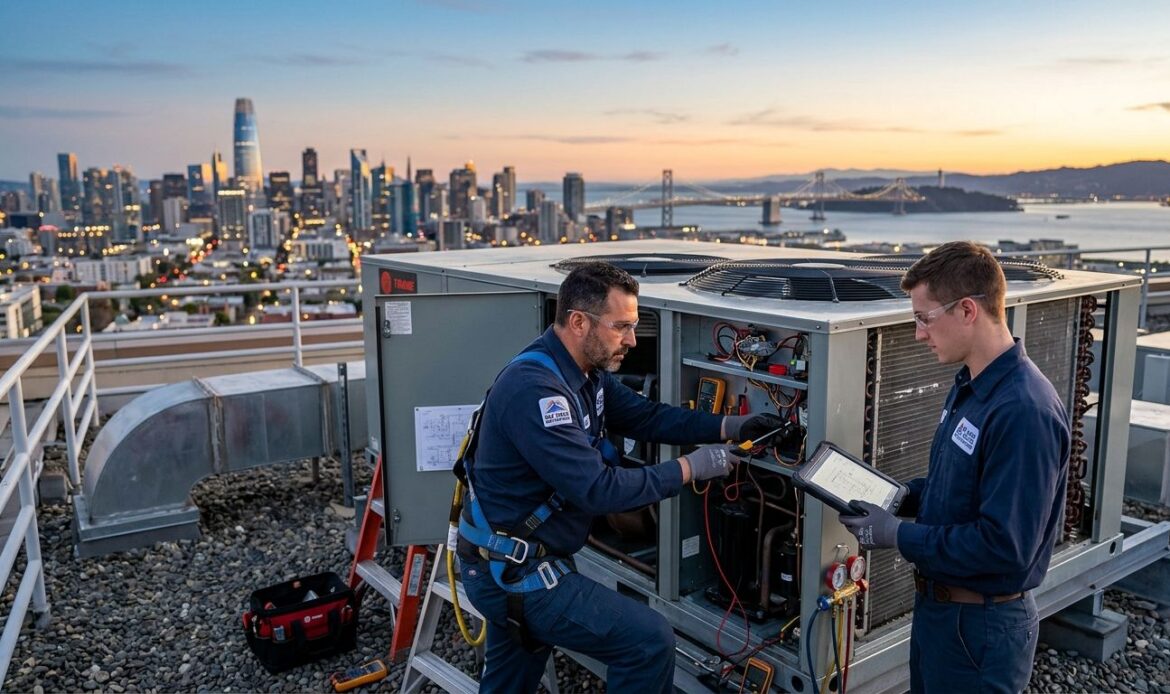
Choosing the best commercial air conditioning repair service in the Bay Area comes down to three things: does the contractor cover your county, do they carry documented commercial experience on rooftop and package units, and can they show up before your walk-in cooler or server room hits a critical temperature. This guide ranks the options by use case so you can match a provider to your building type instead of guessing.
- Comfort Factor’s commercial AC repair covers Sonoma, Marin, Napa, Solano, and Contra Costa counties in 2026.
- The best commercial AC repair service Bay Area businesses pick depends on building type: office, retail, brewery, or multi-tenant property.
- Licensed contractors with a C-20 classification and commercial rooftop experience outperform residential-only crews on package units.
- Maintenance contracts for property managers cut emergency repair calls versus reactive-only service.
Why this matters
A failed rooftop unit on a July afternoon in Petaluma or Napa is not a comfort problem, it is a revenue problem. Restaurants lose covers, tasting rooms lose humidity control on inventory, and offices lose staff productivity within an hour of a compressor failure.
Commercial AC repair also runs on different equipment than a residential system. Rooftop package units, VRF systems, and process cooling loads for wineries or cannabis cultivation rooms need technicians who work on that equipment regularly, not a residential tech doing a commercial call as a side job. The best commercial AC repair service in the Bay Area for 2026 is the one that matches your equipment, your county, and your uptime tolerance – not just the first name that shows up in search.
Coverage across commercial HVAC services in Sonoma County sets the baseline most Bay Area businesses should expect: same contractor, multiple counties, one point of contact for repair and maintenance.
What makes the best commercial AC repair service
- County-wide response time – can the contractor reach your site same-day, not next-week
- California C-20 license verification – commercial HVAC work requires a valid, checkable license
- Commercial equipment experience – rooftop package units, VRF, and walk-in refrigeration are not residential split systems
- Maintenance contract options – scheduled tune-ups reduce emergency calls during peak summer months
- Vertical-specific experience – breweries, wineries, and cannabis cultivation rooms run process cooling loads that comfort-cooling techs miss
- Transparent diagnostics – itemized findings before repair, not a flat "replace it" recommendation
Commercial AC repair options at a glance
| Service | Best for | Standout feature | Key limitation |
|---|---|---|---|
| Sonoma County commercial AC repair | Multi-property portfolios across the North Bay | Single point of contact across five counties | Peak-summer scheduling can push out non-emergency requests |
| Napa commercial AC repair | Wineries, tasting rooms, hospitality | Familiarity with humidity-sensitive equipment | Narrower geographic focus than county-wide plans |
| Petaluma commercial AC repair | Retail and restaurant rooftop units | Fast response on failed package units | Built for single-site businesses, not large portfolios |
| Sonoma Valley towns (Oakmont, Glen Ellen, Penngrove, Larkfield-Wikiup) | Small commercial properties in unincorporated areas | Local routing cuts drive time in rural service zones | Fewer large-equipment technicians on standby than metro coverage |
| Maintenance contracts for property managers | Multi-tenant buildings and portfolio owners | Scheduled tune-ups reduce mid-summer breakdown calls | Requires a contract commitment, not built for one-off repairs |
| Specialty commercial cooling (breweries, wineries, cannabis) | Temperature-sensitive production facilities | Experience with process cooling loads beyond comfort cooling | Specialty parts can mean longer lead times |
1. Sonoma County commercial AC repair: best for multi-county portfolios
This is the broadest option and the one most Bay Area property owners default to first. It covers office buildings, retail centers, and multi-tenant properties across the North Bay under one service agreement, which matters when you manage more than one address.
Sonoma County commercial AC repair pros:
- One contractor across five counties (Sonoma, Marin, Napa, Solano, Contra Costa)
- Handles both emergency repair and scheduled maintenance
- Familiar with older commercial buildings common in Sonoma and Marin
Sonoma County commercial AC repair cons:
- Peak summer months (July-September) mean longer wait times for non-urgent calls
- County-wide coverage means less hyper-local availability than a single-city specialist
Best for: businesses that own or manage property in more than one Bay Area county. Verdict: Book if county-wide coverage matters more than same-day guarantees.
2. Napa commercial AC repair: best for wine country hospitality
Tasting rooms, hospitality venues, and wine country offices run humidity and temperature control that a generic commercial tech doesn't always understand. Commercial AC repair in Napa is built around that specific mix of retail-facing space and inventory-sensitive back-of-house.
Napa commercial AC repair pros:
- Experience with humidity-sensitive tasting rooms and hospitality spaces
- Local routing inside Napa County cuts response time
- Works alongside wine storage and production HVAC needs
Napa commercial AC repair cons:
- Narrower geographic radius than the county-wide plan
- Less relevant if your business sits outside Napa Valley
Best for: wineries, tasting rooms, and hospitality businesses in Napa Valley. Verdict: Book if your building doubles as a customer-facing hospitality space.
3. Petaluma commercial AC repair: best for retail and restaurant rooftop units
Restaurants and retail storefronts in Petaluma depend on rooftop package units that can't wait three days for a repair slot. Commercial AC repair in Petaluma targets exactly that failure mode.
Petaluma commercial AC repair pros:
- Fast turnaround on failed rooftop package units
- Local presence in downtown Petaluma's commercial corridor
- Works with restaurant kitchens where heat load complicates cooling
Petaluma commercial AC repair cons:
- Best suited to single-site businesses rather than multi-location portfolios
- Less depth on specialty verticals like cultivation or cold storage
Best for: single-location retail and restaurant operators in Petaluma. Verdict: Book for storefronts that can't absorb downtime.
4. Sonoma Valley towns: best for small commercial properties in unincorporated areas
Oakmont, Glen Ellen, Penngrove, and Larkfield-Wikiup sit outside the main metro corridors, which means some contractors skip them or add a trip fee. Local routing through these towns keeps response times reasonable without the drive-time penalty.
Pros:
- Reduces drive time for small commercial properties in rural Sonoma Valley
- Covers a cluster of unincorporated towns under one service radius
Cons:
- Fewer large-equipment technicians on standby than a metro-based team
- Less useful if your business sits in a denser commercial corridor
Best for: small offices, shops, and production spaces in Sonoma Valley's unincorporated towns. Verdict: Book if you've been quoted a trip fee elsewhere for a rural address.
5. Maintenance contracts for property managers: best for multi-tenant buildings
Reactive-only repair is the most expensive way to run commercial HVAC. Maintenance contracts for property managers shift the model to scheduled tune-ups, which is the standard recommendation across the HVAC industry for reducing mid-summer breakdown calls.
Maintenance contract pros:
- Scheduled visits catch failing components before they cause an emergency call
- Predictable service calendar simplifies budgeting for multi-tenant buildings
- Prioritized scheduling during peak demand months
Maintenance contract cons:
- Requires a contract commitment, not a fit for a single one-off repair
- Value depends on how many units are under management
Best for: property managers overseeing multi-tenant office or retail buildings. Verdict: Book if you're currently paying for emergency calls that a spring or fall tune-up would have caught.
6. Specialty commercial cooling: best for temperature-sensitive production facilities
Breweries, wineries, and cannabis cultivation rooms run process cooling loads, not comfort cooling. A technician trained only on office HVAC will misdiagnose a fermentation-room temperature swing as a thermostat issue when it's actually a load-sizing problem.
Specialty cooling pros:
- Experience with process cooling loads beyond standard comfort cooling
- Understands the tighter tolerances production facilities require
Specialty cooling cons:
- Specialty parts and larger equipment can mean longer repair lead times
- Smaller pool of technicians qualified for this work compared to general commercial repair
Best for: production facilities where temperature swings affect product, not just comfort. Verdict: Book, but confirm parts lead time before you're mid-crisis.
Get a commercial AC repair quote
Serving Sonoma, Marin, Napa, Solano, and Contra Costa counties in 2026.
How this list was ranked
Each entry is scored against the six criteria above: county coverage, license verification, commercial equipment experience, maintenance contract availability, vertical-specific experience, and diagnostic transparency. No single option wins every category, which is why the ranking is organized by use case instead of a single winner.
Which commercial AC repair service should you choose?
If you manage property across more than one Bay Area county, start with Sonoma County commercial AC repair coverage – it's the broadest fit for 2026. If you run a single storefront or restaurant, the city-specific option (Napa or Petaluma) gets you faster local response. If your building runs a production process – brewery, winery, or cultivation room – specialty commercial cooling experience matters more than response time alone.
Property managers overseeing multiple tenants should default to a maintenance contract over reactive repair; it's the one option on this list that reduces how often you need the rest of it.
FAQ
What’s the best commercial AC repair service in the Bay Area?
The best fit depends on your building type: county-wide coverage suits multi-property portfolios, while city-specific service in Napa or Petaluma suits single-location businesses needing faster local response in 2026.
How much does commercial AC repair cost in the Bay Area?
Cost depends on the unit size, the failure type, and whether parts need to be sourced. Get an itemized diagnostic before agreeing to a repair rather than a flat quote over the phone.
Is commercial AC repair different from residential AC repair?
Yes. Commercial systems typically use rooftop package units or VRF systems built for larger loads, and technicians need specific training on that equipment beyond residential split-system experience.
How often should commercial AC units be serviced?
Twice a year – once in spring before peak cooling season and once in fall – is the standard maintenance schedule recommended across the HVAC industry to catch failing components early.
Do commercial AC repair contractors need a special license in California?
Commercial HVAC work in California requires a C-20 contractor license. Verify any contractor’s license number before signing a repair or maintenance agreement.
What counties does Comfort Factor cover for commercial AC repair?
Comfort Factor covers Sonoma, Marin, Napa, Solano, and Contra Costa counties for commercial heating and cooling repair, installation, and maintenance in 2026.
Is a maintenance contract worth it for a multi-tenant building?
Yes, if you’re currently paying for repeat emergency repair calls. Scheduled tune-ups catch failing capacitors, refrigerant leaks, and worn belts before they cause a full breakdown.
Do wineries and breweries need specialty HVAC service?
Yes. Fermentation and cultivation spaces run process cooling loads with tighter tolerances than office comfort cooling, and require technicians experienced with that equipment.
One last thing
The single most overlooked line item on this list is the maintenance contract – most Bay Area businesses only call a commercial AC repair service after a unit has already failed during a heat spell, which is also the most expensive and slowest way to get it fixed in 2026. A spring tune-up costs less time and less stress than an August emergency call.
Related guides