

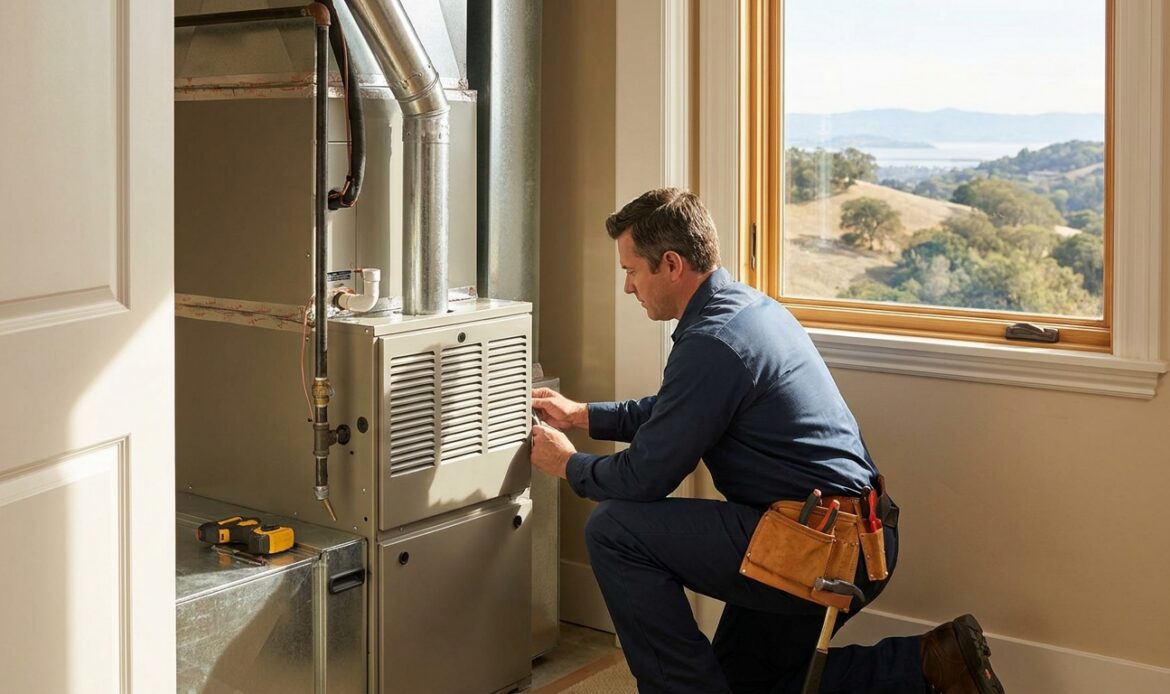
Furnace installation in Marin County means sizing for two different climates in the same zip code — foggy coastal towns like Bolinas and Point Reyes, and warmer inland pockets around Novato and San Rafael. This guide breaks down what a right-sized furnace looks like for a Marin home in 2026 and which options are worth your money.
- Furnace installation in Marin County favors 95%+ AFUE condensing units for 2026 code compliance — that’s the safe pick.
- Heat pumps compete well in Marin’s mild coastal microclimates, but cold-night reliability still favors a furnace in San Rafael and Novato.
- Single-stage 80% AFUE furnaces are a skip for Marin’s damp fog belt — they short-cycle and lose efficiency fast.
- Furnace installation typically finishes in one day; Marin County permit review adds separate lead time.
Why this matters
A furnace that's sized wrong runs constantly, drives up utility bills, and fails early. In Marin County, the marine layer that rolls through Mill Valley and Sausalito every evening pushes indoor temperatures down fast even when daytime highs sit in the 60s. A furnace built for a drier inland climate short-cycles here, and short-cycling is the number one cause of premature furnace failure.
The 2022 California Energy Code, still the operative standard through 2026, sets a minimum efficiency floor and pushes new installs toward higher-AFUE equipment. That's the baseline. Whether you go higher than the floor depends on your home's exposure, ductwork condition, and how many rooms you're actually heating.
Who this is for
This guide is built for Marin County homeowners replacing an aging furnace or installing one in a home that never had one — older houses in Fairfax, San Anselmo, and unincorporated West Marin often ran on wall heaters or nothing at all. If you're comparing a straight furnace against a heat pump vs. furnace setup for a fog-belt home, this is also for you.
What to look for in furnace installation for Marin County homes
AFUE rating matched to your microclimate
Homes within a mile or two of the coast lose more heat overnight to condensation and damp air, so a 95%+ AFUE condensing furnace pays back faster there than in warmer inland Marin. Inland homes in Novato can often run a mid-efficiency unit without the same runtime penalty.
Ductwork condition, not just the furnace
A new furnace pushed through leaky, decades-old ductwork loses a meaningful share of its output before it reaches a single room. Older Marin housing stock — especially homes built before 1980 in Kentfield and Larkspur — commonly needs duct sealing or a partial redesign alongside the furnace swap.
Two-stage or variable-speed operation
Single-stage furnaces run at full blast or not at all, which means noisy startups and temperature swings. Two-stage and variable-speed models modulate output, holding a steadier temperature through Marin's cold, damp nights without cycling on and off every ten minutes.
Permit and inspection timeline
Marin County requires permits for furnace replacement and new installation, and inspection scheduling adds lead time on top of the actual install day. Build that into your timeline if you're replacing a furnace that just failed in the middle of winter.
Compatibility with existing ductwork or a heat pump future
If you're even considering electrification down the road, ask whether the furnace install is compatible with a dual-fuel setup or whether ductwork sizing will support a future heat pump installation in Marin County. Retrofitting twice costs more than planning once.
Filtration for wildfire smoke season
Marin's wildfire season runs roughly August through October, and a furnace's air handler doubles as your whole-home filtration system during smoke events. A MERV 13-rated filter slot built into the new install matters more here than in most parts of the country.
Top picks for Marin County furnace installation
High-Efficiency Condensing Furnace (95-98% AFUE) — the safe pick. Handles Marin's damp coastal nights without short-cycling and meets 2026 code with margin to spare. Verdict: Buy.
Two-Stage Variable-Speed Furnace — the quiet upgrade. Modulates output instead of blasting full heat, which matters in older homes where bedrooms sit close to the furnace closet. Verdict: Consider.
All-Electric Heat Pump System — the wildcard. Competitive in Marin's mild coastal microclimates and pairs well if you're already leaning toward electrification; check the heat pump installation option for Marin County homes before you commit to gas. Verdict: Consider.
Ductless Zoned System — the no-ductwork fix. Skips duct sealing entirely for homes that never had central heat, common in older West Marin properties. Verdict: Consider.
Standard Single-Stage Furnace (80% AFUE) — the budget pick that isn't. Meets the bare code minimum but runs constantly in fog-belt towns and loses its cost advantage within a few winters. Verdict: Skip.
“A furnace sized for inland Marin will short-cycle all winter three miles from the coast.”
What to avoid
- Oversizing to "be safe." A furnace too big for the square footage cycles on and off rapidly, wearing out components years early instead of running efficiently.
- Skipping the ductwork inspection. A brand-new high-AFUE furnace connected to leaky 1970s ducts loses a chunk of its output before it heats a single room.
- Ignoring permit timing. Scheduling an install without accounting for Marin County inspection windows leaves you without heat longer than necessary during a cold snap.
If your current system is closer to end of life than mid-life, it's worth checking when to replace your HVAC system before sinking money into repairs on a unit that won't make it another winter.
Verdict comparison
| Pick | Efficiency | Noise Level | Best For | Verdict |
|---|---|---|---|---|
| High-Efficiency Condensing (95-98% AFUE) | Highest | Low | Coastal fog-belt homes | Buy |
| Two-Stage Variable-Speed | High | Lowest | Older homes, uneven room temps | Consider |
| All-Electric Heat Pump | High (climate-dependent) | Low | Mild inland/coastal mix | Consider |
| Ductless Zoned System | High | Low | No existing ductwork | Consider |
| Standard Single-Stage (80% AFUE) | Code minimum | High | Rarely the right call in Marin | Skip |
Ready for a furnace installation quote?
Comfort Factor sizes and installs furnaces across Marin County homes.
FAQ
What’s the best furnace for a Marin County home?
A 95%+ AFUE condensing furnace is the safe pick for most Marin County homes in 2026, especially in coastal fog-belt towns where nights stay damp and cold. Inland homes with milder overnight temperatures can sometimes run a mid-efficiency unit without a runtime penalty.
How much does furnace installation cost in Marin County?
Cost depends on furnace size, ductwork condition, and whether duct sealing or redesign is needed alongside the swap. Get a home-specific quote rather than relying on national averages, since ductwork condition varies widely across older Marin housing stock.
Is a heat pump better than a furnace in Marin County?
Heat pumps compete well in Marin’s mild coastal microclimates, but a straight furnace still holds an edge for consistently cold nights in inland areas like Novato and San Rafael. The right call depends on your home’s exposure and whether you’re planning to electrify eventually.
How long does furnace installation take?
The physical install typically finishes in a single day for a straightforward swap. Marin County permit review and inspection scheduling add separate lead time on top of that, so plan ahead if your old furnace is already failing.
Do I need a permit for furnace installation in Marin County?
Yes, Marin County requires a permit for furnace replacement and new installation. Factor inspection scheduling into your timeline, especially if you’re replacing a furnace during a cold spell.
How often should I replace a furnace?
Furnaces typically last 15 to 20 years before efficiency drops and repair costs start outpacing replacement costs. Short-cycling, rising utility bills, and uneven room temperatures are earlier warning signs worth acting on.
What AFUE rating should I look for in 2026?
The 2022 California Energy Code sets an 80% AFUE floor, still the operative minimum through 2026, but 95% to 98% AFUE units are the better long-term pick for Marin’s damp coastal climate. The gap in fuel savings adds up faster near the coast than inland.
Can older Marin homes with outdated ductwork get a furnace installed?
Yes, but ductwork sealing or partial redesign is often part of the job in homes built before 1980. Skipping that step means the new furnace loses output before it ever reaches a room.
One last thing
The furnace itself is rarely the weak link in a Marin County heating system — the ductwork is. A 98% AFUE furnace connected to leaky, undersized ducts performs worse than an 80% unit on tight, well-sealed ductwork. Get the ducts checked before you pick the furnace, not after.
Related guides