

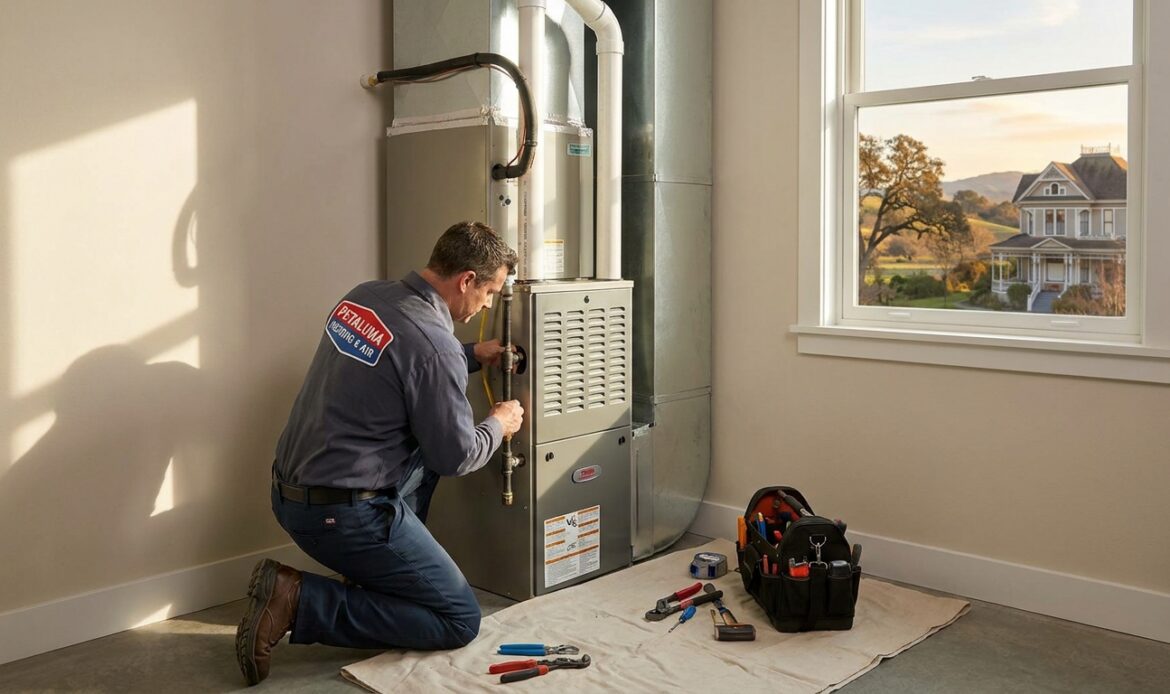
Furnace installation in Petaluma comes with its own rules: mild North Bay winters, a mix of 1960s ranch homes and newer Southgate-area builds, and Sonoma County permit requirements that trip up out-of-town installers. This guide breaks down what actually matters for a Petaluma furnace replacement in 2026, not generic HVAC advice.
TL;DR
For most Petaluma homes, a 96% AFUE gas furnace is the Buy — it matches the county's mild-but-damp winters and current Title 24 efficiency rules without over-spending on capacity you won't use. A heat pump or dual-fuel setup is a strong Consider if you're chasing electrification rebates in 2026. Skip anything sized off square footage alone — Petaluma's older housing stock needs an actual load calculation. Furnace installation in Petaluma, CA typically runs one to two days once permits clear.
Why this matters
Petaluma winters aren't brutal, but they're long and damp — average lows sit in the low 40s°F from December through February, and fog off the Petaluma River keeps humidity high in older homes near downtown. That combination punishes undersized or poorly sealed systems. A furnace that's fine in Sacramento's dry cold will short-cycle and struggle here.
Many Petaluma houses date to the 1960s-1980s, with original ductwork run through crawl spaces that were never built for today's blower speeds. If your furnace is already limping, a heating repair in Petaluma visit can tell you whether you're looking at a repair or a full replacement before you commit to a new install.
Who this is for
This guide is written for Petaluma homeowners replacing a furnace that's 15+ years old, dealing with uneven heating between rooms, or facing a failed heat exchanger inspection. It's also for buyers of older homes near the historic downtown core who inherited a furnace nobody's touched since the last owner moved in. If you're building new construction or doing a full addition, the sizing math changes — talk to an installer before assuming any of the picks below apply directly.
What to look for in furnace installation for Petaluma homes
AFUE rating matched to your actual winter load
AFUE (Annual Fuel Utilization Efficiency) tells you what percentage of fuel becomes usable heat. In Petaluma's mild climate, a 96% AFUE furnace pays back faster than in colder inland regions because it's not running as many total hours — but it still beats an 80% unit on your gas bill every month of the year.
A real Manual J load calculation, not a square-footage guess
Older Petaluma homes often have inconsistent insulation between additions and original construction. A contractor who quotes furnace size off square footage alone will oversize the unit, and an oversized furnace short-cycles, wears out faster, and leaves rooms unevenly heated. Insist on a room-by-room load calculation.
Ductwork condition in crawl spaces
Petaluma's raised-foundation homes near the river and in older neighborhoods commonly have ductwork with 20-30% leakage by the time it's 30 years old. Installing a new high-efficiency furnace onto leaky ducts wastes a meaningful chunk of the efficiency gain you just paid for.
City of Petaluma and Sonoma County permitting
Furnace replacements in Petaluma require a mechanical permit, and 2026 Title 24 energy code updates affect what equipment qualifies for permit sign-off. An installer who skips the permit step leaves you exposed at resale — buyers' inspectors flag unpermitted HVAC work routinely.
Fuel flexibility given local electrification incentives
Sonoma County and PG&E have pushed incentives toward heat pumps and dual-fuel systems in recent years. You don't have to go electric, but you should know what's on the table before you lock into a gas-only replacement for the next 15-20 years.
Installer track record in your specific neighborhood
A contractor who's worked Petaluma's east side ranch homes and the older Victorian-adjacent housing downtown knows the duct quirks and permit process cold. That local experience shows up in fewer callbacks.
Top picks for Petaluma furnace installation
The safe pick: 96% AFUE gas furnace
This is the standard replacement for most Petaluma homes still on natural gas. Expect a rated output in the 60,000-80,000 BTU range for a typical 1,800-2,400 square foot home, confirmed by load calc rather than assumed. It handles Petaluma's damp winters without the oversizing problems common with older 80% units. Verdict: Buy for most gas-heated households replacing a failing furnace in 2026.
The wildcard: heat pump or dual-fuel system
A heat pump handles both heating and cooling from one system, which matters in a place where summer highs can hit the 90s°F even with mild winters. Dual-fuel pairs a heat pump with a gas furnace backup for the coldest nights. Rebate programs tied to electrification have shifted the math on these in 2026 compared to five years ago. Verdict: Consider if you're already planning to add AC or you want the rebate math to work in your favor.
The budget pick: 80% AFUE mid-efficiency furnace
Lower upfront cost, simpler venting, and a shorter installation timeline than a high-efficiency condensing furnace. It's a reasonable call for a rental property or a home you're planning to sell within a few years. Verdict: Consider for short-hold properties, Skip if you're staying long-term — the fuel savings on a 96% unit add up fast in Sonoma County's gas rates.
The flexible fix: ductless heat pump zones
If only part of your Petaluma home needs better heating and cooling — a converted garage, an addition, a room over a detached structure — a ductless system solves it without touching existing ductwork. Ductless AC installation in Petaluma covers systems that heat as well as cool, since most modern ductless units are heat pumps under the hood. Verdict: Buy for problem rooms, Skip as a whole-house primary system unless your home is genuinely small.
The comfort upgrade: variable-speed blower furnace
A variable-speed blower ramps output up and down instead of blasting full power then shutting off, which smooths out the temperature swings common in older, leakier Petaluma homes. It also runs quieter — a real factor in smaller homes where the furnace closet sits near a bedroom. Verdict: Buy if even heating and noise matter to you and the budget allows the step up from a single-stage unit.
What to avoid
- A furnace sized by square footage alone. Petaluma's mixed-era housing stock has too much insulation variance for that shortcut to be reliable.
- Skipping the permit to save time. It surfaces at resale inspection and can mean redoing work you already paid for.
- A contractor with no local crawl-space experience. Petaluma's raised foundations aren't universal in the Bay Area, and unfamiliarity here shows up as duct leaks and callback repairs.
Verdict comparison
| Option | AFUE / Efficiency | Best for | Verdict |
|---|---|---|---|
| 96% gas furnace | 96% AFUE | Most Petaluma homes, long-term stay | Buy |
| Heat pump / dual-fuel | Varies, rebate-eligible | Adding AC, electrification incentives | Consider |
| 80% mid-efficiency furnace | 80% AFUE | Rentals, short-hold properties | Consider/Skip |
| Ductless heat pump zone | Varies by unit | Additions, problem rooms | Buy for zones |
| Variable-speed blower furnace | 96%+ AFUE | Even heating, noise-sensitive homes | Buy |
FAQ
What does furnace installation in Petaluma cost?
Cost depends on furnace size, ductwork condition, and equipment tier, so get written quotes comparing at least two system options before signing anything in 2026.
How long does a furnace installation take?
A standard swap in an existing closet typically takes one day; jobs needing ductwork repair or a permit inspection stretch to two days.
Is a heat pump better than a furnace for Petaluma's climate?
A heat pump works well given Petaluma's mild winters and handles summer cooling too, making it a strong option if you also need AC — a gas furnace still wins on raw heating cost during the coldest nights for many households.
Do I need a permit for furnace installation in Petaluma?
Yes — the City of Petaluma requires a mechanical permit for furnace replacement, and 2026 Title 24 code updates affect which equipment qualifies.
How often should a Petaluma furnace get serviced?
Once a year, ideally in early fall before the damp winter season starts, catches most issues before they become emergency calls.
What size furnace do I need for my Petaluma home?
There's no universal number — a room-by-room Manual J load calculation accounts for your home's insulation, window count, and layout, which matters more here than square footage alone.
Can I install a furnace myself?
No — gas line work and duct connections require a licensed contractor, and unpermitted work creates problems at resale.
What AFUE rating should I look for in Sonoma County?
96% AFUE is the practical standard for long-term homeowners; 80% AFUE is acceptable only for short-hold or rental properties where upfront cost matters more than lifetime fuel savings.
One last thing
Petaluma's mild winters mean a lot of furnaces installed here in the 2000s and 2010s were oversized for the actual load — contractors quoted off square footage, not a load calc, and homeowners have been paying for it in short-cycling and uneven rooms ever since. If your current furnace runs in bursts and never seems to even things out, that's usually the reason, and it's worth confirming with a proper load calculation before you buy the same mistake twice in 2026.
If your system is acting up right now rather than planned for later, emergency HVAC repair in Petaluma covers same-issue diagnostics before you commit to a full replacement.