

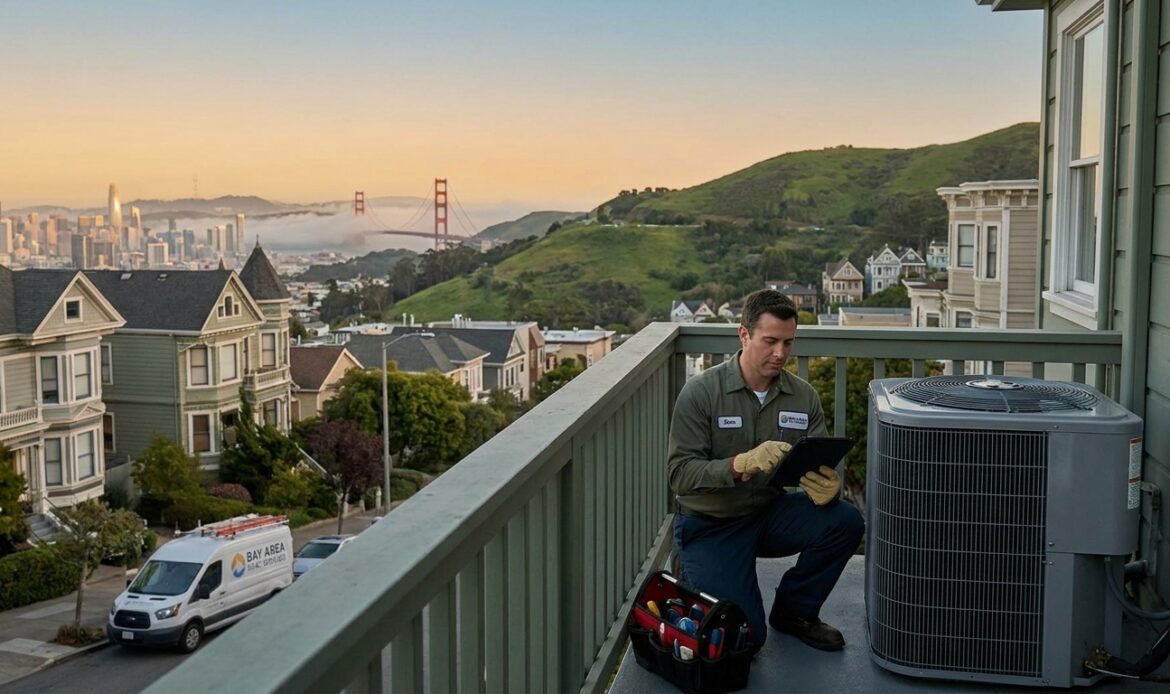
Bay Area homeowners lose more money to skipped HVAC maintenance than to any single repair bill — a $150 tune-up now beats a $4,000 compressor replacement later. This guide breaks down what a real hvac maintenance plan bay area homeowners should expect actually includes, who needs one, and which plan structure fits your house.
TL;DR
A solid hvac maintenance plan bay area homeowners can rely on includes two visits per year (spring AC check, fall furnace check), priority scheduling during heat waves, and a discount on repairs — not just a filter swap and a handshake. Comfort Factor's residential maintenance coverage is the safe pick for most single-family homes in Sonoma, Marin, Napa, Solano, and Contra Costa counties in 2026, especially homes with systems older than seven years. Skip any plan that doesn't include a written inspection report — you can't verify what you're paying for without one.
Why this matters
Bay Area HVAC systems work harder than people assume. Coastal fog corrodes coils in Petaluma and Sonoma County faster than dry-heat regions ever see, and inland Napa summers push AC units past 100°F for days at a stretch. A neglected system doesn't just fail — it fails at the worst possible time, usually during the first heat wave or the first cold snap of the season.
Comfort Factor sees the same pattern every year: units that skip maintenance for two-plus seasons show up as emergency calls in July and December. A maintenance plan isn't an upsell — it's the difference between a scheduled Tuesday morning visit and a Saturday night emergency fee.
Who this is for
This guide is built for Bay Area homeowners who own their HVAC system outright — not renters, not landlords managing multi-unit buildings — and who want to avoid the two most common failure points: a compressor that dies in August and a furnace igniter that fails in December. If your system is under one year old and still under manufacturer warranty, a maintenance plan protects that warranty. If your system is past year seven, a plan is what buys you the early-warning signs before a $6,000-plus replacement becomes your only option.
What to look for in a maintenance plan
Two seasonal visits, not one
A single annual visit misses half the problem. AC coils need inspection before summer load hits; furnace heat exchangers need inspection before the first cold night in 2026. One-visit plans are cheaper for a reason — they catch half the failures.
Priority scheduling during peak season
When a heat dome hits Napa or Solano County in July, every HVAC contractor in the region gets flooded with same-day calls. Plan members should get scheduling priority over one-off callers — if that's not written into the plan terms, you're paying for a discount, not for reliability.
A written inspection report, every visit
You need documentation of refrigerant levels, capacitor readings, and coil condition after every visit — not a verbal "looks fine." This report is also what you hand a buyer if you sell the house, and what you hand an insurer if a failure claim comes up.
Repair discount stacked on top of visits
Most legitimate plans bundle a 10-15% discount on any repair found during a visit. That's the real value driver — the visits themselves are a wash cost-wise, but the discount pays for itself the first time a capacitor or contactor needs replacing.
Coverage that matches your system type
Ductless mini-splits, central AC, and furnaces each need different maintenance checklists. A plan that treats every system the same way isn't tailored — ask specifically what's inspected on your system type before signing anything.
No long-term lock-in without an out clause
Annual plans should renew annually, not auto-lock you into a three-year contract. If a company won't let you cancel after one bad visit, that's a signal about how they handle disputes.
Top picks by home type
The straightforward pick — Napa County central systems. Homes in Napa running central AC through 100-degree summers need a plan that front-loads the spring visit. One measurable number: refrigerant charge within 2% of manufacturer spec catches most efficiency losses before they show up on the electric bill. If your system has never had a documented charge check, start with Napa heating repair as your baseline inspection point before enrolling. Verdict: Buy if your system is 3+ years old.
The coastal-fog pick — Petaluma and Sonoma County homes. Marine layer moisture corrodes outdoor coils faster here than almost anywhere else in the region. A plan with coil-cleaning built into every visit, not just a filter check, is non-negotiable. Homes with furnace issues showing up mid-winter should get a look through Petaluma furnace repair before their next scheduled visit. Verdict: Buy for anything within 15 miles of the coast.
The multi-zone pick — ductless mini-split households. Homes running three or more indoor units need a plan priced per zone, not a flat single-system rate. Each indoor head has its own filter and coil that needs separate attention — a generic plan built around central AC will miss half the equipment. Homes considering an upgrade or expansion should review ductless mini-split installation in Sonoma County before locking into a maintenance contract sized for the wrong system count. Verdict: Consider — confirm per-zone pricing before signing.
The older-system pick — anything past year 10. At this age, the maintenance visit is really a decision-support tool: is it cheaper to keep repairing or time a replacement for 2026 while rebates and off-season pricing are available? A plan here should include a documented efficiency trend across visits, not just pass/fail notes. Verdict: Consider, with a replacement conversation built into the second annual visit.
The set-and-forget pick — bundled multi-year contracts. These lock in pricing for three years but strip out your ability to switch providers if service quality drops. Verdict: Skip unless the contract includes a no-penalty exit after year one.
What to avoid
- "Free" maintenance bundled into a financed installation — the visit cost is usually baked into a higher loan APR, not actually free.
- Plans priced per visit with no annual commitment discount — you're paying retail rate twice a year instead of a bundled rate.
- Contractors who won't specify what's inspected — if the plan description says "full system check" with no itemized list, ask for the checklist in writing before paying anything.
Verdict comparison
| Home type | Visits/year | Key criteria | Verdict |
|---|---|---|---|
| Napa central AC, 3+ years old | 2 | Refrigerant charge check | Buy |
| Petaluma/Sonoma coastal | 2 | Coil corrosion inspection | Buy |
| Multi-zone ductless | 2 (per zone) | Per-zone pricing | Consider |
| System past year 10 | 2 | Efficiency trend documentation | Consider |
| Multi-year locked contract | 2 | Exit clause | Skip |
FAQ
What's included in a typical HVAC maintenance plan in the Bay Area?
Most 2026 plans include two seasonal visits (spring cooling check, fall heating check), a written inspection report, and a repair discount, usually 10-15% off parts and labor found during the visit.
How much does an HVAC maintenance plan cost in 2026?
Pricing varies by system count and home size, so get a specific quote for your address rather than relying on a regional average — a single central system costs less to maintain than a three-zone ductless setup.
Is a maintenance plan better than paying for one-off tune-ups?
Yes, if you'll actually use both visits — the discount on unplanned repairs is what makes the math work, not the tune-up itself.
How often should a Bay Area furnace get serviced?
Once a year at minimum, ideally in early fall before the first cold snap, since igniter and heat exchanger failures show up most often on the coldest night of the season.
Does a maintenance plan void my manufacturer warranty if I skip it?
Some manufacturers require documented annual maintenance to keep a warranty valid — check your unit's paperwork, since this varies by brand and installation date.
Can a maintenance plan catch a failing capacitor before it dies?
Usually yes — capacitor readings drift measurably before full failure, and that's one of the checks included in a standard seasonal visit.
Is coil cleaning necessary every year on the coast?
Yes, more so than inland — marine layer moisture and salt air corrode aluminum coils faster in Petaluma and coastal Sonoma County than in Napa's drier inland climate.
Should renters get a maintenance plan?
No — that's the landlord's responsibility contractually in almost every Bay Area lease; renters should confirm maintenance is happening, not pay for it directly.
One last thing
The single biggest maintenance mistake in 2026 isn't skipping visits — it's skipping the fall furnace check because the AC ran fine all summer. Furnace igniters and heat exchangers fail independently of how well the AC performed, and December service calls in the Bay Area run at a premium compared to a scheduled October visit.