

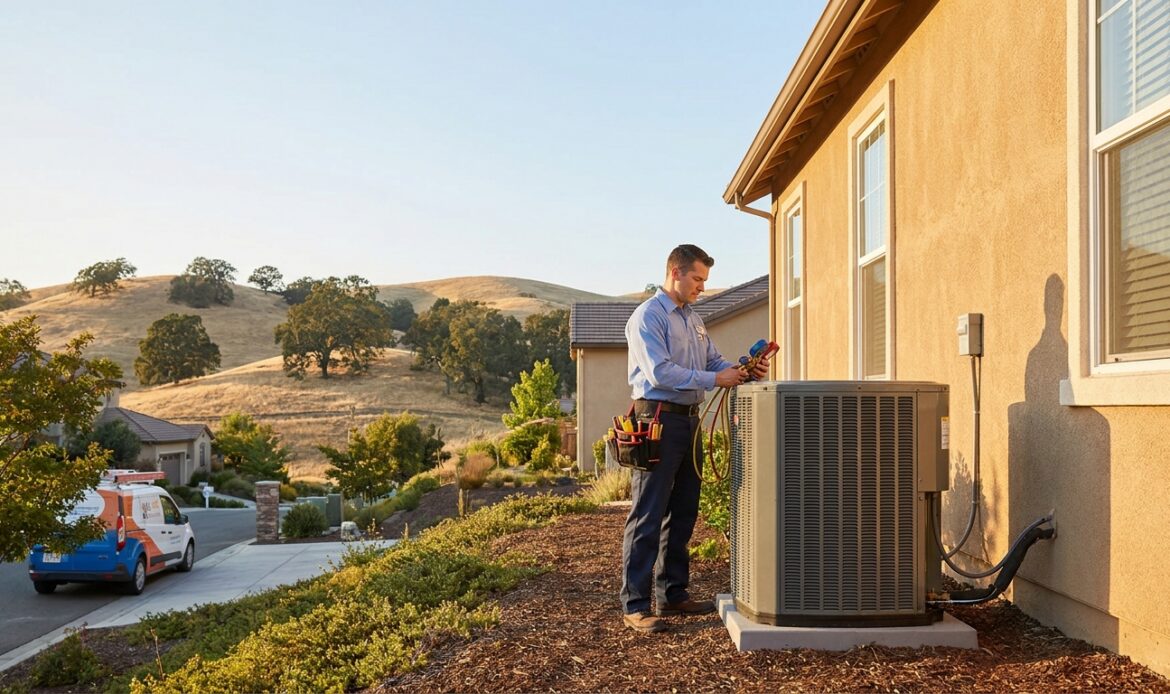
Contra Costa County runs hot in the inland valleys and mild along the bay, which means your heating and cooling needs depend heavily on which side of the county you live on. This guide breaks down what to look for in HVAC services for Contra Costa County homeowners, which service types deliver the most value, and where the money traps are.
TL;DR
Contra Costa County spans two distinct climate zones — inland cities like Concord, Walnut Creek, Antioch, and Brentwood regularly hit 100°F+ in July and August, while Richmond and El Cerrito stay 15-20 degrees cooler thanks to bay influence. For 2026, heat pump installation is the strongest buy for most single-family homes here, since it handles both heating and cooling with one system and qualifies for regional efficiency incentives. AC-only repair makes sense if your system is under 8 years old; anything older with a failing compressor is a replace, not repair situation. Comfort Factor services residential and commercial HVAC accounts across the Bay Area, including Contra Costa County.
Why this matters
A mismatched system in Contra Costa County either freezes you out in January or leaves you sweating through a 105°F afternoon in Antioch with a unit that can't keep up. The county's temperature swing — from coastal fog in Richmond to triple-digit inland heat — means a one-size answer doesn't work. Getting the sizing, efficiency rating, and service cadence right the first time saves thousands over a system's 12-15 year lifespan.
Homeowners who skip an annual tune-up also see compressor failures 2-3 years earlier than those on a maintenance schedule, based on manufacturer service data cited across the HVAC industry. That's the gap this guide closes.
Who this is for
This guide is built for homeowners in Contra Costa County — Walnut Creek, Concord, Danville, Antioch, Brentwood, Pittsburg, Richmond, and everywhere in between — who are choosing between repair, replacement, or a full system upgrade in 2026. If you're managing a commercial property instead of a single-family home, the calculus on tonnage and duty cycles changes; Comfort Factor handles both residential and commercial HVAC work across the region.
What to look for in HVAC services for Contra Costa County homeowners
Climate-zone-specific sizing
A contractor quoting the same 3-ton system for a Richmond bungalow and a Brentwood two-story is guessing, not sizing. Inland heat loads run significantly higher than coastal ones, so a proper Manual J load calculation matters more here than in flatter, single-climate counties.
SEER2 rating on new equipment
Federal minimum efficiency as of 2023 is SEER2 13.4 for most residential AC systems, but inland Contra Costa homes running the compressor 4-5 months a year see faster payback on units rated SEER2 15 or higher. The higher the rating, the lower your summer electric bill in Concord or Antioch specifically.
Heat pump compatibility with your electrical panel
Many Contra Costa homes built before 1990 have 100-amp panels that can't support a heat pump without an upgrade. Confirm this before you commit to a heat pump quote — it's the single most common surprise cost in 2026 heat pump installs.
Maintenance plan cadence, not just one-time repair
One repair visit fixes today's problem. A twice-yearly maintenance cadence — spring AC check, fall furnace check — catches refrigerant leaks and worn capacitors before they cause a mid-July breakdown in a 100°F Brentwood afternoon.
Local permit and inspection familiarity
Contra Costa County and its incorporated cities each handle HVAC permits slightly differently. A contractor who's pulled permits in Walnut Creek and Antioch specifically moves faster than one learning the county's process on your job.
Response time for emergency repair
When your AC fails during an inland heat wave, a same-day or next-day response isn't a nice-to-have — it's the difference between a rough night and a genuinely unsafe indoor temperature for kids or elderly residents.
Top service priorities for Contra Costa County homes
Heat pump installation — the smart 2026 upgrade
Heat pumps now deliver a coefficient of performance around 3-4, meaning they produce 3-4 units of heat for every unit of electricity consumed — well ahead of gas furnaces on efficiency in the Bay Area's mild winters. They also cool in summer, replacing a separate AC unit. The same install crews handling heat pump installation in Napa work across the wider region, including Contra Costa. Verdict: Buy for anyone replacing a system older than 12 years or building all-electric.
AC repair on systems under 8 years old
If your compressor, condenser, or refrigerant lines fail on a unit installed in the last 8 years, repair almost always beats replacement on cost. A single repair typically runs a fraction of full replacement cost, and the rest of the system's expected lifespan still has 7-10 years left. Crews running AC repair work out of Napa cover the same service radius into Contra Costa. Verdict: Consider — get a diagnostic before assuming replacement is required.
Full system replacement on units 15+ years old
A 15-year-old AC or furnace running on R-22 refrigerant (phased out since 2020) is a ticking cost bomb — parts are scarce and refrigerant is expensive when available at all. Replacing before failure, rather than after, avoids a no-cooling emergency during a 100°F August week. Verdict: Buy if your system predates 2011.
Standalone furnace repair without an AC pairing
If you're only fixing a furnace in a home that still runs window units or no AC at all, you're solving half the problem in a county where summer highs justify central cooling. Verdict: Skip — pair the furnace fix with a cooling conversation, or you'll be back in six months for the AC side.
Ductless mini-split for additions and ADUs
Contra Costa's ADU boom means a lot of new square footage isn't tied into the main duct system. A ductless mini-split handles that addition without an expensive ductwork extension. Verdict: Consider for any room addition or ADU built after your main system was sized.
What to avoid
- The "same size as before" replacement. Swapping in an identical-tonnage system without a new load calculation ignores insulation upgrades, added square footage, or window changes since the original install — you'll likely oversize or undersize.
- Skipping the electrical panel check on heat pump quotes. A quote that doesn't mention your panel amperage is an incomplete quote in older Contra Costa neighborhoods.
- One-and-done repair with no maintenance follow-up. A contractor who fixes the immediate issue but never mentions a maintenance plan is optimizing for the next emergency call, not your system's lifespan.
Verdict comparison
| Service | Best for | Typical urgency | 2026 verdict |
|---|---|---|---|
| Heat pump installation | All-electric homes, systems 12+ years old | Planned, not emergency | Buy |
| AC repair (system under 8 yrs) | Recent installs with a single component failure | Same-week | Consider |
| Full system replacement | Units 15+ years old, R-22 systems | Planned before peak season | Buy |
| Furnace-only repair, no AC | Homes without central cooling | Reactive | Skip |
| Ductless mini-split | ADUs, additions, room extensions | Planned | Consider |
FAQ
What's the best HVAC service for Contra Costa County homeowners in 2026?
Heat pump installation is the strongest overall pick for 2026, since it covers both heating and cooling in a county with hot inland summers and mild coastal winters. Repair is the better call only when the existing system is under 8 years old and the failure is a single component.
Is heat pump installation better than a traditional AC and furnace setup?
For most Contra Costa homes, yes — a heat pump replaces two systems with one and runs at a coefficient of performance around 3-4, versus a gas furnace's roughly 0.95-0.98 efficiency. The exception is homes with an undersized electrical panel that can't support the added load without an upgrade.
How much does AC repair cost in Contra Costa County?
Costs vary by the failed component — a capacitor swap is inexpensive, while a compressor replacement runs much higher. Get a diagnostic quote before assuming the worst; check current pricing directly with a contractor for your specific system and issue.
How often should HVAC systems get maintenance in Contra Costa County?
Twice a year — once before summer for AC and once before winter for heating — catches most failures before they become emergency repairs. Systems on a consistent maintenance schedule tend to run 2-3 years longer before major component failure.
Do I need a bigger AC unit because Contra Costa gets so hot?
Not necessarily bigger — you need correctly sized. Oversizing causes short-cycling and poor humidity control even in a 100°F Antioch summer; a proper Manual J load calculation accounts for your specific home's heat gain, not just the outdoor temperature.
Is it worth replacing an old furnace before it fails completely?
Yes, if it's running on an older refrigerant type or is past the 15-year mark — planned replacement during shoulder season avoids paying emergency rates during a January cold snap or July heat wave.
What size heat pump does a typical Contra Costa home need?
It depends on square footage, insulation, and window exposure, not a flat rule of thumb — a load calculation is the only reliable way to size correctly, and skipping it is the most common installation mistake in the county.
Does Comfort Factor serve commercial properties in Contra Costa County too?
Comfort Factor handles residential and commercial HVAC accounts across Sonoma, Marin, Napa, Solano, and Contra Costa counties, so a mixed portfolio of home and business properties can work with one contractor.
One last thing
The single biggest cost driver homeowners overlook in Contra Costa County isn't the equipment — it's the electrical panel. A heat pump quote that skips the panel check will come back with a change order mid-install, and that's the moment a straightforward 2026 upgrade turns into a multi-week delay. Ask about panel capacity before you sign anything.