

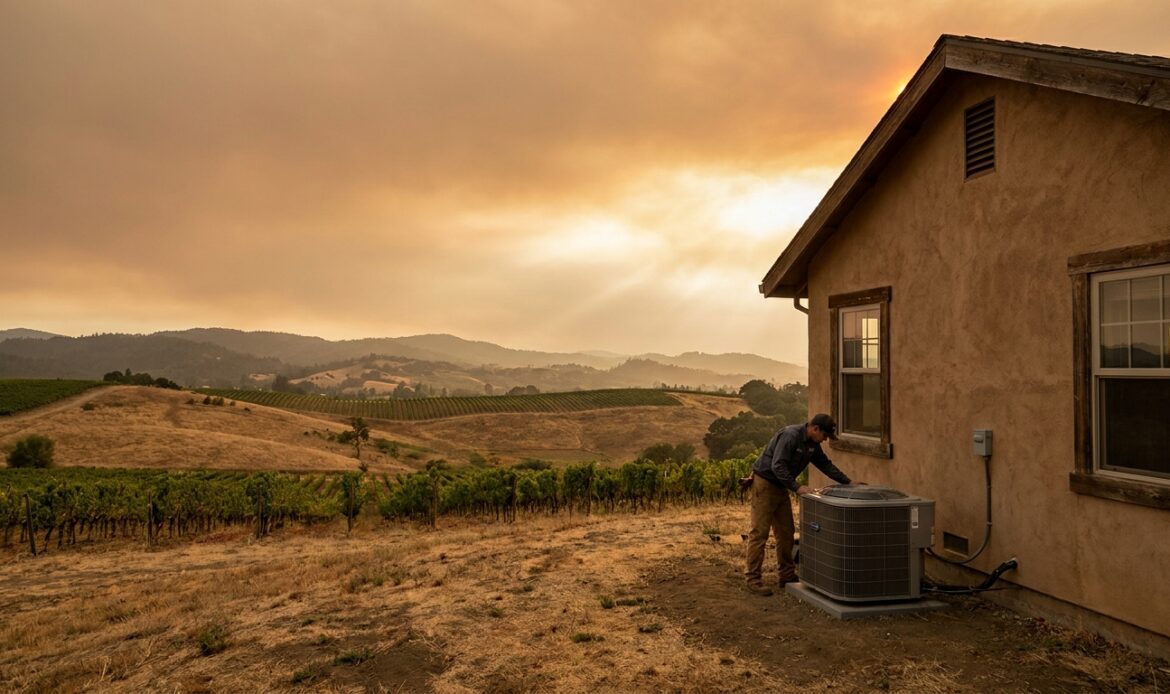
Wildfire smoke turns Sonoma County's AQI from single digits to hazardous within hours, and your HVAC system is the first line of defense between that smoke and your living room. This guide walks through the exact steps to get your system wildfire-ready before the 2026 fire season peaks in August and September.
TL;DR
Sonoma County wildfire season runs roughly June through November, with the sharpest AQI spikes historically hitting between late August and mid-October. Preparing your HVAC for wildfire season means upgrading to a MERV 13 filter, sealing duct leaks, checking your fresh-air intake damper, and scheduling a pre-season tune-up before smoke season arrives — not during it. Homes with ductless mini-split systems handle smoke infiltration better than older central systems with leaky return ducts. Verdict: get a MERV 13 filter and a professional duct inspection done in 2026 before July, or you're filtering smoke through a system that's fighting itself.
Why this matters
A standard MERV 8 filter, the kind most Sonoma County homes shipped with, catches maybe 20% of PM2.5 particles — the fine particulate matter in wildfire smoke that gets deep into lungs. MERV 13 filters catch upwards of 85% of those same particles, according to ASHRAE filtration standards.
The problem isn't just the filter. Duct leaks pull unfiltered outside air straight into your supply lines, bypassing the filter entirely. Homes near Larkfield-Wikiup, Glen Ellen, and Oakmont, all zones that have seen direct wildfire exposure in past seasons, report the worst indoor air quality complaints during smoke events specifically because of duct leakage, not filter quality.
Getting ahead of emergency HVAC repair in Sonoma County before a smoke event means you're not waiting in a queue with every other homeowner once AQI hits 200.
What you'll need
- A MERV 13-rated filter sized for your system (check your unit's filter slot dimensions first — not every system accepts MERV 13 without a retrofit)
- A smoke detector or AQI monitor for indoor reference (many homeowners use a $30-$80 consumer PM2.5 monitor)
- Weatherstripping or duct mastic for sealing gaps around the air handler and visible duct joints
- A flashlight and basic screwdriver set for inspecting the air handler cabinet
- A scheduled pre-season maintenance appointment, ideally booked by June 2026
- A battery backup or portable generator if you're on a PSPS-prone circuit (common across rural Sonoma County)
The steps
1. Check your filter rating and upgrade if needed
Pull your current filter and check the MERV number printed on the frame. If it reads MERV 8 or lower, you're not filtering wildfire smoke effectively. Swap to MERV 13 — but confirm your blower motor can handle the added static pressure first, since older systems can struggle to push air through a denser filter.
Common mistake: jamming a MERV 13 into a system rated only for MERV 8 without checking blower capacity, which reduces airflow and can strain the motor over a full smoke season.
2. Inspect and seal duct leaks
Walk your attic or crawlspace and look for visible gaps at duct joints, disconnected flex duct, or crushed sections. Seal accessible gaps with mastic, not standard duct tape, which degrades within a year in Bay Area attic temperatures that regularly exceed 120°F in July and August.
This step matters more in older homes throughout Petaluma and Napa where duct systems were installed before 2000 and haven't been resealed since.
3. Check the fresh-air intake damper
Many central systems have a fresh-air intake that pulls a small amount of outside air in for ventilation. During smoke events, that damper needs to close. Locate it near your air handler and confirm it can be manually shut, or ask your technician to add a smoke-detection-triggered auto-close damper during your next service visit.
4. Schedule a pre-season tune-up
Book a maintenance appointment in May or June 2026, before the first smoke advisory hits. A tune-up catches refrigerant issues, worn blower belts, and clogged coils that turn into full breakdowns exactly when AQI spikes and demand for repairs across the county surges. HVAC maintenance plans for Bay Area homeowners build this seasonal timing in so you're not calling during a smoke event.
5. Consider a ductless mini-split for problem rooms
If your central system has chronic duct leakage you can't fully seal, a ductless mini-split for bedrooms or a home office removes duct infiltration from the equation entirely since air handles the space directly with no ductwork to leak. Ductless mini-split installation in Sonoma County is worth pricing out if smoke exposure is a recurring problem at your address.
6. Set up backup power for PSPS events
Public Safety Power Shutoffs often coincide with high fire-risk conditions, meaning your HVAC system can go dark exactly when smoke is worst. A battery backup sized for your air handler, or a portable generator with a transfer switch, keeps filtration running through an outage. Skipping this step means opening windows during a shutoff — the opposite of what you want during a smoke event.
7. Test your system before the season starts
Run the system for a full cycle in May or June 2026 and listen for unusual noise, weak airflow, or short-cycling. Catching a failing capacitor or a dying blower motor in June costs less and takes less time than an emergency call in September when every HVAC crew in Sonoma County is booked out.
Common mistake: waiting until the first smoke advisory to test the system, when technicians are already stretched thin across Petaluma, Sonoma, and Napa service calls.
Troubleshooting
Filter clogs within days during a smoke event. MERV 13 filters load up fast during heavy smoke. Keep a spare on hand and swap when static pressure feels noticeably higher or airflow drops.
System runs constantly but indoor air still smells like smoke. This usually points to duct leakage pulling in unfiltered air. Get a duct inspection rather than assuming the filter is failing.
Blower motor sounds strained after a MERV 13 upgrade. The filter is likely too dense for your system's static pressure rating. Downgrade to MERV 11 or have a technician confirm blower compatibility.
AQI monitor reads high indoors even with the system running. Check that all windows and doors are sealed and that the fresh-air damper is fully closed, not just partially.
System won't restart after a PSPS event. Some systems need a manual reset after a power interruption. Check the breaker and the thermostat's reset sequence before assuming a mechanical failure.
Uneven smoke smell between rooms. Rooms far from the air handler often show worse air quality during smoke events. This is a strong sign a ductless mini-split for that specific room would outperform trying to force more airflow through existing ducts.
Tools and resources
- Best heat pump installers in Sonoma County for homeowners weighing a full system upgrade before the season starts
- Consumer PM2.5 monitors (widely available under $100) for real-time indoor air quality tracking
- PurpleAir or AirNow.gov for outdoor AQI tracking specific to Sonoma County zip codes
- MERV 13 filters sized to your unit's filter slot, available through most HVAC suppliers and big-box hardware stores
What to do next
If you're not sure whether your current system can handle a MERV 13 filter or needs a bigger fix, start with how to choose an HVAC contractor in the Bay Area to line up a technician who can assess filtration capacity, duct integrity, and backup power needs in one visit before smoke season hits its peak in 2026.
FAQ
What's the best filter for wildfire smoke in Sonoma County? MERV 13 is the practical ceiling for most residential systems, catching roughly 85% of PM2.5 particles versus 20% for a standard MERV 8 filter. Confirm your blower motor can handle it before installing.
Is a ductless mini-split better than central air during wildfire season? For rooms with chronic duct leakage, yes — ductless systems skip ductwork entirely, removing one of the main paths smoke uses to get indoors. Whole-home central systems still work fine if ducts are properly sealed.
How much does it cost to prep an HVAC system for wildfire season? A filter upgrade runs $20-$60, duct sealing varies by scope, and a pre-season tune-up is typically the cheapest line item compared to an emergency repair during peak smoke season.
When does wildfire season typically start in Sonoma County? Fire risk builds through summer and typically peaks between late August and mid-October, though dry, windy conditions can create risk as early as June in a low-rainfall year like parts of 2026 have shown.
Can I run my HVAC system with the windows open during a smoke event? No — this defeats filtration entirely and pulls smoke straight into your home. Keep windows and doors sealed and let the system's filter do the work.
Do I need a whole-home air purifier in addition to my HVAC filter? Not always. A properly sealed system with a MERV 13 filter handles most smoke events. Severe or prolonged smoke exposure is where a dedicated purifier adds a second layer.
What happens to my HVAC system during a PSPS power shutoff? It stops entirely unless you have battery or generator backup, which means no filtration exactly when smoke risk is often highest.
How often should I replace my filter during wildfire season? Check monthly at minimum, and more often during active smoke events since MERV 13 filters load up faster than standard filters when particulate levels spike.
One last thing
Most Sonoma County homeowners upgrade their filter and stop there — but the fresh-air intake damper is the step almost everyone skips, and it's the one that lets unfiltered smoke bypass a brand-new MERV 13 filter entirely. Check that damper before you check anything else in 2026.