

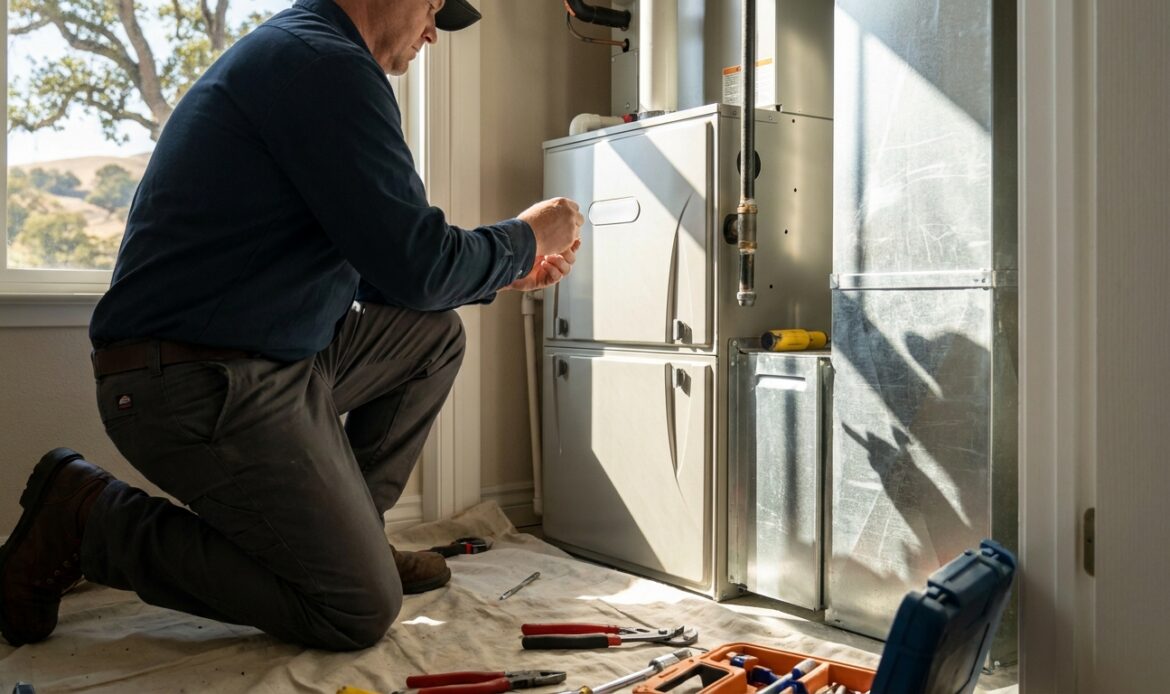
Furnace installation in Contra Costa County means picking the right AFUE rating, the right BTU size for your ductwork, and a licensed contractor who pulls permits before the first bolt goes in. Homes in Walnut Creek, Concord, Danville, and Antioch have different heat-load needs than coastal Bay Area properties, and that changes which furnace makes sense in 2026.
- A 95%+ AFUE condensing furnace is the buy for most Contra Costa homes with existing gas ductwork in 2026.
- Dual-fuel systems pairing a furnace with a heat pump cut winter gas use while keeping backup heat for cold snaps – Consider.
- Skip a straight 80% AFUE swap-out if your home qualifies for 2026 heat pump rebates – you’re leaving money on the table.
- Manual J load calculations, not square footage guesses, should size every furnace installation in Contra Costa County.
Why this matters
Contra Costa County runs hotter and drier inland than Marin or coastal Sonoma, but winter lows in Danville, Alamo, and Clayton still drop into the high 30s. A furnace sized wrong – too big or too small – short-cycles, wastes gas, and dies years early. HVAC services in Contra Costa County covers the full range of heating and cooling work, but furnace installation specifically hinges on three things: correct sizing, code compliance, and whether a straight gas replacement still makes sense given where California heating incentives sit in 2026.
Most furnaces installed before 2010 run at 78-80% AFUE. A 2026 replacement at 95%+ AFUE recovers 15-17 cents of every heating dollar that used to go up the flue. That's not marketing – it's the efficiency delta between an old non-condensing unit and a modern condensing furnace, and it's the first number worth checking before you sign a contract.
Who this is for
This guide is for Contra Costa County homeowners whose furnace is 15+ years old, whose heating bills climbed noticeably over the last two winters, or whose HVAC contractor already flagged a cracked heat exchanger or failing igniter. It's also for anyone building or remodeling in Walnut Creek, Pleasant Hill, or San Ramon who needs to decide between a gas furnace and an all-electric heat pump before ductwork gets closed up. If your furnace still runs fine and your last service visit didn't flag anything, signs it's time to replace your HVAC system is worth reading before you spend money you don't need to.
What to look for in furnace installation for Contra Costa County homes
AFUE rating matched to your ductwork
A 96% AFUE furnace needs PVC intake/exhaust venting, not the old metal flue your 80% unit used. If your ducts and venting were never upgraded, jumping straight to the highest AFUE number on the shelf adds cost without adding comfort. Match the rating to what your house can actually support in 2026, not to the biggest number on the spec sheet.
Correct BTU sizing via Manual J
A typical 1,800-2,500 sq ft Contra Costa home lands in the 60,000-80,000 BTU range, but stucco construction, attic insulation, and window count all shift that number. Oversized furnaces short-cycle – they heat fast, shut off, and cycle again within minutes, which wears out components and leaves rooms unevenly heated. A licensed contractor runs a Manual J load calculation before quoting equipment size, not after.
Ductwork condition, not just the furnace
A new furnace pushed through leaky, 20-year-old ductwork loses 20-30% of conditioned air before it reaches the register in older Bay Area homes. If your ducts run through an unconditioned attic or crawlspace, sealing and insulating them alongside the furnace swap changes the math on your gas bill more than the furnace upgrade alone.
Permits and Title 24 compliance
California's Title 24 energy code applies to furnace replacements, not just new construction. Contra Costa County requires permits for furnace installation, and skipping that step creates real problems at resale – buyers' inspectors flag unpermitted HVAC work every time. Permit turnaround typically runs 5-10 business days depending on the jurisdiction.
Warranty terms and manufacturer certification
Manufacturer warranties on furnaces typically run 10 years on parts when a licensed, certified installer handles the work – and can drop to 5 years or void entirely with a non-certified install. Ask which brands the contractor is factory-certified to install before you compare quotes on price alone.
Contractor licensing
California requires a C-20 license for HVAC contractors. Verify the license number through the CSLB before signing anything – it takes two minutes and it's the single easiest way to filter out unlicensed operators quoting furnace installation in Contra Costa County.
Top picks: furnace and heating system options for 2026
Standard 80% AFUE gas furnace – the budget-safe pick. Lowest upfront equipment cost, 15-18 year typical lifespan, works with existing metal flue venting in most older homes. Right call if you're not staying in the house long-term and just need reliable heat. Verdict: Consider.
High-efficiency 95%+ AFUE condensing furnace – the efficiency pick. Recovers 15-17 cents per heating dollar versus an old 80% unit, requires PVC venting, and typically pairs with a variable-speed blower for quieter operation. This is the default recommendation for most Contra Costa homes replacing a furnace in 2026. Verdict: Buy.
Dual-fuel system (furnace plus heat pump) – the hybrid pick. Runs on the heat pump for mild Contra Costa winters and switches to gas furnace backup only when temperatures drop hard. Cuts gas use most of the season while keeping reliable heat for the coldest nights. See heat pump vs furnace tradeoffs before committing. Verdict: Consider.
Full heat pump conversion, no gas furnace – the wildcard. Electric-only heating and cooling from one system, eligible for 2026 California heat pump rebate programs, and no gas line dependency. Makes the most sense for homeowners already planning to electrify. Check heat pump installation in Contra Costa County for what that install actually involves. Verdict: Buy for electrification-focused homeowners, Skip if you need cold-night backup heat immediately.
Furnace replacement bundled with duct sealing – the overlooked pick. Adds cost upfront but addresses the 20-30% air loss common in older Contra Costa duct systems. Skipping this and installing a high-efficiency furnace into leaky ducts wastes the efficiency gain you just paid for. Verdict: Buy if your ducts are original to the house.
Get a furnace installation quote
A second opinion before you sign – fast scheduling across Contra Costa County.
What to avoid
- A same-size, same-brand swap without a load calculation. Contractors quoting a furnace replacement without measuring your home's actual heat load are guessing, not sizing.
- Skipping the permit to save time. Unpermitted furnace work becomes a disclosure problem at resale and can void manufacturer warranty coverage.
- Choosing AFUE rating before checking venting compatibility. A 96% AFUE furnace quoted without PVC venting in the estimate means someone missed a step – or is planning to cut corners.
Verdict comparison
| System type | AFUE / efficiency | Best for | Verdict |
|---|---|---|---|
| Standard 80% AFUE gas furnace | ~80% | Short-term ownership, existing metal flue | Consider |
| High-efficiency condensing furnace | 95%+ | Most Contra Costa homes replacing in 2026 | Buy |
| Dual-fuel (furnace + heat pump) | Varies by mode | Mild-winter homes wanting lower gas use | Consider |
| Full heat pump conversion | N/A (electric) | Electrification-focused homeowners | Buy / Skip by priority |
| Furnace + duct sealing bundle | Depends on furnace chosen | Homes with original, leaky ductwork | Buy |
FAQ
How much does furnace installation cost in Contra Costa County?
Cost depends on furnace AFUE rating, ductwork condition, and whether venting needs upgrading for a condensing unit. Get a written quote that itemizes equipment, labor, and permit fees separately before comparing contractors.
Do I need a permit for furnace installation in Contra Costa County?
Yes, furnace replacement requires a permit under California’s Title 24 energy code. Permit turnaround typically runs 5-10 business days depending on the local jurisdiction.
Is a heat pump better than a furnace in Contra Costa County?
A heat pump handles most Contra Costa winters efficiently on electricity alone, while a furnace gives faster recovery on the coldest nights. Many 2026 installs use a dual-fuel setup to get both.
How long does a furnace installation take?
A standard furnace swap typically takes one day when ductwork and venting don’t need modification. Adding duct sealing or venting upgrades extends the job to two days.
What AFUE rating should I choose for a Contra Costa County home?
Most homes benefit from 95%+ AFUE condensing furnaces in 2026, provided the home can support PVC venting. Older homes with intact metal flue venting sometimes stick with 80% AFUE units to avoid venting upgrade costs.
How often should a furnace be replaced?
Furnaces typically last 15-20 years before efficiency losses and repair frequency make replacement the better financial move. A furnace older than 15 years with rising repair costs is a strong replacement signal.
Are there rebates for furnace installation in California in 2026?
Direct furnace rebates are limited, but heat pump and dual-fuel systems qualify for broader California electrification incentive programs in 2026. A contractor quoting your job should flag which options qualify.
Can I install a furnace myself to save money?
No – furnace installation in California requires a licensed C-20 contractor and a permit, and gas line work done without a license creates safety and insurance liability.
One last thing
The detail most homeowners skip: a furnace that's the right AFUE rating but installed into leaky, unsealed ductwork still loses 20-30% of the heat you just paid to generate. Duct sealing is the cheapest efficiency gain most Contra Costa County furnace installations leave on the table in 2026.
Related guides
- Signs it's time to replace your HVAC system
- Heat pump vs furnace in California
- AC installation in Contra Costa County