

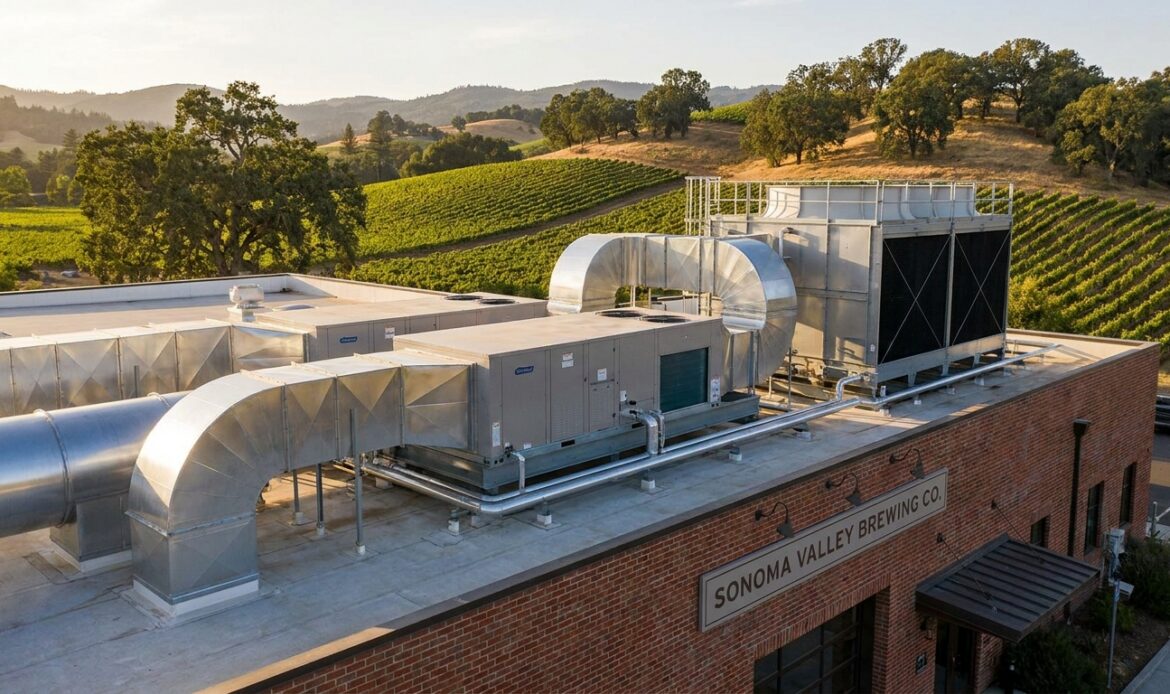
Brewery HVAC isn't scaled-up house HVAC — a 15-barrel production floor throws off heat and moisture that a residential-grade system can't touch, and a taproom crowded on a Friday night behaves nothing like a living room. This guide breaks down what Sonoma County brewery owners actually need from a commercial system, not what a generic contractor quote assumes.
- Commercial HVAC for a brewery in Sonoma County means sizing for boil-off steam, CO2 buildup, and taproom occupancy swings, not square footage alone.
- Dedicated makeup air handling wins for production floors with kettles and mash tuns running daily — verdict: Buy.
- Ductless mini-splits work for taproom-only conversions but fail as the sole system for a working brewhouse — verdict: Consider with limits.
- Wildfire smoke season adds a filtration requirement most brewery HVAC quotes skip entirely in 2026.
- A single rooftop package unit sized off floor area, with no makeup air plan, is the most common mistake breweries make.
Why this matters
A brewery mismatched to its HVAC system doesn't just run hot — it fails health inspections, fogs windows in the taproom, and burns through compressor life twice as fast as a properly sized setup. Sonoma County adds two variables most contractors outside the wine country corridor don't plan for: wildfire smoke intrusion during peak fermentation months and humidity swings between the coastal fog belt and inland heat in Santa Rosa and Petaluma.
Getting commercial HVAC right for a brewery is a load-calculation problem first and an equipment-brand problem a distant second. Comfort Factor handles commercial HVAC services in Sonoma County for production spaces exactly like this, and the pattern repeats across almost every taproom-plus-brewhouse layout in the county.
Who this is for
This guide is for brewery owners and facility managers running a combined production-and-taproom space in Sonoma County — Santa Rosa, Petaluma, Sebastopol, Windsor, or anywhere else in the county where a converted warehouse or industrial park unit now houses fermenters, a canning line, and a public bar. If you're evaluating a system for a 3-barrel nano-brewery with no public seating, the calculus shifts; this guide assumes at least some retail foot traffic alongside active brewing.
What to look for in commercial HVAC for a brewery
Makeup air capacity matched to exhaust
Every brewhouse hood, kettle vent, and boil-off exhaust pulls conditioned air out of the building. If your makeup air unit can't replace that volume, you get negative pressure — doors that won't close, backdrafting water heaters, and a taproom that never cools down. Size makeup air to match or slightly exceed total exhaust CFM, not to a percentage of floor area.
Humidity control separate from temperature control
Fermentation and mash rooms run high humidity even with the temperature dialed in, and standard AC won't dehumidify fast enough once relative humidity climbs past the mid-60s. A brewery needs a system that treats humidity as its own variable, with dedicated dehumidification tied to the production zone rather than blended into the general cooling loop.
Zoning between production and taproom
The brewhouse and the taproom have opposite thermal profiles: one is a heat source running constantly, the other swings with occupancy on weekend afternoons. A single zone forces one space to compensate for the other. Two zones — sometimes three if there's a cold-storage or keg room — keep both areas comfortable without fighting each other.
CO2 and air quality monitoring integration
Fermentation releases CO2, and a sealed production room without ventilation tied to a monitor is a safety liability, not just a comfort issue. Look for a system design that ties exhaust fans to CO2 sensors rather than running on a timer, so ventilation responds to actual fermentation activity.
Redundancy for peak production days
A brewhouse running back-to-back brew days can't afford a mid-week HVAC failure that shuts down fermentation temperature control. Redundant compressors or a documented rapid-repair response matter more here than in a standard retail space, where a few warm hours is an inconvenience rather than a lost batch.
Wildfire smoke filtration for Sonoma County specifically
Sonoma County breweries deal with smoke intrusion during fire season in ways that Bay Area coastal locations mostly don't. A system without MERV-13 or better filtration on the makeup air intake pulls smoke straight into the taproom during exactly the weeks when outdoor patio seating would otherwise be the draw.
Top picks for brewery HVAC in Sonoma County
The workhorse pick: dedicated commercial package unit with makeup air add-on. This pairs a rooftop package unit sized for the taproom's sensible cooling load with a separate makeup air unit tied to the brewhouse exhaust hoods, keeping the two systems from fighting each other. It's the standard setup for combined production-and-retail spaces running more than 5 barrels. Verdict: Buy for any brewery with an active brewhouse and public seating.
The retrofit pick: heat pump installation for the taproom zone. A heat pump handles the taproom's heating and cooling swings efficiently, especially useful in Sonoma County's shoulder-season fog-to-heat swings, and it pairs well with a separately ducted production-side system. Heat pump installation in Sonoma County covers the sizing math for spaces this size. Verdict: Buy for the taproom zone specifically, not as a whole-building solution.
The budget trap: ductless mini-splits as the only system. Mini-splits handle a small taproom or office nicely, and ductless mini-split installation in Sonoma County is a legitimate fit for taproom-only conversions with no active brewing on-site. But a mini-split head has no makeup air capability and can't keep pace with kettle steam or fermentation humidity in a working brewhouse. Verdict: Consider for taproom-only spaces, Skip as the sole system for an active production floor.
The wildcard: dedicated dehumidification unit added to an existing system. Rather than replacing the whole HVAC plant, a standalone commercial dehumidifier tied into the fermentation room's exhaust handles the humidity problem without touching temperature zoning elsewhere. It's a lower-cost fix for breweries with a working system that just can't keep humidity down. Verdict: Consider if temperature control is already adequate and humidity is the sole complaint.
The overkill pick: full building replacement with multi-zone VRF. Variable refrigerant flow systems handle zoning elegantly and scale well for multi-tenant buildings with a brewery as one tenant among several. For a standalone single-tenant brewery, the upfront complexity and commissioning time rarely pay off compared to a package-unit-plus-makeup-air setup. Verdict: Skip unless the building has multiple tenants sharing the system.
“If your makeup air can’t outrun the exhaust hoods, you’re just air conditioning the parking lot.”
What to avoid
A single rooftop unit sized off square footage alone. Contractors unfamiliar with brewery loads default to a square-foot rule of thumb that ignores kettle heat and exhaust volume entirely, leaving the brewhouse permanently warm and humid regardless of tonnage installed.
Skipping the envelope conversation. Breweries in converted warehouse spaces often have poor insulation and no vapor barrier, which means the HVAC system fights heat gain and moisture intrusion the building itself should be blocking. The same physics apply whether you're in a Sonoma County industrial park or an Alberta walk-out basement — sealing the envelope with spray foam insulation cuts the load before a compressor ever has to work for it, and a brewhouse with an unsealed shell will never hit its humidity targets no matter what unit sits on the roof.
A contractor with no commercial food-and-beverage HVAC references. Residential HVAC experience doesn't automatically transfer to production spaces with health-code airflow requirements. Reviewing how to choose an HVAC contractor in the Bay Area before signing a commercial quote catches most of these mismatches early.
Verdict comparison table
| Solution | Handles makeup air | Handles humidity | Best for | Verdict |
|---|---|---|---|---|
| Package unit + makeup air | Yes | Partial | Combined brewhouse + taproom | Buy |
| Heat pump (taproom zone) | No | Partial | Taproom heating/cooling | Buy for taproom only |
| Ductless mini-splits only | No | No | Taproom-only, no brewing | Consider / Skip for production |
| Standalone dehumidifier add-on | No | Yes | Existing system, humidity-only fix | Consider |
| Multi-zone VRF | Yes | Yes | Multi-tenant buildings | Skip for single-tenant |
Get a brewery HVAC quote
Load calculations for makeup air, humidity, and taproom zoning in Sonoma County.
FAQ
What’s the best commercial HVAC setup for a Sonoma County brewery?
A rooftop package unit paired with a dedicated makeup air unit sized to the brewhouse exhaust hoods is the most reliable setup for a combined production-and-taproom brewery in 2026. Ductless systems alone can’t replace the air volume a kettle or mash tun exhausts.
Is a heat pump better than a furnace for a brewery taproom?
A heat pump handles the taproom’s heating and cooling swings more efficiently than a furnace-plus-AC combo, especially through Sonoma County’s fog-to-heat shoulder seasons. It shouldn’t be relied on for the production side without a separate makeup air plan.
How much makeup air does a brewery need?
Makeup air should match or exceed the total exhaust CFM pulled by kettle hoods, boil-off vents, and any spot exhaust fans in the fermentation room. Undersizing it creates negative building pressure, which shows up as doors that won’t shut and a taproom that never cools.
Does wildfire smoke affect brewery HVAC in Sonoma County?
Yes — wildfire season pulls particulate smoke into a taproom through any makeup air intake that lacks MERV-13 filtration or better. This matters most for breweries with patio seating that closes down during heavy smoke weeks.
Can ductless mini-splits handle a brewery production floor?
Ductless mini-splits handle a small taproom or office fine but can’t manage the humidity and makeup air demands of an active brewhouse. They work as a Consider pick for taproom-only conversions with no on-site brewing.
How often should a brewery service its HVAC system?
Production spaces running daily brew cycles need more frequent filter changes and coil checks than a standard commercial building because of the added humidity and particulate load. Quarterly maintenance checks catch drift before it turns into a mid-brew-day failure.
What’s the difference between residential and commercial HVAC for a brewery?
Commercial HVAC for a brewery accounts for kettle exhaust, CO2 buildup, and humidity from fermentation — loads a residential system was never designed to handle. Commercial-grade equipment also carries the redundancy and service response times a production schedule depends on.
Do breweries need separate HVAC zones for the taproom and brewhouse?
Most combined-use breweries need at least two zones because the brewhouse runs as a constant heat and humidity source while the taproom swings with customer occupancy. Forcing both spaces onto one zone means one side is always uncomfortable.
One last thing
The detail most brewery owners skip: tying exhaust fans to a CO2 sensor instead of a timer. A timer runs exhaust on a fixed schedule regardless of what's actually fermenting that day, which either wastes conditioned air during quiet weeks or under-ventilates during a heavy production run — a sensor-tied system does neither.
Related guides
- Commercial HVAC services in Petaluma
- Heat pump installation in Petaluma (commercial)
- How to prepare your HVAC for Sonoma County wildfire season
- AC maintenance in Petaluma (commercial)