

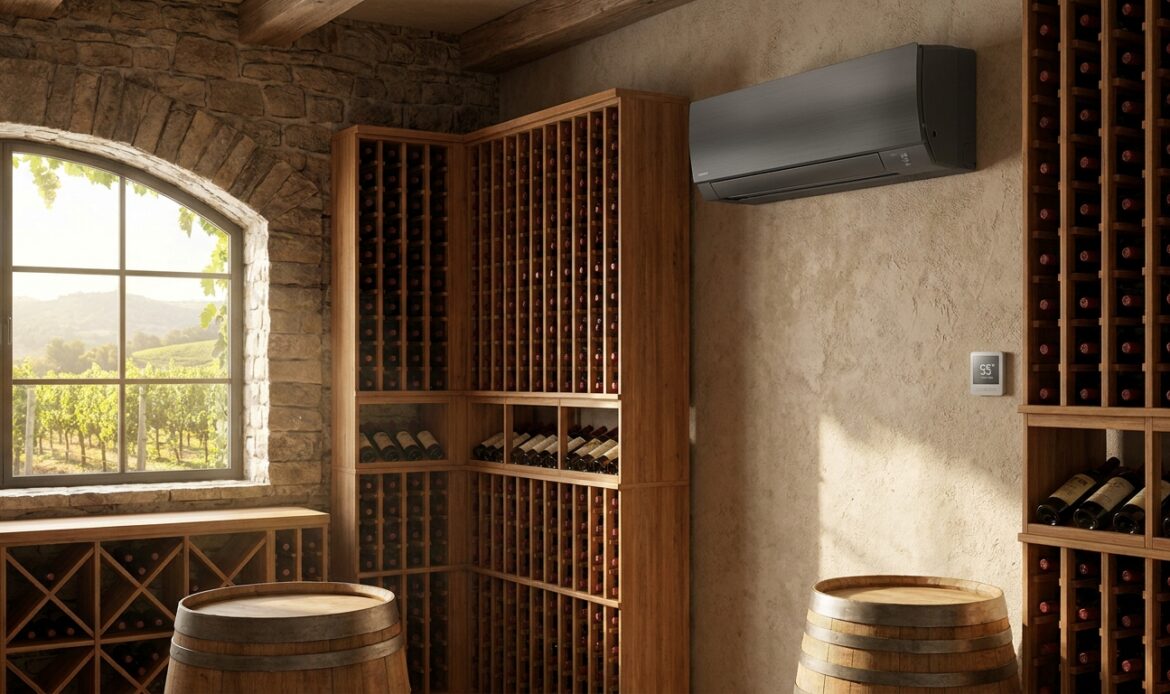
A ductless mini-split is the standard fix for Napa Valley wine cellars because it holds a steady 55-58°F without the humidity swings a standard whole-house AC creates.
- A ductless mini split wine cellar Napa Valley setup holds 55-58°F and 50-70% humidity without ductwork — Buy for cellars under 1,500 bottles.
- Standard central AC dries out corks and swings temperature 8-10°F per cycle — Skip for any cellar over 200 bottles.
- Single-zone units under 12,000 BTU handle most home cellars; oversized units short-cycle and spike humidity — Consider carefully before buying by BTU alone.
- Professional install matters more than the unit brand in older Napa County homes with uninsulated walls — Buy the install, not just the equipment.
Who this is for
This guide is for Napa Valley homeowners converting a closet, basement corner, or purpose-built room into a wine cellar and trying to figure out how to keep it at cellar temperature without running new ductwork through a house that wasn't built for it. It's for anyone who's already lost a bottle or two to a cellar that swung from 55°F to 70°F during a September heat spike, and for anyone building new who doesn't want to retrofit a whole-home HVAC system just for one room. If your collection is 100 bottles or 3,000, the sizing changes but the logic doesn't: wine needs stable temperature and moderate humidity more than it needs cold air.
Why this matters
Wine stored above 70°F for extended stretches ages faster and can push corks out; storage below 50% humidity dries corks and lets air in. Napa Valley's climate swings from 100°F+ summer afternoons to 35°F winter nights, which is exactly the kind of daily and seasonal swing a cellar needs to be insulated against. A ductless AC installation in Napa solves this because the compressor sits outside, the air handler mounts inside the cellar, and the system runs on its own thermostat independent of the rest of the house. No ducted system can isolate one room that precisely without a dedicated zone, and most Napa County homes built before the 1990s don't have the duct capacity to add one anyway.
What to look for in a ductless mini-split for a wine cellar
Precise low-temperature range
Most residential mini-splits are calibrated for human comfort, meaning 68-78°F. A wine cellar needs consistent operation down to 55°F, and not every unit holds accuracy that low without cycling erratically. Check the manufacturer's rated operating range before buying — a unit that stops performing reliably below 60°F isn't a cellar unit, it's a bedroom unit with a cellar price tag.
Humidity management, not just cooling
Standard AC removes moisture as a side effect of cooling, which is fine for a living room and wrong for a cellar. You want 50-70% relative humidity, and a unit that overcools to hit temperature will over-dry the air in the process. Look for models with a dedicated dry mode or humidity sensor rather than one that treats humidity as an afterthought.
Noise and vibration near stored bottles
Vibration disturbs sediment in aging reds over years of storage, and a noisy compressor cycling every 20 minutes is unpleasant in a room you'll walk into often. Indoor units rated below 25 decibels on low fan speed are the quiet end of the residential range; anything louder is noticeable in a small enclosed cellar.
Sizing to the room, not the collection
It's tempting to size by bottle count, but the real variable is cubic footage, insulation, and how many walls face unconditioned space. How ductless mini-splits work in older Bay Area homes covers why a 200-square-foot uninsulated cellar in a 1920s Napa farmhouse can need more capacity than a better-insulated 400-square-foot space built in 2026.
Line set and condensate routing
Basement and interior cellars often need the line set and condensate drain routed through a wall, crawlspace, or up to the roofline, which is a bigger factor in Napa Valley homes with stone foundations or slab construction. This is where install quality matters more than unit selection — a poorly routed line set is the most common source of leaks and warranty claims.
Insulation and vapor barrier before equipment
No mini-split, however good, compensates for an uninsulated cellar door or a missing vapor barrier. R-13 to R-19 wall insulation and a sealed vapor barrier are the baseline before sizing equipment; skipping this step means undersizing every unit you compare afterward.
Top picks for a Napa Valley wine cellar
Single-zone ductless mini-split — the safe pick. A 9,000-12,000 BTU single-zone system covers most home cellars up to roughly 300 square feet and holds 55°F within a tight range when the room is properly insulated. This is the configuration Comfort Factor installs most often for Napa County cellars under 1,500 bottles. Buy if your cellar is a converted closet, under-stair space, or single room with one exterior wall.
Multi-zone system — the wildcard. If the cellar shares a floor plan with a tasting area or adjoining room you also want conditioned, a multi-zone system runs one outdoor compressor to two or three indoor heads, each on its own thermostat. It costs more upfront than a single zone but avoids running two separate outdoor units. Consider this if you're building new construction or doing a larger remodel — talk sizing through with an installer before committing.
Retrofit unit for an older home — the practical pick. Napa Valley has a lot of stone, adobe, and pre-1960s construction where duct retrofits are impractical or destructive to historic finishes. A ductless retrofit avoids cutting into walls entirely; the best ductless AC installers in the Bay Area know how to route line sets around original foundation stonework without compromising the structure. Buy for any pre-1970s cellar conversion.
Oversized 18,000+ BTU unit for a small cellar — skip it. An oversized unit cools the room fast, then shuts off before it's pulled enough moisture out of the air, leaving humidity too high or swinging wide between cycles. This is the single most common sizing mistake in Napa Valley cellar installs. Skip unless your cellar genuinely exceeds 500 square feet.
What to avoid
- Portable AC units marketed for wine storage. They can't hold 55°F consistently and most can't dehumidify without also overcooling — fine for a weekend, not for a permanent collection.
- Standard central AC extended into the cellar. It shares one thermostat with the rest of the house, so the cellar swings whenever the living room does — exactly the instability wine can't handle.
- DIY-installed mini-splits with unlicensed refrigerant charging. A slightly undercharged system will run constantly and still miss target temperature, and it usually voids the manufacturer warranty in California.
Verdict comparison
| Option | Temperature accuracy | Humidity control | Noise | Verdict |
|---|---|---|---|---|
| Single-zone mini-split | High (55°F+) | Good with dry mode | Under 25 dB | Buy |
| Multi-zone system | High per zone | Good, independent zones | Under 25 dB per head | Consider |
| Retrofit for older homes | High, install-dependent | Good | Under 25 dB | Buy |
| Oversized single unit | Poor, short-cycles | Poor, over-dries then swings | Louder on cycling | Skip |
| Standard central AC extension | Poor, shared thermostat | Poor | Varies | Skip |
If a cellar sits idle for weeks at a time between visits, get a system checked before wine sits at an off-target temperature unnoticed — emergency HVAC repair in Napa exists for exactly that scenario, where a failed compressor in July could mean a ruined vintage before anyone notices.
FAQ
What is the best ductless mini split for a wine cellar in Napa Valley?
A single-zone 9,000-12,000 BTU ductless mini-split rated for operation down to 55°F is the best fit for most home wine cellars under 1,500 bottles in 2026. Larger or shared-space cellars need a multi-zone system sized to square footage, not bottle count.
Is a ductless mini split better than central AC for a wine cellar?
Yes, a ductless mini-split runs on its own thermostat independent of the rest of the house, which central AC extended into a cellar cannot do. Central AC shares the house’s temperature swings, which is the opposite of what wine storage needs.
How much does ductless mini split installation cost for a wine cellar?
Cost depends on BTU capacity, line set routing, and whether the cellar needs added insulation before install — get a quote based on your specific room rather than a flat estimate. Older homes with stone or slab foundations typically need more routing work than new construction.
What temperature and humidity should a wine cellar hold?
Most wine cellars target 55-58°F with 50-70% relative humidity year-round. Swings beyond that range accelerate aging and can dry out or push corks.
Can a mini-split control humidity as well as temperature?
Units with a dedicated dry mode or humidity sensor manage both, while units that only cool tend to over-dry the air chasing a temperature setpoint. Look for this feature specifically when comparing models for cellar use.
Do I need a professional install for a wine cellar mini-split in Napa County?
Yes, refrigerant charging and line set routing require a licensed contractor in California, and DIY installs commonly run undercharged, missing target temperature even with the right-sized unit. Improper installs also typically void the manufacturer warranty.
How big a mini-split do I need for a 300-bottle wine cellar?
Sizing depends on cubic footage and insulation, not bottle count directly — a well-insulated 200-square-foot room often needs less capacity than an uninsulated one of the same size. A load calculation from an installer is more accurate than a bottle-count rule of thumb.
Why does my wine cellar mini-split cycle on and off constantly?
Short-cycling usually means the unit is oversized for the room, cooling fast and shutting off before humidity is properly managed. Downsizing to match actual square footage, not desired bottle capacity, usually fixes it.
One last thing
The detail most homeowners miss: a cellar door with a poor seal undoes almost everything else on this list, because every time it opens, warm humid air rushes in and the mini-split has to work overtime to recover — a tight-sealing door with weatherstripping matters as much as the BTU rating on the unit itself.
Related guides