

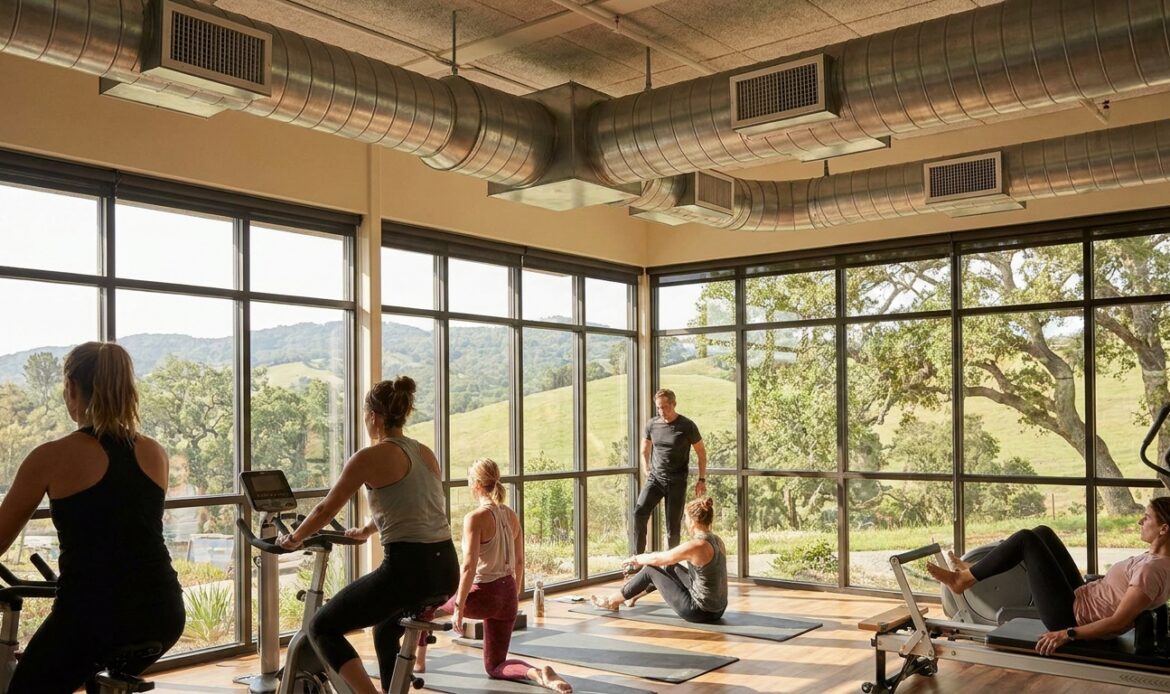
Fitness studios in Marin County run hotter, wetter, and harder than almost any other commercial space — and the HVAC system either keeps up with 40 sweating bodies in a 6pm spin class or it becomes the reason members cancel.
- Commercial HVAC for a fitness studio in Marin County needs 1.5-2x the cooling capacity of a standard retail space per square foot.
- Ductless multi-zone systems win for boutique studios under 3,000 sq ft — Buy.
- Packaged rooftop units handle larger gyms with locker rooms and separate zones — Consider.
- Skip single-zone residential heat pumps for any studio running back-to-back classes — they can’t recover fast enough.
- Comfort Factor installs and services commercial HVAC across Marin County, including studios in San Rafael, Novato, and Mill Valley.
Why this matters
A yoga or HIIT studio isn't a normal commercial tenant. Occupancy swings from empty to 30-plus people in minutes, humidity spikes fast from body heat and breath, and members notice a stuffy room before they notice anything else about your brand.
Get the sizing wrong and you're either running the compressor into the ground trying to catch up between classes, or overcooling an empty room at 7am and burning utility budget for nothing. Commercial HVAC services in Marin County built around residential logic — one thermostat, one zone, standard fresh-air rates — fail fitness studios within the first hot summer.
Comfort Factor works with studio owners across Marin County who inherited undersized systems from a previous retail tenant, or who are building out a new space and don't want to guess twice.
Who this is for
This guide is for studio owners and operators in Marin County — yoga, Pilates, cycling, HIIT, boxing, CrossFit — planning a new HVAC install, replacing a failing rooftop unit, or troubleshooting a space that never feels right no matter what the thermostat says. If you're leasing a former retail or restaurant space and converting it to a studio, read this before you sign off on whatever system is already installed.
What to look for in HVAC for a fitness studio
Cooling capacity per square foot, not per the lease listing
A general commercial rule of thumb puts standard retail cooling needs around 300-400 sq ft per ton. A fitness studio with sustained high-intensity classes often needs closer to 150-250 sq ft per ton because body heat and moving air load the system far harder than a boutique or office ever does. Undersize this number and the room never fully recovers between classes.
Ventilation and fresh-air exchange rate
ASHRAE guidance for exercise rooms calls for significantly higher outdoor air changes than retail or office space, because CO2 and humidity build up fast with heavy breathing. A studio running on a system designed for a nail salon will feel thick and stale by the third class of the day, and members will feel it before you do.
Zoning for uneven occupancy
A studio isn't one uniform space — the workout floor, the front desk, and any locker room or lobby all carry different heat loads at different times. Single-zone systems force you to pick one setpoint for a room with three very different needs, which means somewhere is always uncomfortable.
Recovery speed between classes
The gap between a 5:30pm class ending and a 6:15pm class starting might be 15 minutes. Your system needs to pull room temperature and humidity back down in that window, not over the next hour. This is a compressor capacity and airflow question, not a thermostat setting.
Noise level during workouts
A compressor or blower cycling loudly over a quiet stretch class or a meditation-focused studio undercuts the experience you're selling. Equipment noise ratings matter more here than in a typical retail buildout.
Maintenance access and service history
Studios run long hours, seven days a week, which means more run-hours per year than a typical 9-to-5 office tenant. A system that's hard to service, or has no maintenance history from the prior tenant, becomes a liability fast. Before you commit to a space, get a second opinion on whatever's already installed — choosing an HVAC contractor in the Bay Area covers what to check before you sign a service agreement.
Top picks for a Marin County fitness studio
The all-around workhorse: ductless multi-zone heat pump
Best fit for boutique studios under 3,000 sq ft with one main workout floor and a small lobby. Multi-zone ductless systems let you run the studio floor cold during a 6am bootcamp while keeping the front desk at a normal setpoint, without one unit fighting itself. Comfort Factor handles ductless AC installation in Marin County for exactly this kind of buildout. Verdict: Buy for single-floor studios that need flexible zoning without a full rooftop unit.
The heavy lifter: packaged rooftop unit (RTU)
Best fit for larger gyms — 4,000 sq ft and up — with locker rooms, a retail area, and a main floor that all need separate handling. RTUs deliver higher tonnage in one package and are the standard commercial choice for buildouts this size across Marin County. Verdict: Consider if your studio has multiple distinct rooms and higher class capacity; it costs more upfront than ductless but scales better with square footage.
The efficiency play: heat pump with enhanced dehumidification
Best fit for hot yoga or any studio running elevated humidity by design. Standard AC pulls some moisture out of the air as a side effect of cooling, but a studio deliberately running warm and humid needs a system built to handle that load without icing the coil or short-cycling. Comfort Factor's heat pump installation in Marin County work includes sizing for exactly this kind of sustained-humidity use case. Verdict: Buy if humidity control is core to your class format, Skip if you're just trying to save money on a standard system for a standard studio.
The tempting shortcut: leftover retail-tenant system
The unit already sitting on the roof from the previous tenant looks like free money — it's installed, it's paid for, and turning it on costs nothing. But a system sized for a boutique clothing store or a nail salon was never built for 30 people doing burpees. Verdict: Skip unless a licensed technician has confirmed tonnage and airflow match studio-level occupancy, not retail-level.
Get a commercial HVAC quote for your studio
Sizing, install, and maintenance for Marin County fitness spaces.
What to avoid
- Single-zone residential heat pumps sized for a home living room — they can't recover fast enough between back-to-back classes and will run in a constant deficit during peak hours.
- Undersized ductwork inherited from a retail buildout — even a correctly sized condenser can't perform if the ducts choke airflow to the workout floor.
- Skipping a load calculation because the last tenant's system worked fine — a yoga studio and a boutique clothing store have almost nothing in common load-wise, even in the identical square footage.
Verdict comparison
| System type | Best for | Recovery speed | Verdict |
|---|---|---|---|
| Ductless multi-zone heat pump | Boutique studios under 3,000 sq ft | Fast, per-zone | Buy |
| Packaged rooftop unit (RTU) | Larger gyms with multiple rooms | Fast, needs correct tonnage | Consider |
| Heat pump with enhanced dehumidification | Hot yoga / high-humidity formats | Moderate, humidity-dependent | Buy for humidity-heavy formats |
| Leftover retail-tenant system | Nobody, without a load recheck | Slow, often insufficient | Skip |
| Standard residential single-zone | Home use only | Too slow for class turnover | Skip |
“A system sized for a boutique clothing store was never built for thirty people doing burpees.”
FAQ
What size HVAC system does a fitness studio need in Marin County?
Fitness studios typically need 150-250 sq ft of space per ton of cooling, compared to 300-400 sq ft per ton for standard retail. A studio running high-intensity classes back-to-back needs the higher end of that capacity to recover between sessions.
Is a ductless system better than a rooftop unit for a fitness studio?
Ductless multi-zone systems work best for boutique studios under 3,000 sq ft with simple layouts. Packaged rooftop units make more sense for larger gyms with multiple rooms like locker areas and separate retail space.
How much does commercial HVAC cost for a fitness studio in 2026?
Cost depends on square footage, system type, and whether ductwork already exists in the space. A load calculation and site visit from a licensed contractor gives an accurate number for your specific studio layout.
Can I reuse the HVAC system from a previous retail tenant?
Only after a technician confirms the tonnage and airflow match studio-level occupancy, not retail-level. Most retail systems are undersized for the heat and humidity load of a full fitness class.
Do hot yoga studios need a different HVAC setup than a regular gym?
Yes. Hot yoga and other high-humidity formats need enhanced dehumidification built into the heat pump or AC system to avoid coil icing and short-cycling. A standard system built for dry-climate cooling will struggle to keep up.
How often should a fitness studio HVAC system get serviced?
Studios running long hours seven days a week accumulate more run-hours per year than a typical office, so maintenance should happen more frequently than a standard commercial schedule. Quarterly checks catch airflow and refrigerant issues before they cause a mid-class breakdown.
What’s the biggest HVAC mistake fitness studio owners make?
Assuming the existing system from a previous tenant will work without a load recalculation. A space that housed a retail store or office almost never has the cooling capacity or ventilation rate a fitness studio needs.
One last thing
The gap between a class ending and the next one starting is the single best diagnostic for whether a studio's HVAC is right-sized — if the room hasn't recovered in 15 minutes, the system is undersized, not broken, and no thermostat setting fixes that.
Related guides
- AC installation in Marin County
- Commercial HVAC services in Marin County
- Commercial HVAC for a brewery in Sonoma County