

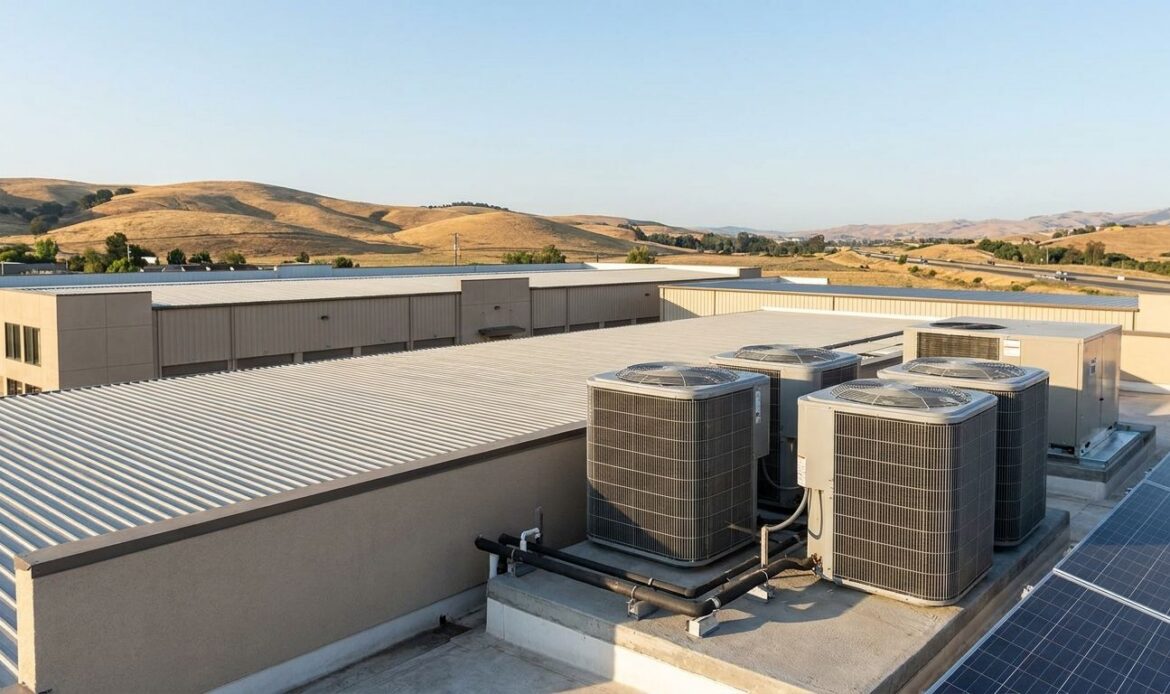
A self-storage facility in Solano County runs on square footage, not square feet of office space — climate-controlled units, long hallways, and a small leasing office all need different comfort strategies, and commercial HVAC for a self storage facility in Solano County has to account for all three at once.
- Packaged rooftop units are the right call for climate-controlled bays over 20,000 sq ft — Buy.
- Ductless mini-splits handle the leasing office alone; don’t extend them across the whole facility — Buy for office only.
- Skip a single central system for the whole building — zoning failures are the top complaint from Solano County operators in 2026.
- Humidity control below 55% relative humidity is non-negotiable for climate-controlled storage — Consider dehumidification add-ons a requirement, not an upgrade.
Why this matters
Self-storage operators lose tenants over two things: security incidents and mold claims. HVAC failures cause the second one directly, and a single undersized or poorly zoned system can turn a climate-controlled unit into a humidity trap within days during a Solano County summer, when outdoor temps regularly clear 95°F in Vacaville and Fairfield. Getting commercial HVAC services in Solano County sized and zoned correctly on day one avoids callback repairs that eat into margin for years.
Who this is for
This guide is for owners and property managers running a self-storage facility in Solano County — whether that's a single-story climate-controlled building in Vacaville, a mixed drive-up and indoor facility in Fairfield, or a multi-building complex in Vallejo. If your facility has a leasing office, a break room, and rows of climate-controlled units under one roof, the equipment decisions below apply directly to you.
What to look for in commercial HVAC for a self-storage facility
Zone independence
A self-storage building is really three buildings in one: the office, the hallways, and the climate-controlled units. One thermostat controlling all three means the office runs cold to keep the units dry, or the units run warm to keep the office comfortable. Independent zoning lets each area hit its own target without fighting the others.
Humidity control, not just temperature
Tenants pay a premium for climate-controlled storage specifically to protect furniture, electronics, and documents from moisture damage. A system that hits 72°F but lets relative humidity climb past 60% is still failing the tenant, even if the thermostat reads fine.
Equipment reliability with minimal on-site staff
Most self-storage facilities run with one or two staff members, sometimes none after hours. A rooftop unit that fails at 6 p.m. on a Friday in July can sit undetected until Monday unless the system flags it. Reliability and remote alerting matter more here than in a fully staffed office building.
Energy cost across large square footage
A typical Solano County facility runs 30,000 to 80,000 square feet of conditioned or semi-conditioned space. Even a 10% efficiency gap on equipment translates into real monthly cost at that scale, so SEER2 ratings and duty cycle matter more than sticker price.
Installation and service access
Rooftop units keep service technicians off the facility floor and away from tenant units, which matters for security-conscious operators. Ground-mounted or unit-mounted equipment can require access through occupied storage areas, which slows down maintenance and raises liability questions.
Permits and code compliance
Solano County requires permits for most commercial HVAC installations and replacements, and inspection delays can push a project timeline out by weeks if paperwork isn't handled up front. A contractor familiar with the local permitting process avoids surprises mid-installation.
Top picks for self-storage HVAC in Solano County
Packaged rooftop units — the workhorse pick
Rooftop units (RTUs) are the standard for climate-controlled storage bays because they keep equipment off the facility floor and scale in 3-to-5-ton increments as square footage grows. A facility running 40,000 square feet of climate-controlled space typically needs six to eight 5-ton units split across zones rather than one oversized unit trying to cover everything.
RTUs are proven for large open spaces, and Solano County's rooftop access rules are straightforward for single-story commercial buildings. Verdict: Buy for any climate-controlled bay over 15,000 square feet.
Ductless mini-splits for the leasing office — the flexible pick
The leasing office and break room don't need commercial-grade tonnage — they need fast temperature response and low install disruption. A ductless mini-split installation in Solano County handles a 300-to-800-square-foot office in a day or two, with no ductwork tie-in to the main facility system.
Keeping the office on its own mini-split also means a failure in the office unit doesn't touch climate control in the storage bays, and vice versa. Verdict: Buy for office and break room zones only — don't extend mini-splits across full storage bays.
Heat pump systems for dual heating and cooling — the efficient pick
Heat pumps handle both heating and cooling from one system, which cuts equipment count for facilities that need winter heat in the office or in any occupied space. Modern heat pump systems rated for Solano County's climate maintain output efficiently down into the high 30s, which covers all but the coldest nights the county sees.
A heat pump repair in Solano County or new installation makes sense where the facility has year-round occupied space and wants to consolidate equipment. Verdict: Consider for facilities with meaningful winter heating needs; Skip if the facility is cooling-only.
Dehumidification add-ons — the moisture control pick
Standard air conditioning cools air but doesn't always pull humidity down fast enough for climate-controlled storage promises. A dedicated dehumidification system, run alongside the primary HVAC, holds relative humidity at or below 55% consistently, which is the threshold most climate-controlled storage marketing implies to tenants.
This is the piece facilities skip to save on upfront cost, and it's the piece that generates mold claims eighteen months later. Verdict: Buy for any facility marketing itself as climate-controlled.
Building management and remote monitoring — the low-staff pick
A basic zoning and monitoring system flags temperature or humidity drift before it becomes a tenant complaint, and it alerts staff to equipment failure without someone walking the halls daily. For a facility running with one or two on-site staff, this closes the gap between a Friday-night failure and a Monday-morning tenant call.
Verdict: Consider for any facility over 30,000 square feet or running with limited on-site staff.
Get a self-storage HVAC quote
Zoning, humidity control, and rooftop sizing reviewed for your facility.
What to avoid
- Residential-grade split systems sized for houses. They look cheaper on the quote, but they're not built for the duty cycle of a commercial building running near-continuous in Solano County summers, and they fail within a season or two under that load.
- One central system for the entire building. It looks simpler and cheaper to install, but it means the office and the storage bays are always fighting each other's setpoint, and a single failure takes down the whole facility instead of one zone.
- Skipping dehumidification to save on upfront cost. It looks like a reasonable line-item cut, but it's the fastest way to end up with a mold claim from a tenant storing furniture or documents.
Comparison at a glance
| System | Zone independence | Humidity control | Best for |
|---|---|---|---|
| Packaged rooftop units | High | Moderate (needs add-on) | Climate-controlled bays 15,000+ sq ft |
| Ductless mini-splits | High (single zone) | Moderate | Office and break room only |
| Heat pump systems | High | Moderate | Facilities needing winter heat |
| Dehumidification add-on | N/A (supplemental) | High | Any climate-controlled facility |
| Building management system | N/A (monitoring) | N/A (monitoring) | Facilities with limited on-site staff |
Before signing off on a system, confirm the contractor is how to choose an HVAC contractor in the Bay Area-vetted for commercial permitting in Solano County specifically — county permitting timelines differ from Sonoma or Napa, and a contractor unfamiliar with local inspection requirements can add weeks to a project.
FAQ
What size HVAC system does a self-storage facility need in Solano County?
Most climate-controlled facilities need multiple 3-to-5-ton rooftop units split across zones rather than one large system. A 40,000-square-foot climate-controlled facility typically runs six to eight 5-ton units, sized by zone rather than total square footage alone.
Is a heat pump better than a rooftop AC unit for a storage facility?
Heat pumps make sense when the facility needs both heating and cooling in occupied space, like an office. For pure cooling in storage bays, packaged rooftop units are usually the more cost-effective choice.
How much humidity control does climate-controlled storage actually need?
Relative humidity should stay at or below 55% to protect stored furniture, electronics, and documents. Standard air conditioning alone often doesn’t hit that target consistently, which is why a dedicated dehumidification add-on matters.
Can one HVAC system serve both the office and the storage units?
It can, but it shouldn’t. Running the office and storage bays on separate zones or separate systems avoids the setpoint conflicts that come from trying to serve two very different spaces with one thermostat.
Do self-storage facilities in Solano County need permits for HVAC installation?
Yes. Solano County requires permits for most commercial HVAC installations and replacements, and inspection delays can extend a project timeline if paperwork isn’t submitted correctly up front.
How often should commercial HVAC be serviced at a self-storage facility?
Twice-yearly maintenance, once before summer and once before winter, catches most failures before they become tenant-facing problems. Facilities running near-continuous cooling in summer benefit from a mid-season check as well.
What’s the biggest HVAC mistake self-storage operators make?
Skipping zoning and dehumidification to save on upfront cost. Both show up later as tenant complaints or mold claims that cost more to resolve than the equipment would have cost to install correctly.
One last thing
The facilities that avoid mold claims in 2026 aren't running the most expensive equipment — they're running the most consistent monitoring. A humidity sensor that alerts staff at 58% relative humidity, before it hits the 60% threshold where damage starts, costs far less than the equipment upgrade needed to fix a facility-wide moisture problem after the fact.
Related guides