

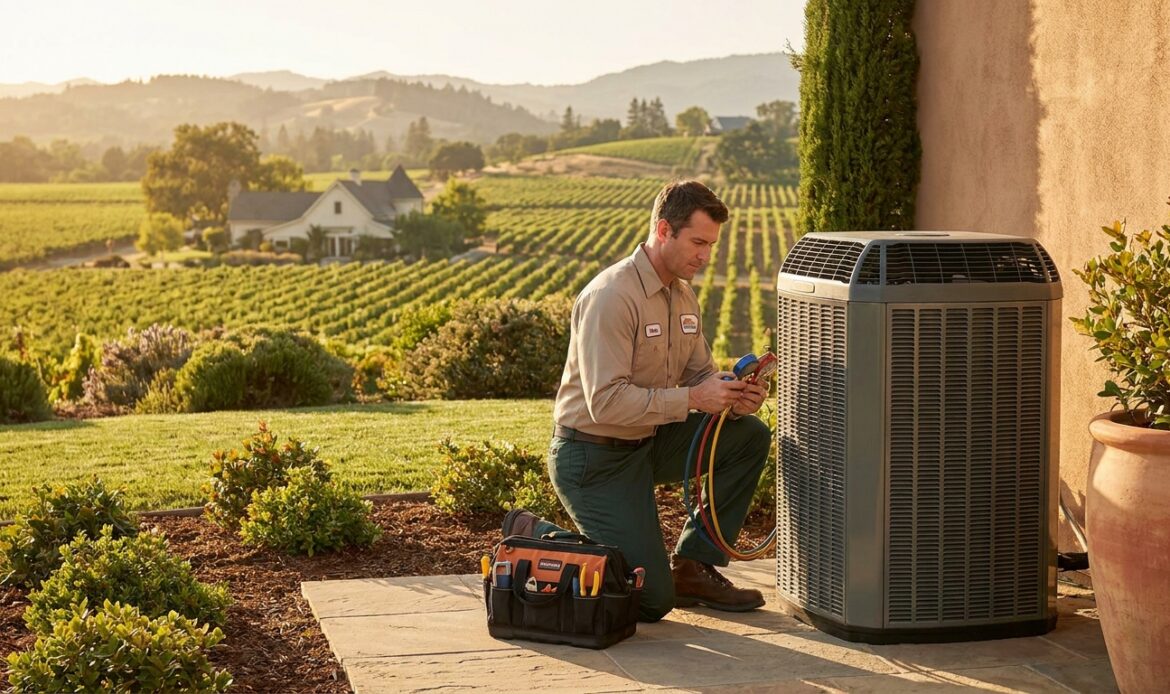
An AC tune-up in Napa isn't a luxury add-on — it's the one appointment that decides whether your system survives August without a breakdown call. This guide breaks down what a real tune-up should include, who needs one before the 2026 heat season, and which Comfort Factor service fits your situation.
TL;DR
An ac tune up in Napa should run 60-90 minutes, cover refrigerant charge, coil cleaning, electrical testing, and airflow, and cost far less than an emergency repair mid-July. Homeowners with systems 5-10 years old need this every spring; anyone whose AC is already struggling should skip the tune-up and go straight to repair. Verdict: schedule a tune-up before Memorial Day 2026 if your system is over 3 years old — Comfort Factor's Napa techs catch capacitor and refrigerant issues before they turn into no-cool calls.
Why this matters
Napa summers push past 95°F for weeks at a stretch, and AC units that limped through 2025 without a check-up are the ones failing on the hottest day of 2026. A tune-up isn't cosmetic — a system running low on refrigerant by even 10% can use up to 20% more energy to deliver the same cooling, according to industry efficiency data cited by ENERGY STAR. That's real money on a Napa PG&E bill every single month of summer.
The other reason it matters: most AC failures don't happen out of nowhere. A weak capacitor, a dirty coil, or a clogged filter builds up over months and then fails on the one day you need cooling most. Catching it in April costs a fraction of an emergency dispatch in July.
Who this is for
This guide is for Napa homeowners with a central AC or ductless system that's 2 years or older, especially anyone who hasn't had a professional check the unit since it was installed. If you're already on one of Comfort Factor's seasonal HVAC maintenance plans, a tune-up is likely already scheduled — this is for everyone else who's been putting it off.
It's also for anyone who bought a Napa home in the last year and has no service history on the HVAC system. You don't know what the last owner skipped, and a tune-up is the cheapest way to find out before you're stuck without cooling in July 2026.
What to look for in an AC tune-up for Napa homes
Full refrigerant charge check
Refrigerant doesn't get "used up" like gas in a car — if the level is low, there's a leak somewhere in the system. A real tune-up checks the charge against manufacturer specs, not just a quick gauge glance, because an undercharged system in Napa's dry heat will short-cycle and wear out the compressor faster.
Coil cleaning, inside and out
Napa's dust and pollen load, especially near vineyard properties, coats outdoor condenser coils fast. Dirty coils force the compressor to work harder for the same output, and that shows up directly on your summer electric bill.
Electrical and capacitor testing
Capacitors are the single most common point of AC failure, and heat stress accelerates their decline — a capacitor rated for 5-10 years can fail in 3 if it's been running through repeated 100°F+ days. A tune-up tests capacitor readings against spec, not just a visual check.
Filter and airflow verification
A restricted filter chokes airflow across the whole system, forcing the coil to run colder than it should and risking a frozen evaporator coil in the middle of summer. This should be a five-minute check every visit, not an afterthought.
A written report, not a verbal "looks fine"
You want documented readings — refrigerant pressure, capacitor microfarads, temperature split across the coil — not a tech saying everything's good and walking off. Documentation is what tells you whether next year's tune-up shows improvement or decline.
Top picks by situation
The routine reset — for systems under 10 years old with no current symptoms. One number that matters: a properly tuned system typically runs a 18-22°F temperature split between return and supply air. If your tech measures within that range, you're set for the season. Verdict: Schedule now, before the spring rush.
The pre-heat-wave rescue — for units already showing weak airflow or uneven cooling room to room. If the tune-up reveals a coil or compressor issue beyond a cleaning and recharge, and the unit is past 12-15 years old, central AC installation in Napa is the more honest recommendation than another patch job. Verdict: Consider replacement if the tech flags compressor wear.
The ductless refresh — for homes running mini-splits in additions, ADUs, or converted spaces. Ductless systems need coil and filter service too, and if the existing unit can't keep up with a newer room addition, ductless AC installation in Napa covers zones a tune-up alone can't fix. Verdict: Buy the tune-up first — upgrade only if capacity is the real problem.
The no-cool emergency — for anyone whose AC is dead right now, not "acting weird." Skip the tune-up conversation entirely and call for emergency HVAC repair in Napa — a tune-up won't fix a system that isn't running at all. Verdict: Skip the tune-up, book same-day repair.
What to avoid
- Flat-fee "tune-ups" with no documented readings. If the invoice doesn't show refrigerant pressure or capacitor numbers, you paid for a filter swap, not a diagnostic.
- Tune-ups sold as a lead-in to a hard sales pitch. A legitimate visit flags real issues; it doesn't scare you into a same-day system replacement without measured data.
- Skipping the tune-up because the unit is "new." New installs still need a first-year check — refrigerant charge and airflow settings often need fine-tuning after the first full summer.
Verdict comparison
| Scenario | Best for | Key number to watch | Verdict |
|---|---|---|---|
| Routine reset | Systems under 10 years, no symptoms | 18-22°F temp split | Schedule now |
| Pre-heat-wave rescue | Weak or uneven airflow | 12-15+ years old unit | Consider replacement |
| Ductless refresh | Additions, ADUs, mini-splits | Zone capacity mismatch | Tune-up first, upgrade if needed |
| No-cool emergency | AC not running at all | 0% output | Skip tune-up, book repair |
FAQ
What's the best time of year for an AC tune-up in Napa?
March through May, before the first 90°F stretch hits. Booking a 2026 tune-up in early spring avoids the summer backlog when every HVAC company in Sonoma and Napa counties is slammed with no-cool calls.
How much does an AC tune-up cost in Napa?
Costs vary by system size and condition, so get a direct quote rather than relying on a national average — check current pricing directly with Comfort Factor for your specific unit.
Is a tune-up worth it if my AC seems fine?
Yes — most refrigerant leaks and capacitor weaknesses don't produce symptoms until the unit is under real load on a hot day. A spring tune-up catches issues before they become July emergencies.
How long does an AC tune-up take?
A thorough tune-up runs 60-90 minutes for a standard residential system. Anything wrapped up in 15 minutes skipped steps.
Do ductless mini-splits need tune-ups too?
Yes. Ductless systems still need coil cleaning, filter checks, and refrigerant verification — skipping this shortens their lifespan just like a central system.
Can a tune-up prevent a full AC breakdown?
It catches the most common failure points — capacitors, refrigerant charge, dirty coils — before they cause a total system failure. It can't fix a compressor that's already failing.
Should I get a tune-up before or after buying a new AC?
If you're buying a Napa home with an unknown HVAC history, get a tune-up and inspection first. It tells you whether you're maintaining an existing system or need to budget for replacement.
Is an AC tune-up different from AC maintenance?
Not meaningfully — most contractors use the terms interchangeably for the same seasonal inspection and service visit.
One last thing
The number most Napa homeowners never check: capacitor readings. A capacitor rated at 30 microfarads that's drifted to 24 will still run the AC — right up until the first 100°F day of 2026, when it won't start at all. That's the failure a tune-up catches that a homeowner walking past the outdoor unit never would.