

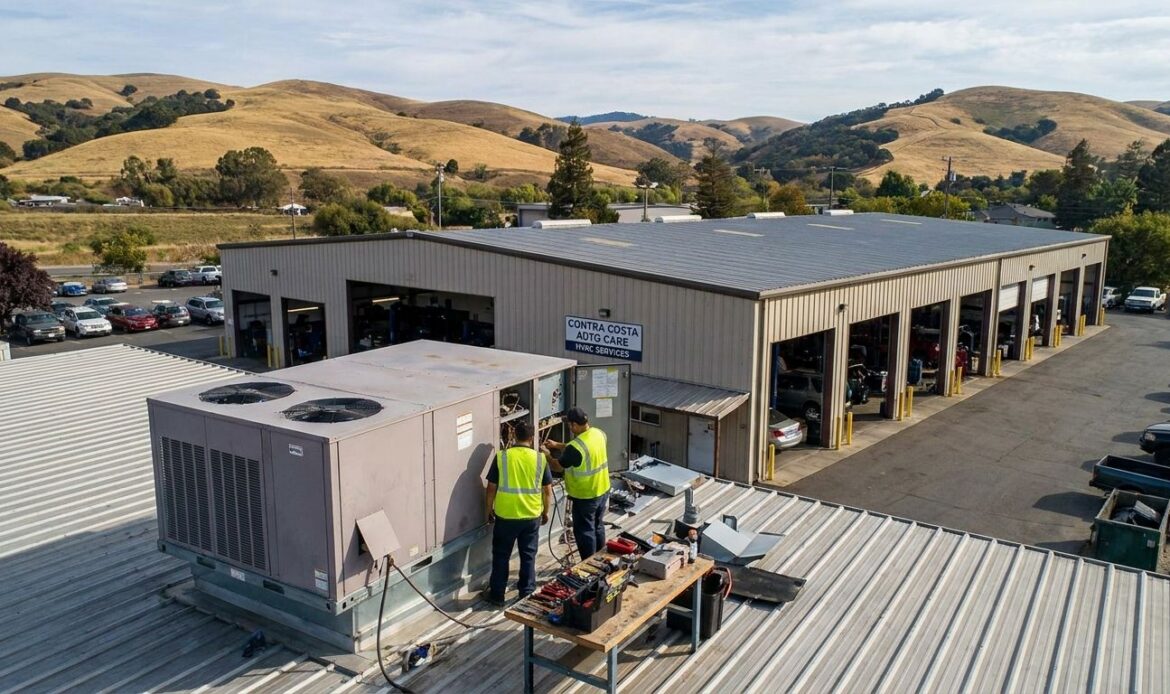
An auto repair shop runs on airflow the same way it runs on labor hours: open bay doors, running exhaust extractors, and grease-heavy dust all fight against whatever heating and cooling system you install. This guide breaks down what commercial HVAC for an auto repair shop in Contra Costa County actually needs to handle, and which configurations hold up.
- Auto repair shops need zoned commercial HVAC, not one office-grade system covering shop floor and waiting room together.
- Make-up air matters more than tonnage: a bay door left open for a minute can pull conditioned air out fast.
- Heat pump installation in Contra Costa County cuts office and waiting-room energy use while bays stay on a separate system.
- Standard residential-grade filters clog with grease and metal dust inside 60 to 90 days in a working shop.
- Rooftop packaged units with dedicated make-up air are the workhorse pick for 2026 shop retrofits.
Why this matters
Contra Costa County runs a wide temperature swing — Concord and Antioch hit the high 90s in July, Richmond and the shoreline cities stay 15 to 20 degrees cooler most afternoons. A shop built for one microclimate underperforms in another, and an auto repair bay adds a variable most HVAC contractors never see in a house or office: doors that open dozens of times a day.
Undersized or mismatched commercial HVAC services in Contra Costa County show up as comfort complaints from techs working under vehicles in 55-degree bays in January, or customers walking into an 85-degree waiting room in August because the office shares ductwork with an uninsulated shop floor. Fixing that after the fact costs more than specifying it correctly in 2026.
Who this is for
This guide is written for owners and facility managers of independent auto repair shops, tire centers, and light collision shops in Contra Costa County — Concord, Walnut Creek, Antioch, Pittsburg, Richmond, and Martinez — running 2 to 12 service bays with an attached office or customer waiting area. If your building mixes a conditioned retail or office zone with an open shop floor, the sizing and zoning problem below applies directly to you.
What to look for in commercial HVAC for an auto repair shop
Split-zone capacity
Your shop floor and your customer-facing space need to run as separate zones, not one shared system. Techs working near open bays tolerate a wider temperature range than a customer sitting in a waiting room, and running both off one thermostat means someone is always uncomfortable. A two-zone or three-zone setup — shop floor, office, waiting room — is the baseline spec for 2026, not an upgrade.
Make-up air and ventilation
Every time a bay door opens, conditioned air leaves and unconditioned air, along with any drifting exhaust, comes in. Shops running vehicle lifts and exhaust extraction systems need dedicated make-up air units sized to the number of active bays, not a single rooftop unit trying to recondition the whole volume after every door cycle. Skipping this is the single most common reason a "new" commercial HVAC install still feels wrong six months later.
Recovery time after bay doors open
A system rated correctly for square footage can still struggle if its recovery time — how fast it gets the space back to setpoint after a door opens — is too slow. Shops that cycle doors 20+ times a day need equipment with faster recovery than the tonnage chart alone would suggest, which is why load calculations for auto shops run higher than a warehouse of the same square footage.
Rooftop unit accessibility and load capacity
Most auto repair buildings in Contra Costa County are steel-frame or tilt-up concrete with a flat or low-slope roof, which makes rooftop packaged units the practical mounting choice. Confirm the roof structure can carry the unit's weight and that curb placement doesn't sit directly over a lift or paint booth exhaust path — a detail a lot of quick retrofits miss.
Filtration for dust, grease, and metal particulate
Grinding, brake work, and general shop dust load filters faster than in any office building. Standard MERV 8 residential-grade filters common in office HVAC clog in 60 to 90 days in a working bay; shops running heavier fabrication or brake work need a filtration plan built around that cycle, not a generic quarterly schedule.
Maintenance built for continuous-duty operation
A shop system runs longer hours under harder conditions than a typical office. Maintenance intervals that work fine for a retail store are too infrequent for a shop running compressors, lifts, and exhaust fans on the same electrical service. Build the maintenance plan around actual duty cycle, not a default calendar reminder.
Get a shop HVAC quote
Comfort Factor sizes commercial systems for Contra Costa County auto shops.
Top picks for auto repair shop HVAC
Rooftop packaged unit with dedicated make-up air — the workhorse pick. Sized in the 7.5 to 20-ton range depending on bay count, this configuration handles the shop floor's volume while a separate make-up air unit replaces what bay doors let escape. It's the standard 2026 spec for shops running 4 or more bays. Buy if your building has 4+ bays and doors that open more than a dozen times a shift.
Heat pump for the office and waiting room — the efficiency play. A heat pump handles both heating and cooling for the smaller, tighter-sealed office zone, running far more efficiently than resistance heat or a standalone furnace for that square footage. Heat pump installation in Contra Costa County pairs well with a rooftop unit on the shop side, keeping the two zones on separate equipment entirely. Buy for any shop where the customer-facing space is under 1,500 square feet.
Ductless mini-split zones for small offices or break rooms — the flexible add-on. Where running new ductwork into a back office or break room isn't practical, ductless heads solve the zoning problem without touching the shop floor's system at all. Consider this for retrofits where opening walls for ductwork isn't worth the cost.
Single shared rooftop unit across shop and office — the tempting shortcut. One unit, one thermostat, lower upfront cost. It looks efficient on paper and fails in practice because the shop floor's load swings wreck comfort in the office every time a bay door opens. Skip this unless your shop and office are physically separated by a sealed wall with no shared airflow.
What to avoid
- Sizing off square footage alone. A load calculation that ignores bay door cycles and exhaust fan CFM will undersize the system even if the tonnage math looks right on paper.
- Residential-grade filtration on a shop-floor system. It will clog fast and choke airflow long before the next scheduled service visit.
- Skipping make-up air to save on install cost. It's the piece that gets cut first on tight bids and the piece that causes the most comfort complaints afterward.
Verdict comparison
| Configuration | Best for | Recovery after door open | Verdict |
|---|---|---|---|
| Rooftop unit + make-up air | 4+ bay shops | Fast | Buy |
| Heat pump for office/waiting room | Offices under 1,500 sq ft | N/A (sealed zone) | Buy |
| Ductless mini-split zones | Small back offices, retrofits | Fast (isolated zone) | Consider |
| Single shared rooftop unit | Nothing recommended here | Slow | Skip |
FAQ
What size HVAC system does an auto repair shop need?
Most 4 to 8 bay shops in Contra Costa County run 7.5 to 20-ton rooftop units on the shop floor, sized by bay door cycle frequency and exhaust CFM, not square footage alone. Office and waiting-room zones are sized separately, usually 2 to 5 tons.
Is a heat pump better than a furnace for an auto shop office?
A heat pump handles both heating and cooling in one system and runs more efficiently than a furnace-plus-AC setup for a sealed office zone. It doesn’t replace the shop floor’s rooftop system, which needs make-up air the office doesn’t require.
How often should HVAC filters be changed in an auto repair shop?
Shop-floor filters need checking every 30 to 60 days because grinding dust and grease load them faster than office-grade filtration. Office and waiting-room zones can typically run on a standard quarterly schedule.
Does an auto repair shop need separate HVAC zones?
Yes, splitting the shop floor from the office and waiting room into separate zones prevents bay-door temperature swings from disrupting customer-facing comfort. A shared single system almost always underperforms in one zone or the other.
What is make-up air and why does an auto shop need it?
Make-up air replaces conditioned air lost every time a bay door opens, which happens dozens of times a day in an active shop. Without it, the main system spends most of its capacity just recovering from door cycles instead of maintaining setpoint.
Can ductless mini-splits work in an auto repair shop?
Ductless mini-splits work well for small offices or break rooms where running new ductwork isn’t practical, but they aren’t a substitute for a rooftop system on an open shop floor. They’re best used as a targeted add-on, not the primary shop-floor solution.
How much does commercial HVAC cost for an auto repair shop in Contra Costa County?
Cost depends on bay count, whether make-up air is added, and whether existing ductwork or rooftop curbs can be reused. Get a site-specific quote rather than estimating from square footage alone, since load calculations for shops run higher than for a comparable office.
One last thing
The detail that gets missed most in shop HVAC planning isn't tonnage — it's rooftop curb placement relative to paint booth and exhaust fan discharge points. Put a rooftop unit's intake too close to an exhaust discharge and you're recirculating fumes into the same air you just paid to condition. Walk the roof plan before the unit gets ordered, not after it's installed.
Related guides