

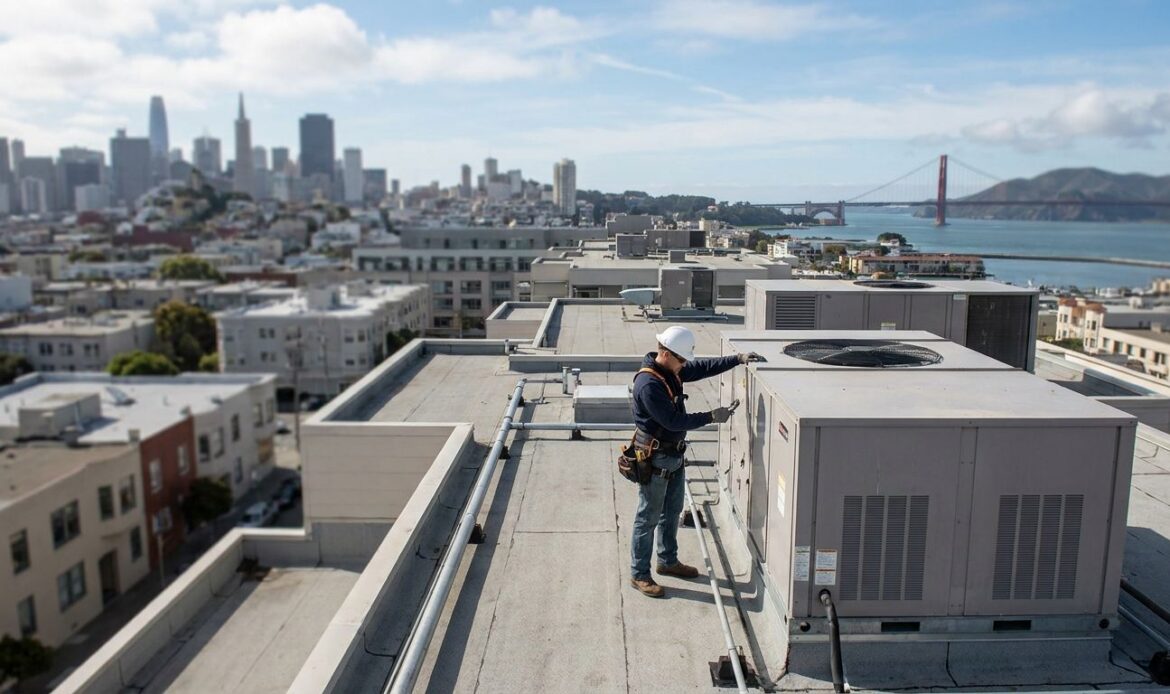
Commercial HVAC downtime costs more than a repair bill — it costs lost revenue, spoiled inventory, and customers who leave for a competitor with working air conditioning. This guide ranks the maintenance plan types that actually protect Bay Area commercial buildings in 2026, and tells you which one fits your property.
- Quarterly Preventive Maintenance Plans win for most Bay Area offices and retail spaces in 2026 — Buy.
- Priority Response Contracts are worth the premium for restaurants, breweries, and medical offices that can’t tolerate downtime.
- Basic Filter & Inspection Plans are a Skip for any building running equipment older than 10 years.
- Multi-site portfolios save the most per building once you cross 3+ properties under one contract.
Why this matters
A commercial rooftop unit that fails in July during a Sonoma County heat wave doesn't get fixed same-day just because you ask nicely. Contractors triage by contract status first. Buildings on an active commercial HVAC maintenance plan get scheduled ahead of walk-in calls, and that scheduling priority is the real value most property managers underweight when comparing plans on price alone.
The difference between a $400/year filter-swap contract and a $2,000/year full-service plan isn't the filters. It's what happens the week your compressor starts short-cycling in August 2026 and every HVAC crew in Sonoma and Marin counties is booked solid.
How this list is ranked
Each plan tier below is scored against four things that matter specifically for Bay Area commercial buildings: response-time commitment, coverage scope (parts vs. labor vs. both), fit for local risk factors like wildfire smoke season and heat waves, and total cost of ownership over a 5-year equipment life. Plans that only cover a filter swap and a visual inspection rank lower even when they're cheaper, because they don't reduce the breakdown risk that actually drives commercial HVAC costs.
The ranked list
1. Quarterly Preventive Maintenance Plan — the workhorse choice
Four visits a year, each covering coil cleaning, refrigerant charge checks, belt and bearing inspection, and thermostat calibration. This is the tier that catches a failing capacitor in March before it strands your building without cooling in a June heat wave.
Most office buildings, retail stores, and light commercial spaces across Contra Costa and Solano counties run on this tier because it matches the four-season maintenance rhythm California's climate actually demands — one visit before summer, one before winter, and two in between. Verdict: Buy for any single-tenant commercial building under 20,000 square feet. See how this applies to an office building maintenance program in Contra Costa County.
2. Priority Response Maintenance Contract — the safety net
This tier adds a guaranteed 24-48 hour response window on top of scheduled visits, plus after-hours dispatch for revenue-critical failures. Restaurants, tasting rooms, and medical offices lean on this tier because a same-day AC outage isn't an inconvenience — it's a closed business.
A Sonoma County brewery running fermentation-sensitive HVAC zones can't wait three days for a callback in the middle of harvest season. Verdict: Buy for any building where an HVAC outage stops revenue within hours, including the kind of setup covered in commercial HVAC for a brewery in Sonoma County.
3. Full-Service Partnership Plan — the all-in option
Combines quarterly preventive visits with parts and labor coverage on covered repairs, plus priority scheduling. This is the tier that turns an unpredictable repair budget into a flat annual number, which matters for property managers reporting to ownership groups.
The tradeoff is cost: this tier runs meaningfully higher than a quarterly-only plan, and it only pays off if your equipment is under 12 years old and still worth protecting. Verdict: Consider for buildings with equipment in the 5-12 year range; Skip if your units are already past 15 years and due for replacement instead of protection.
4. Basic Filter & Inspection Plan — the bare minimum
Two visits a year, filter changes, and a visual check. No refrigerant testing, no coil cleaning, no priority scheduling. It's the cheapest line item on most vendor quotes, and it's the one most likely to leave you stranded during a July breakdown because the technician who could've caught a failing contactor in April never looked past the filter rack.
Verdict: Skip for any commercial building with equipment older than 10 years or any occupancy where downtime costs money per hour.
5. Custom Multi-Site Portfolio Plan — for property managers with multiple buildings
Bundles quarterly maintenance and response-time guarantees across three or more properties under one contract, one invoice, and one point of contact. Per-building cost typically drops once a portfolio crosses that three-property threshold, because scheduling and travel overhead spread across more service visits.
A warehouse operator with sites across Solano County or a retail chain with locations across the Bay Area gets more leverage negotiating a single multi-site contract than juggling separate vendor relationships. Verdict: Buy for any operator managing 3+ commercial properties, including the kind of footprint described for a warehouse in Solano County.
Comparison table
| Plan tier | Visits/year | Response time | Best for | Verdict |
|---|---|---|---|---|
| Quarterly Preventive | 4 | Standard scheduling | Offices, retail, light commercial | Buy |
| Priority Response Contract | 4 | 24-48 hrs guaranteed | Restaurants, breweries, medical | Buy |
| Full-Service Partnership | 4 + repairs | Priority scheduling | Equipment 5-12 years old | Consider |
| Basic Filter & Inspection | 2 | None | Nothing with real downtime risk | Skip |
| Custom Multi-Site Portfolio | 4 per site | Guaranteed, bundled | 3+ properties | Buy |
“The cheapest maintenance plan is only cheap until the compressor fails during the one week every technician in the county is booked solid.”
Where to source a plan
- Match the plan to your equipment age, not your budget line item. A 3-year-old rooftop unit doesn't need parts-and-labor coverage; a 12-year-old one does.
- Ask about response-time guarantees in writing, not in the sales pitch. "We'll try to get to you fast" is not a contract term.
- Confirm the plan covers wildfire smoke season prep. Filtration checks before Sonoma and Napa county fire season are a different service than a routine spring tune-up, and not every basic plan includes it — see what's involved in preparing HVAC for wildfire smoke season.
Get a commercial HVAC maintenance quote
Comfort Factor covers commercial buildings across Sonoma, Marin, Napa, Solano, and Contra Costa counties.
What to avoid
- A plan with no response-time commitment. If the contract doesn't name a window, there isn't one — you're back of the line during peak season like everyone else.
- A plan priced by square footage alone, ignoring equipment age. A 20,000-square-foot building with a 3-year-old system needs less coverage than a 10,000-square-foot building running units from 2011.
- Skipping a plan entirely because your building "hasn't had problems." Commercial units fail without warning after 10-15 years of runtime, and a system with no maintenance history is the hardest one to diagnose fast when it does.
FAQ
What’s the best HVAC maintenance plan for a commercial building in the Bay Area?
A quarterly preventive maintenance plan is the best fit for most Bay Area offices, retail spaces, and light commercial buildings in 2026. Buildings with revenue-critical uptime needs, like restaurants or medical offices, should add a priority response guarantee on top.
How much does commercial HVAC maintenance cost in California?
Cost varies by building size, equipment count, and coverage scope, with basic filter-and-inspection tiers priced lowest and full-service parts-and-labor plans priced highest. Get a specific quote based on your building’s equipment count rather than relying on a flat per-square-foot estimate.
How often should commercial HVAC systems be serviced?
Most commercial systems in the Bay Area need service at least twice a year, and quarterly visits catch more failures before they become breakdowns. Buildings running equipment through wildfire smoke season or heavy summer cooling loads benefit from the additional two visits.
Is a maintenance contract worth it for a small retail space?
Yes, if the space depends on customer comfort to stay open during business hours. A single AC outage during a Petaluma or Napa summer weekend can cost more in lost sales than a year of preventive maintenance.
What’s included in a commercial HVAC maintenance visit?
A standard visit covers coil cleaning, refrigerant level checks, belt and bearing inspection, filter replacement, and thermostat calibration. Full-service tiers add covered parts and labor on top of the inspection.
Can a maintenance plan help with wildfire smoke season?
Yes, plans that include filtration checks ahead of fire season reduce the risk of smoke infiltration through a poorly sealed or under-maintained system. This matters most for buildings in Sonoma and Napa counties where fire season overlaps directly with peak cooling demand.
Do multi-site businesses need a different plan?
Businesses managing three or more commercial properties typically get better per-building pricing under a bundled multi-site contract than separate agreements. It also simplifies vendor management to one point of contact and one service history across all locations.
What happens if I skip maintenance in year one?
Skipping maintenance doesn’t cause immediate failure, but it removes the early-warning inspection that catches a failing capacitor or refrigerant leak before it becomes an emergency repair. Most commercial breakdowns traced back to skipped maintenance show up in year two or three, not year one.
One last thing
The plan tier matters less than the trigger point: schedule the first preventive visit before the season that stresses your equipment most, not after. A Bay Area commercial building that gets its cooling system inspected in April 2026, ahead of summer load, catches failures a June-scheduled visit would miss entirely because the system hasn't been pushed hard enough yet to show the symptom.
Related guides
- Commercial HVAC services in Sonoma County
- How to choose an HVAC contractor in the Bay Area
- Commercial HVAC for a retail store in the Bay Area