

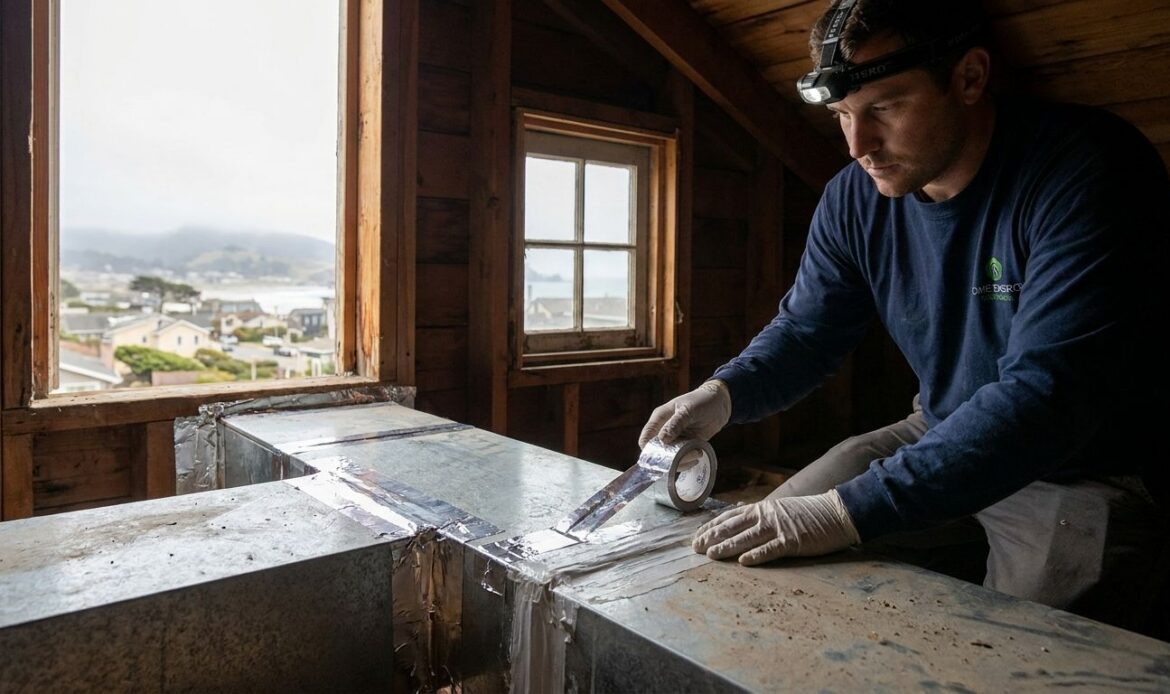
Leaky ductwork is the reason a furnace or heat pump runs hard while a house still feels uneven, and duct sealing bay area contractors get asked about most often centers on old attic runs in Sonoma, Marin, Napa, Solano, and Contra Costa county homes. The right fix depends on duct material, attic access, and how much of the run sits exposed to summer heat or wildfire smoke.
- Mastic sealant is the safe pick for most Bay Area duct systems built before 2000 — Buy.
- Aeroseal works best on hard-to-reach runs behind finished ceilings — Consider.
- Cloth-backed duct tape fails within a few seasons despite the name — Skip.
- The U.S. Department of Energy estimates 20-30% of conditioned air escapes through duct leaks before reaching a vent.
- California’s Title 24 code sets duct insulation minimums between R-6 and R-8 in unconditioned attics.
Why this matters
A duct system with unsealed joints is working against the equipment attached to it. The furnace or heat pump cycles longer, the attic (which regularly tops 120°F in valley towns like Napa and Concord during summer) leaks that superheated air straight into the supply side, and the thermostat reads a temperature that has nothing to do with what's actually blowing out of the vents.
Comfort Factor sees this pattern across older housing stock in Sonoma and Marin counties: duct sealing is skipped during a system replacement because it's invisible, then the new equipment underperforms and the homeowner blames the unit instead of the ducts. Sealing the distribution side before or alongside an HVAC upgrade is what makes the upgrade actually pay off in 2026.
Who this is for
This guide is for Bay Area homeowners with a forced-air furnace or heat pump system and visible signs of duct loss: rooms that never reach set temperature, a spike in summer power bills, or dust streaking around vent covers. It's especially relevant to owners of homes built before 2000, when duct insulation and sealing standards were far looser than they are today, and to anyone converting to a heat pump who wants the new equipment to actually hit its rated efficiency. If your ductwork also runs through an attic in a wildfire-prone area, sealing does double duty by cutting the path smoke and ash can take into the home — worth reading how to prepare your HVAC for Sonoma County wildfire season alongside this guide.
What to look for in duct sealing for Bay Area homes
Duct material and age
Galvanized sheet metal, flex duct, and duct board each seal differently, and a technician who doesn't check material before quoting a price is guessing. Ductwork older than 15-20 years often has brittle mastic joints and crushed flex sections that need more than a surface reseal — sometimes sections need replacing outright, not just sealed.
Attic access and exposure
Bay Area attics see extreme temperature swings, often over 100°F between winter mornings and summer afternoons, and that cycling is what breaks down old sealant faster than in milder climates. A contractor who inspects the full attic run, not just the accessible first ten feet, catches the leaks that actually matter.
Insulation paired with sealing
Sealing without addressing insulation only solves half the problem. California's Title 24 code calls for duct insulation in the R-6 to R-8 range in unconditioned attics, and pairing that with sealing is what actually stops the summer heat gain and winter heat loss that inflate utility bills.
Testing before and after
A legitimate duct sealing job includes a duct blaster or pressure test before work starts and after it finishes, with numbers to compare. Without that test, there's no way to confirm the leak reduction actually happened — you're paying for labor on faith.
Compatibility with a planned HVAC upgrade
If a heat pump or new furnace install is on the horizon, sealing should happen as part of that project, not as an afterthought. Undersized or leaky ducts are one of the most common reasons a new heat pump underperforms its rating, so sequencing matters as much as the sealing method itself.
Get your ductwork inspected before you seal it
A duct assessment shows exactly where the leaks are before any work starts.
Top picks for sealing methods
Mastic sealant — the reliable pick. Mastic is a water-based paste applied by hand or brush over duct joints, and it's been the standard fix in residential HVAC for decades because it doesn't crack the way tape does over time. It holds up over 20 years when applied correctly to clean, dry seams. Verdict: Buy for most Bay Area homes with accessible attic or crawlspace ductwork.
Aeroseal (aerosol-based sealing) — the pick for hard-to-reach runs. The technology was originally developed through Lawrence Berkeley National Laboratory research and works by injecting a fine polymer aerosol into the duct system under pressure, which finds and seals leaks from the inside — including joints buried behind drywall or finished ceilings that a technician could never physically reach. Verdict: Consider when ductwork runs through finished spaces with no attic or crawlspace access.
UL 181-rated foil tape — the supporting-cast pick. Foil-backed tape rated to UL 181 is a legitimate sealing material, but it's meant to reinforce mastic-sealed joints or patch flex duct connections, not carry an entire system's sealing job on its own. Verdict: Consider as a secondary material, never as the primary method.
Full duct section replacement — the last-resort pick. Once ductwork passes 15-20 years old with crushed, disconnected, or torn sections, sealing existing joints doesn't fix a duct that's physically failing. Replacing the worst sections alongside sealing the rest is usually cheaper long-term than repeated patch jobs. Verdict: Buy when an inspection shows structural duct damage, not just leaky joints.
Cloth-backed duct tape — the pick to walk away from. Despite the name, standard cloth duct tape is not rated for HVAC duct sealing and dries out, cracks, and peels within a couple of heating and cooling seasons in attic heat. Verdict: Skip entirely for anything beyond a same-day emergency patch.
What to avoid
- Spray foam sealant applied without a pressure test. It looks thorough because it's messy and visible, but without before/after testing there's no proof it actually reduced leakage where it mattered.
- A quote that skips the attic walkthrough. Any contractor pricing duct sealing sight-unseen from a photo or a phone call is guessing at the scope, and Bay Area attic layouts vary enough that this almost always leads to change orders later.
- Hiring the lowest bid without checking licensing. Unlicensed contractors underbid because they skip permits, insurance, and testing equipment — verifying an HVAC contractor's license in California takes a few minutes and rules out the riskiest bids before you commit.
Verdict comparison
| Method | Best for | Key spec | Verdict |
|---|---|---|---|
| Mastic sealant | Most accessible ductwork | 20+ year service life | Buy |
| Aeroseal | Ducts behind finished ceilings | Injected under system pressure | Consider |
| UL 181 foil tape | Reinforcing sealed joints | UL 181 listing standard | Consider |
| Full section replacement | Ductwork past 15-20 years old | Structural damage present | Buy (when needed) |
| Cloth-backed duct tape | Nothing beyond a same-day patch | Not HVAC-rated | Skip |
FAQ
How much air is actually lost through leaky ducts?
The U.S. Department of Energy estimates 20-30% of conditioned air escapes through duct leaks before it reaches a vent. In a Bay Area attic that regularly hits 120°F in summer, that lost air pulls heat straight into the supply side.
Is duct sealing worth it before installing a heat pump?
Yes — leaky or undersized ductwork is one of the most common reasons a new heat pump underperforms its rated efficiency. Sealing ducts as part of the install, rather than after, avoids paying for capacity the ducts can’t deliver.
How long does mastic sealant last on Bay Area ductwork?
Properly applied mastic sealant holds up over 20 years on clean, dry duct joints. Attic temperature swings that exceed 100°F between seasons are what typically break down lower-quality materials faster.
Is Aeroseal better than mastic sealant?
Aeroseal isn’t better across the board — it solves a different problem. It reaches joints behind finished ceilings that mastic application can’t physically access, but for open attic or crawlspace runs, mastic remains the simpler and cheaper standard.
Does duct tape actually seal ducts?
Standard cloth-backed duct tape is not rated for HVAC use despite the name, and it cracks and peels within a couple of seasons in attic heat. UL 181-rated foil tape is the correct material, and even that works best paired with mastic.
Does duct sealing help with wildfire smoke?
Sealed ductwork closes off one of the main paths smoke and ash use to enter a home’s air supply during wildfire season. It works best combined with filtration upgrades rather than as a standalone fix.
How do I know if my ducts need sealing versus full replacement?
A pressure test shows leak volume, while a visual inspection shows physical damage like crushed flex duct or disconnected joints. Ductwork past 15-20 years old with structural damage usually needs section replacement, not just sealing.
Do I need a permit for duct sealing in California?
Permit requirements vary by county and by whether the work is part of a larger HVAC replacement, so check with the local building department before work starts. A licensed contractor handling the paperwork is one more reason to verify licensing before hiring.
One last thing
The detail most homeowners miss: sealing ductwork without testing before and after is functionally the same as not testing at all — you're trusting the contractor's word instead of a number. Ask for the pre- and post-seal pressure test results before final payment, every time, no exceptions in 2026 or any year after.
Related guides
- How to choose an HVAC contractor in the Bay Area
- Best HVAC systems for wildfire smoke filtration in California