

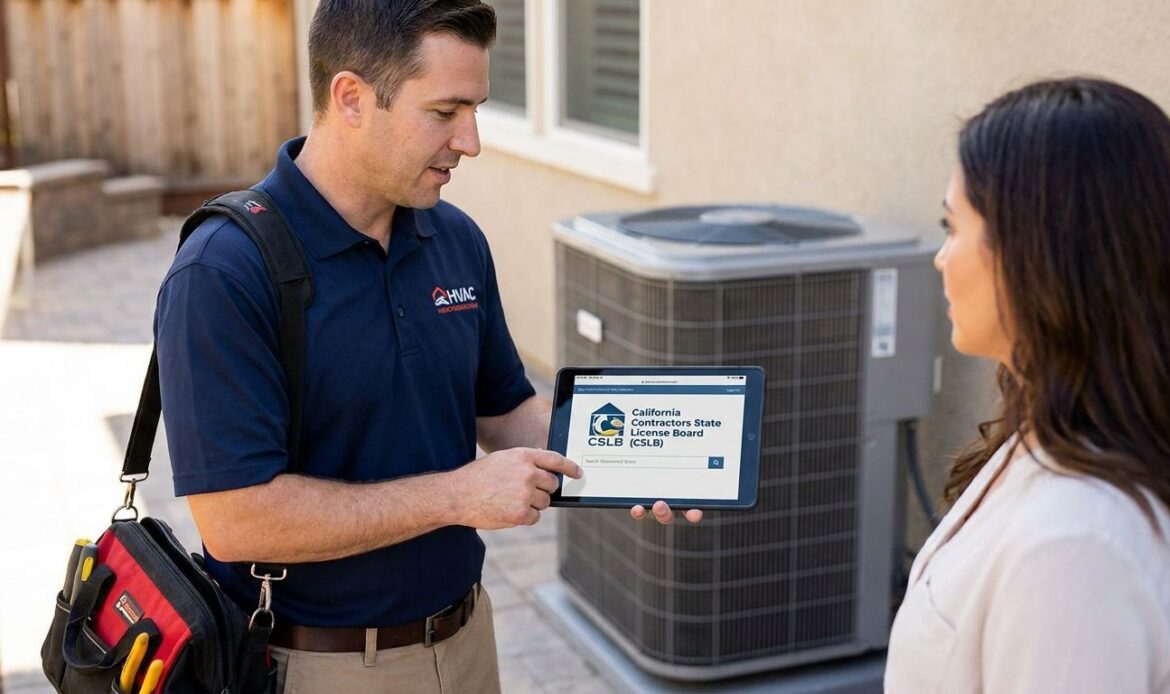
Checking an HVAC contractor's license in California takes about two minutes on one government website, and skipping that step is how homeowners end up with unlicensed installers, voided warranties, and no recourse when the work fails.
- Search any contractor’s name or license number on cslb.ca.gov to confirm how to check HVAC contractor license California status in under two minutes.
- A legitimate HVAC installer carries an active C-20 classification and a current $25,000 contractor bond.
- Ask for the license number before scheduling anything – a contractor who hesitates is the biggest red flag in 2026.
- CSLB’s lookup tool also shows suspensions, bond claims, and disciplinary history going back years.
Why this matters
California requires anyone contracting HVAC work over $500 in labor and materials to hold an active license from the Contractors State License Board (CSLB). No exceptions for "handyman" pricing, no exceptions for a friend-of-a-friend rate.
An unlicensed HVAC job voids most manufacturer warranties on the equipment itself, and if the installer damages your home or gets hurt on your property, an unlicensed contractor typically has no bond and no insurance backing them up. You're the one holding the liability.
The check itself is free, fast, and public. There's no reason to skip it, whether you're comparing bids for a furnace installation in Solano County or hiring for a one-off repair call.
What you'll need
- The contractor's business name exactly as it appears on their estimate or truck signage
- Their CSLB license number, if they've provided one (ask for it if not)
- Five minutes and a phone or computer
- The written bid or contract, so you can cross-check the business name and address
If you're mid-search for a contractor rather than vetting one already on your list, how to choose an HVAC contractor in the Bay Area covers the broader vetting process this license check fits into.
The steps
1. Go to the CSLB license lookup tool
Open cslb.ca.gov and find the "Check a License" or "Verify a Contractor License" search box on the homepage. This is the only official source for California contractor license status – third-party "licensed contractor" directories are not verified against CSLB records.
Don't rely on a screenshot or PDF a contractor sends you. Search the live database yourself every time, even for a contractor you've used before, since a license can lapse or change status between jobs.
Common mistake: searching Google for the business name and trusting the first review site that shows a green "licensed" badge. Review platforms don't verify licensing in real time.
2. Search by license number first, business name second
If the contractor gave you a license number, enter it directly – it's the fastest and most accurate lookup. If you only have a business name, use that field instead; CSLB's search will return partial matches, which helps if you're unsure of the exact legal name.
Business names on invoices sometimes differ from the name on the license (a DBA versus the legal entity). If the search turns up nothing, try the owner's name or the phone number's area code paired with the city.
Common mistake: searching a doing-business-as name that doesn't match CSLB's record for the legal entity, then assuming the contractor is unlicensed. Try the address or the individual's name before ruling it out.
3. Confirm the license classification is C-20
Once you find the record, check the classification code. HVAC work in California requires a C-20 license – Warm-Air Heating, Ventilating and Air-Conditioning. A general B (residential remodeling) license alone doesn't cover HVAC installation or major repair work.
Some contractors hold both a B and a C-20; that's fine and common for companies doing broader remodel work alongside HVAC. What matters is that C-20 (or a relevant HVAC-specific classification) shows up somewhere on the record.
Expected outcome: you see a classification list that includes C-20 next to the contractor's name and license number.
4. Check the license status field
The status will read Active, Expired, Suspended, Revoked, or Inactive. Only Active means the contractor is legally cleared to work. Expired doesn't always mean gone for good – some contractors let a license lapse briefly during renewal – but it means don't sign anything until it's active again.
Suspended or Revoked is a hard stop. CSLB doesn't suspend licenses casually; there's typically a bond claim, unresolved complaint, or disciplinary action behind it.
Common mistake: seeing a license number exists and stopping there without checking status. A license number alone proves nothing if the status is Revoked.
5. Verify the bond and workers' comp fields
Scroll to the bond and insurance section of the record. California requires licensed contractors to carry a $25,000 contractor's bond (raised from $15,000 effective January 1, 2023). If the bond field is blank or shows "none on file," that's a compliance gap worth asking about directly.
Workers' compensation insurance is required for any contractor with employees. CSLB records show a workers' comp status field – check that it's current, not expired.
Expected outcome: bond amount and expiration date both display, and workers' comp shows active coverage if the contractor employs a crew.
6. Read the complaint and legal action history
CSLB publishes a record of disciplinary actions, citations, and bond claims tied to each license. Scroll past the basic status fields to this section before you commit to a bid.
One old, resolved complaint from years ago isn't automatically disqualifying – read what it was for and how it was resolved. A pattern of recent complaints, or an active legal action, is a different story entirely.
Common mistake: ignoring this section because the license shows Active. Active status and a clean complaint history are two separate checks.
7. Cross-check the name and address against your bid
Match the business name, license classification, and physical address on the CSLB record against the estimate the contractor handed you. Scammers sometimes borrow a legitimate license number and attach it to a different, unlicensed operation.
If the address on file is a residential apartment two counties away from where the contractor claims to be based, ask questions before signing.
Expected outcome: the name, address, and classification on your bid match the CSLB record exactly, or close enough to explain (a recent move, a DBA).
Compare a licensed HVAC quote today
Get a straightforward estimate for repair, install, or maintenance work.
Troubleshooting
The license search returns no results. Double-check spelling, try the license number alone with no letters or spaces, or search by the owner's last name. If nothing surfaces after three attempts, the contractor is likely unlicensed.
The contractor won't give you a license number. That's the answer. A licensed HVAC contractor in California has the number memorized or printed on every bid, truck, and invoice by law.
The license shows Active but the classification is wrong (B only, no C-20). Ask directly whether they're subcontracting the HVAC portion to a C-20 licensee. If they can't name that subcontractor and their license, don't proceed.
The bond field shows expired or missing. This is a compliance violation, not a technicality. Contractors are required to maintain a continuous $25,000 bond to hold an active license – a lapse here often means the license itself is at risk.
You found an old complaint and aren't sure if it's disqualifying. Read the complaint type and resolution date. A single resolved payment dispute from 2021 is different from three open complaints filed in 2026.
The address on the license doesn't match the business card. Call CSLB directly at 1-800-321-CSLB (2752) to confirm the license is current and tied to the entity you're hiring, especially for larger jobs like heat pump installation in Contra Costa County.
Tools and resources
- CSLB license lookup – cslb.ca.gov, the only authoritative source for status checks
- CSLB consumer hotline – 1-800-321-CSLB (2752) for phone verification
- Your written bid or contract, to cross-reference business details
- How to know when to replace your HVAC system, useful once you've confirmed a contractor is licensed and you're ready to scope the actual job
What to do next
Once you've confirmed a contractor's license is active, classified C-20, bonded at $25,000, and free of open disciplinary action, move to scoping the job itself. Get the work in writing, including start date, materials, and total cost, before any deposit changes hands.
If you're weighing a repair against a full system swap, the licensing check is step one of a longer decision – system age, refrigerant type, and repair cost all factor in from there.
FAQ
How do I check if an HVAC contractor is licensed in California?
Search the contractor’s name or license number on the CSLB license lookup at cslb.ca.gov. The record shows classification, status, bond, and complaint history within seconds.
What license does an HVAC contractor need in California?
HVAC contractors need a C-20 classification (Warm-Air Heating, Ventilating and Air-Conditioning) from the Contractors State License Board. Some also hold a general B license alongside it.
How much is the contractor bond required in California?
California requires licensed contractors to carry a $25,000 bond, increased from $15,000 effective January 1, 2023. The CSLB record shows the bond amount and expiration date.
Is it illegal to hire an unlicensed HVAC contractor in California?
Yes, for any job over $500 in combined labor and materials. Hiring unlicensed voids most equipment warranties and removes your bond protection if something goes wrong.
What does "Active" status mean on a CSLB license?
Active means the contractor is currently cleared to perform licensed work in California. Expired, Suspended, or Revoked statuses mean the contractor should not be doing licensed HVAC work until resolved.
Can a license number be faked or borrowed?
Yes, some unlicensed operators attach a legitimate number to a different business. Always cross-check the name and address on your bid against the CSLB record before signing.
Does CSLB show contractor complaint history?
Yes, the license lookup includes disciplinary actions, citations, and bond claims. Check this section even when the license status shows Active.
How often do California contractor licenses need renewal?
California contractor licenses renew every two years. A lapsed renewal shows as Expired on the CSLB record until the contractor completes the renewal process.
One last thing
The complaint history section on CSLB's site gets skipped more than any other field, and it's often the most useful one – a contractor with a spotless status but three unresolved 2026 complaints tells you more than the classification code ever will.
Related guides
- Best HVAC contractors in Walnut Creek, CA
- HVAC maintenance plans for Bay Area homeowners
- Best HVAC contractors in Napa, CA