

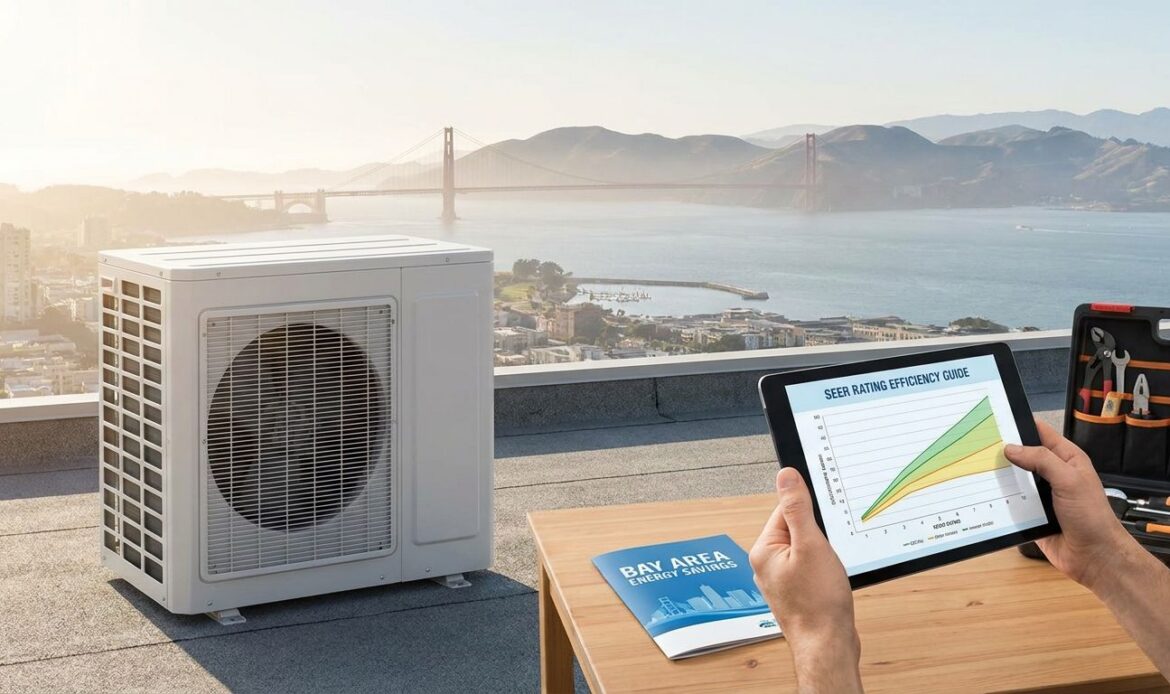
Picking a SEER rating for a Bay Area AC system isn't about chasing the highest number on the sticker — it's about matching efficiency to a climate that rarely gets brutally hot and a budget that shouldn't pay for capacity you'll never use.
- California’s federal minimum for a Bay Area AC system is 13.4 SEER2 as of 2023 — anything sold new must clear that bar.
- Mild coastal summers mean a 16-18 SEER2 system often pays back faster than a 20+ SEER2 unit here.
- Ductwork condition matters as much as the SEER rating — undersized ducts erase efficiency gains.
- Get quotes at two SEER2 tiers before committing so you can compare real installed cost against real savings.
Why this matters
SEER stands for Seasonal Energy Efficiency Ratio, and since 2023 the industry has used an updated metric called SEER2, tested under stricter conditions than the old SEER number. A Bay Area AC system rated 13.4 SEER2 meets the federal minimum for the North region, which includes Sonoma, Marin, Napa, Solano, and Contra Costa counties.
The mistake homeowners make is assuming a system rated 20 SEER2 will always beat one rated 15 SEER2 on the utility bill. That's true in Fresno or Sacramento, where AC runs six months a year. It's a much weaker case in Petaluma or Novato, where fog and marine air keep cooling loads lower than inland California for most of the summer. The right rating depends on how many hours your compressor actually runs, not just what's printed on the box.
If your current system is over 12 years old, the SEER rating question often gets folded into a bigger one — whether it's time to replace the whole system rather than patch it and keep running an outdated rating.
What you'll need
- Your current system's age and nameplate SEER rating (check the outdoor unit's data plate)
- A recent utility bill showing summer kWh usage for comparison
- Square footage and window count of the space you're cooling
- Contact info for two or three licensed HVAC contractors for quotes
- Basic knowledge of your ductwork's age and condition (or a contractor's inspection)
The steps
1. Confirm your climate zone and cooling load
California's Title 24 energy code breaks the state into 16 climate zones, and most of Sonoma, Marin, and coastal Contra Costa fall into zones with mild, fog-moderated summers compared to inland zones like Walnut Creek or Vallejo, which run hotter. A system sized and rated for the Central Valley is overkill on the coast.
Why it matters: cooling load drives return on investment for any SEER2 upgrade. A high-efficiency system in a house that only runs AC 40 days a year takes years longer to pay back the extra upfront cost than the same system in a house that runs AC 120 days a year.
Expected outcome: you'll know whether you're a low-load coastal home or a higher-load inland home before you compare SEER2 tiers.
Common mistake: assuming every Bay Area address has the same cooling need. Petaluma and Concord are 40 miles apart and see very different summer temperatures.
2. Check the SEER2 minimum that applies to your install
Any new split-system central AC installed in California in 2026 must meet at least 13.4 SEER2 under federal rules. This isn't optional — a licensed contractor can't legally sell you anything below that floor for a standard split system.
Why it matters: some older quotes or online listings still reference the pre-2023 SEER scale, which used different test conditions and slightly different numbers. Comparing a SEER2 quote against a SEER-labeled unit apples-to-apples requires knowing which scale you're looking at.
Common mistake: comparing a contractor's SEER2 quote against a manufacturer spec sheet still using the old SEER number, then thinking one bid is more efficient when it's actually the same equipment measured differently.
3. Match the SEER rating to actual runtime, not theoretical heat
If your AC runs fewer than 60 days a year on the coast, jumping from 15 to 20 SEER2 rarely earns back its added cost within a normal ownership period. If you're inland in Solano or Contra Costa county running AC most of the summer, the math shifts in favor of higher efficiency.
Why it matters: efficiency gains only translate into savings when the compressor is actually working. A 20 SEER2 unit sitting idle most of the year doesn't save you anything a 15 SEER2 unit wouldn't.
Expected outcome: a target SEER2 range — usually 14-16 for low-load coastal homes, 16-20 for higher-load inland homes — rather than a single arbitrary number.
4. Get sizing right before you get SEER right
An oversized system short-cycles regardless of its rating, wasting energy and wearing out components faster. A correctly sized system at a moderate SEER2 rating often outperforms an oversized system at a high SEER2 rating. This is where choosing the right AC size for a Bay Area home has to happen before the SEER conversation finishes.
Why it matters: SEER ratings are tested under ideal, steady-state conditions. Short-cycling from bad sizing never hits those conditions, so the real-world efficiency drops no matter what the label says.
Common mistake: letting a contractor quote a bigger unit to be safe — oversizing is the single fastest way to erase a SEER2 upgrade's benefit.
5. Price the SEER2 tiers against real installed cost
Higher SEER2 ratings generally cost more upfront due to larger coils, variable-speed compressors, or two-stage operation. Before locking in a rating, pull quotes at two tiers so you're comparing real installed numbers rather than a spec sheet in isolation — the Bay Area AC installation cost guide breaks down what typically drives that price up or down.
Why it matters: the SEER2 rating with the best efficiency story isn't automatically the best financial decision for your specific house and usage pattern.
Expected outcome: a side-by-side of installed cost against estimated annual usage, so the decision is a number comparison, not a guess.
6. Check ductwork condition before finalizing anything
A high-SEER2 system pushing air through leaky or undersized ducts loses efficiency before the air even reaches a room. Older Bay Area homes, especially pre-1980 construction in Marin and Sonoma counties, commonly have ductwork that was never sized for modern equipment.
Why it matters: manufacturers rate SEER2 assuming properly matched, sealed ductwork. Real installs with compromised ducts can underperform their rating by a meaningful margin.
Common mistake: buying the highest-rated equipment and reusing 30-year-old ducts without inspection, then wondering why bills didn't drop as expected.
Not sure which SEER2 tier fits your home?
Get a free quote and a second opinion before you buy.
7. Confirm licensing and rebate eligibility before signing
Some utility rebate programs require a minimum SEER2 threshold, proof of licensed installation, and specific paperwork submitted before or shortly after install. Working with a properly licensed contractor protects both the rebate eligibility and the warranty on the equipment itself.
Why it matters: unlicensed installs can void manufacturer warranties and disqualify rebate applications entirely, wiping out any efficiency savings with an unplanned repair bill later.
Expected outcome: a signed contract referencing the confirmed SEER2 rating, licensing details, and any rebate paperwork requirements handled before equipment goes in.
Troubleshooting
Contractor pushes the highest SEER2 tier without inspecting ducts. Ask for a duct inspection or static pressure test before agreeing to any tier above 16 SEER2 — a mismatch here cancels out the upgrade.
Two quotes show different SEER numbers and you can't tell which scale they use. Ask directly whether the number is SEER2; anything quoted for new 2026 installs should be labeled that way.
You upgraded SEER2 rating and your bill barely moved. Check thermostat settings and duct sealing first — a rating upgrade without addressing usage habits or leaks rarely shows the full expected savings.
Rebate application got rejected after install. Confirm the rebate program's minimum SEER2 threshold and paperwork deadline before the unit is installed, not after.
Old system still runs fine but sits well under 13.4 SEER2. It's legal to keep running an existing unit below the current minimum — the 13.4 SEER2 floor applies to new installs, not to systems already in service.
Tools and resources
- Outdoor unit data plate — shows current SEER or SEER2 rating
- Recent summer utility bills for a usage baseline
- How to choose an HVAC contractor in the Bay Area — vetting questions to ask before signing
- Title 24 climate zone lookup for your specific address
- Two or three written contractor quotes at different SEER2 tiers
What to do next
Once the SEER2 rating is settled, seasonal upkeep is what protects the efficiency you paid for. Read how to maintain your AC in Northern California summers for the maintenance schedule that keeps a properly rated system running at its rated efficiency for years instead of degrading in year two or three.
FAQ
What SEER rating do I need for a Bay Area AC system in 2026?
Any new split-system central AC installed in 2026 must meet at least 13.4 SEER2, the federal minimum for California’s region. Coastal homes with lower cooling loads often do fine at 14-16 SEER2, while inland homes running AC more often benefit from 16-20 SEER2.
Is SEER2 the same as SEER?
No, SEER2 replaced SEER as the required efficiency metric starting in 2023 and uses stricter, more realistic test conditions. A SEER2 number and an old SEER number aren’t directly interchangeable when comparing equipment.
Does a higher SEER rating always lower my bill in the Bay Area?
Not automatically. Savings depend on how many hours your AC actually runs, and mild coastal summers in Marin or Sonoma County mean a high SEER2 system pays back slower than the same unit in a hotter inland area like Concord or Vallejo.
What’s the minimum SEER2 allowed in California?
California falls in the federal North region, where the minimum for new split-system central AC is 13.4 SEER2, in effect since January 2023. Existing systems installed before that date aren’t required to meet the new floor.
Is a higher SEER2 system worth the extra installed cost?
It depends on your cooling load and how long you plan to stay in the home. Higher SEER2 tiers generally cost more upfront, so comparing installed quotes against expected runtime is the only way to know if the payback period makes sense for your house.
Do Bay Area utilities offer rebates for high-efficiency AC?
Some utility and state programs offer rebates tied to minimum SEER2 thresholds and licensed installation requirements. Eligibility and paperwork deadlines should be confirmed before the equipment is installed, not after.
Can I keep my old ductwork with a new high-SEER2 system?
Only if the ducts are properly sized and sealed for the new equipment. Leaky or undersized ducts common in older Bay Area homes can reduce a high-SEER2 system’s real-world efficiency well below its rating.
How long does a SEER2 upgrade take to pay for itself in the Bay Area?
Payback periods run longer on the coast than inland because AC runs fewer hours per year in fog-moderated climates like Petaluma or Novato. Homes in hotter inland zones like Contra Costa or Solano counties typically see faster payback on higher SEER2 tiers.
One last thing
The SEER2 number on the box means almost nothing if the ductwork behind the wall hasn't been checked in a decade — that's the detail most quotes skip, and it's the one that actually determines whether a Bay Area AC system hits its rated efficiency or falls short of it every summer.
Related guides
- How to choose the right AC size for a Bay Area home
- How to know when to replace your HVAC system
- How much does AC installation cost in the Bay Area
- How to choose an HVAC contractor in the Bay Area
- How to maintain your AC in Northern California summers