

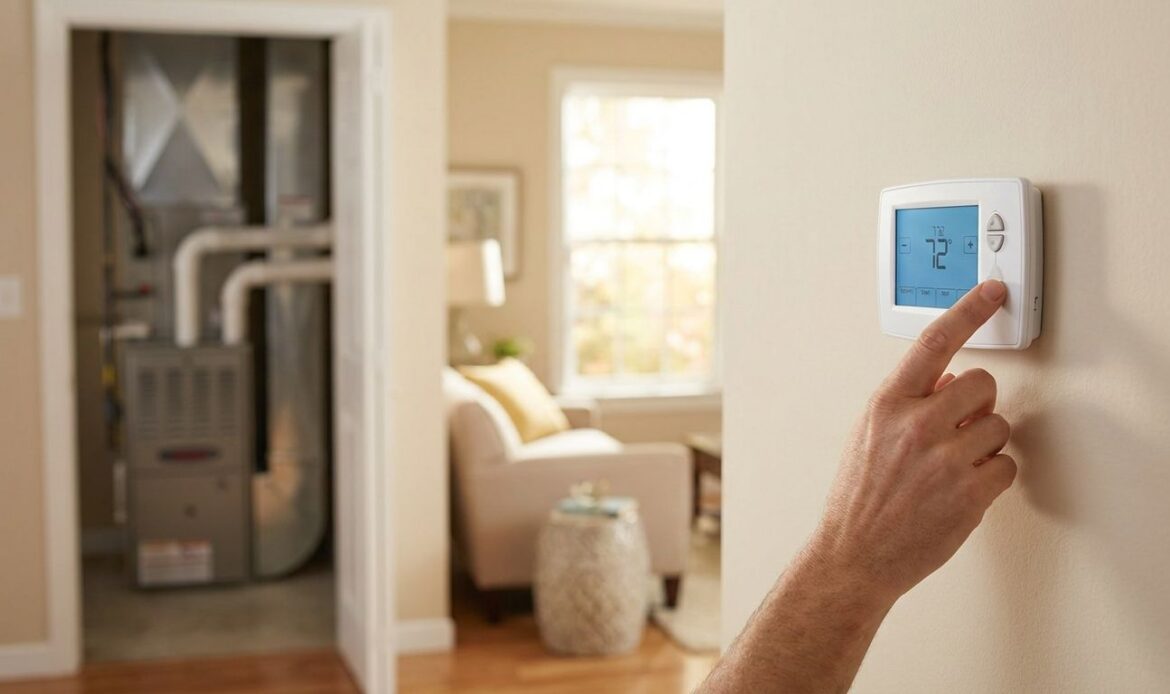
A blank thermostat screen and a dead furnace look the same from across the room, but one is a $20 fix and the other is a service call. This guide walks through the exact checks that separate a thermostat or HVAC system problem before you spend money on the wrong repair.
- A blank or unresponsive thermostat screen usually points to a thermostat or HVAC system power issue, not a compressor failure.
- If jumping the wires directly at the furnace or air handler starts the system, the thermostat is the fault.
- A thermostat that reads correctly but gets no response from the equipment means the problem is in the HVAC system itself.
- Smart thermostats installed without a C-wire cause the short-cycling many homeowners blame on a failing furnace or heat pump.
Why this matters
Most homeowners call for HVAC repair when the actual problem is a $150 thermostat, and the reverse happens just as often – people replace a thermostat twice before realizing the furnace's control board is dead. Getting the diagnosis right in 2026 matters more than ever, since equipment lead times and labor rates keep climbing across Sonoma, Marin, Napa, Solano, and Contra Costa counties. A wrong guess costs a wasted trip and a delayed fix during the exact week you need heat or cooling.
The test is mechanical, not guesswork: does the equipment respond when you bypass the thermostat entirely? If yes, the thermostat or its wiring is the problem. If no, the fault sits in the furnace, heat pump, or air handler itself.
What you'll need
- A basic multimeter (under $20 at any hardware store)
- A small flathead screwdriver to open the thermostat wall plate
- Your HVAC system's breaker location and the equipment's model/serial info
- A flashlight for the furnace closet or attic air handler
- 15-20 minutes of uninterrupted time
- Fresh AA or AAA batteries if your thermostat uses them
The steps
1. Check the thermostat display first
A completely blank screen means the thermostat isn't getting power – that's your starting point, not a system failure. Replace batteries if it's battery-powered, or check the breaker labeled for the furnace/air handler if it's hardwired. A dead screen after fresh batteries and a confirmed breaker means the thermostat itself has failed.
Common mistake: assuming a blank screen means the whole HVAC system is dead. It almost never does – the thermostat and the equipment run on separate power paths in most Bay Area installs.
2. Confirm the setpoint and mode are actually correct
Make sure the thermostat is set to Heat or Cool (not Off or Fan Only) and that the setpoint is at least 3 degrees away from the current room temperature. This sounds obvious, but a setpoint 1 degree off the room temp won't trigger a call for heat or cool – the system isn't broken, it just isn't being asked to run.
Expected outcome: within 60 seconds of a correct setpoint change, you should hear a click at the equipment. No click means move to step 3.
3. Listen and look at the equipment directly
Go to the furnace, air handler, or outdoor heat pump unit and check for any response – a click, a fan spin-up, a light on the control board. This is the single most useful diagnostic step because it isolates the problem to one side of the system immediately.
If you hear nothing and see no lights, the furnace won't turn on troubleshooting path applies – check the door safety switch, the flame sensor, and the breaker at the unit itself before assuming thermostat failure.
4. Test with a thermostat bypass (jumper test)
At the equipment's control board, a technician can jump the R and W terminals (for heat) or R and Y terminals (for cool) to see if the system fires without the thermostat involved. If the furnace or heat pump starts on the jumper test, the thermostat or its wiring run is the problem – not the equipment.
This step involves low-voltage wiring (18-24V) and isn't dangerous, but misreading terminal labels on an unfamiliar control board is the most common DIY mistake here. If you're not comfortable opening the equipment panel, this is where a licensed technician earns the call.
5. Check for heat pump-specific symptoms
Heat pumps that run but never actually warm the house often get blamed on the thermostat when the real issue is a stuck reversing valve or low refrigerant. If the system runs continuously without raising the temperature, the heat pump not heating properly guide covers the reversing valve, defrost cycle, and auxiliary heat checks that a thermostat test alone won't catch.
6. Rule out a tripped compressor lockout
Many systems have a built-in delay of about 5 minutes after any power interruption before the compressor will restart – this protects the compressor but confuses homeowners who think the thermostat command isn't registering. Wait a full 5-10 minutes after any breaker flip or thermostat change before concluding the system is unresponsive.
7. Reset the system cleanly after any power event
If a PG&E outage, breaker trip, or storm knocked power out, both the thermostat and the equipment's control board may need a full reset before they'll talk to each other correctly. The reset your HVAC system after a power outage steps walk through killing power at both the thermostat and the equipment breaker for 60 seconds, then restoring both in the right order.
Common mistake: resetting only the thermostat and not the equipment breaker, which leaves the control board stuck in a fault state even though the thermostat looks fine.
Not sure which one it is? Ask a tech.
A 20-minute diagnostic call usually settles thermostat vs. system in 2026.
Troubleshooting
Thermostat screen flickers or resets randomly. This is almost always a missing or overloaded C-wire on a smart thermostat – the device is drawing power in a way the system wasn't wired for. Ask about a C-wire adapter or a compatible model before assuming the HVAC system is failing.
System short-cycles – runs 2-3 minutes then shuts off repeatedly. This points to the equipment, not the thermostat, most often a dirty flame sensor, a clogged filter restricting airflow, or a refrigerant issue on the outdoor unit. Thermostats don't cause short-cycling; they only report the temperature swings it creates.
Thermostat says Heat On but no warm air comes out. Check that the setpoint is actually enough degrees above room temp to trigger the burner or heat pump compressor, then confirm airflow at a nearby vent. No airflow at all usually means a blower motor or filter problem inside the furnace or air handler itself.
Wi-Fi thermostat won't connect to the app but the physical display works fine. This is a network problem, not an HVAC problem – the equipment will still run on the local schedule even if the app connection drops.
System runs constantly and never satisfies the setpoint. On a heat pump this often means a stuck reversing valve or a refrigerant charge issue; on a furnace it can mean a failing limit switch. Either way, the thermostat is doing its job correctly – it's asking for heat or cool the system can't deliver.
New thermostat installed and system won't respond at all. Wiring terminals get crossed more often than people expect, especially on older Bay Area homes with non-standard color coding. Double-check the wire-to-terminal match against the old thermostat's wiring before assuming the new unit is defective.
Tools and resources
- Multimeter for voltage checks at the thermostat wire terminals
- Furnace filter (check and replace if visibly gray or clogged)
- Smart thermostats built for heat pump systems if you're replacing an incompatible unit
- Manufacturer manual for your specific furnace, heat pump, or air handler model
- A licensed technician for any control board or refrigerant-level diagnosis
What to do next
If the jumper test confirms the equipment is the problem, don't keep throwing thermostats at it – the next question is whether the unit is worth repairing at all. The how to know when to replace your HVAC system guide breaks down the age and repair-cost thresholds that matter in 2026 before you sink more money into an aging furnace or heat pump.
FAQ
How do I know if it’s my thermostat or my HVAC system?
Jump the R and W (heat) or R and Y (cool) terminals directly at the furnace or air handler – if the system starts, the thermostat is the fault; if nothing happens, the problem is in the equipment. This test isolates the two systems in under five minutes.
Can a bad thermostat damage my furnace or heat pump?
A faulty thermostat can cause short-cycling or a system that never gets a call to run, but it rarely damages the furnace or heat pump directly. Prolonged short-cycling from bad wiring can add wear to the compressor over years, though.
Why does my thermostat say the system is running but no air comes out?
This usually means the blower motor, filter, or ductwork has a problem, not the thermostat – the thermostat only sends the call, it doesn’t move air. Check for a clogged filter first since it’s the most common cause.
Does a smart thermostat need a C-wire to work with a heat pump?
Most smart thermostats need a C-wire for continuous power, and without one they can flicker, reset, or cause short-cycling on heat pump systems. Older Bay Area homes without a C-wire often need an adapter kit during installation.
How much does it cost to replace a thermostat versus repair a furnace?
A thermostat replacement is a fraction of the cost of a furnace control board or heat pump compressor repair, which is exactly why confirming the diagnosis first matters. Get a technician’s read on the equipment before authorizing any repair quote.
Why did my HVAC system stop responding after a power outage?
Power outages can leave the equipment’s control board in a fault state even after power returns, requiring a full reset at both the thermostat and the equipment breaker. Waiting 60 seconds before restoring power to each usually clears it.
Is it normal for my heat pump to run constantly in winter?
Heat pumps run longer cycles than furnaces by design, but constant running that never raises the temperature points to a stuck reversing valve or low refrigerant, not normal operation. That’s an equipment issue, not a thermostat setting.
Should I try to fix thermostat wiring myself?
Checking voltage with a multimeter and confirming wire-to-terminal matches is safe for most homeowners since thermostat wiring runs at 18-24 volts. Opening the furnace or heat pump’s control board for a jumper test is where a licensed technician should take over.
One last thing
The jumper test at the equipment – not the thermostat display – is the fastest way to end the guessing, and it's the same first move a Comfort Factor technician makes on a diagnostic call in 2026. Skip the back-and-forth of swapping thermostats twice and go straight to the wire terminals at the furnace or heat pump.
Related guides
- How to troubleshoot a heat pump that's not heating properly
- How to choose an HVAC contractor in the Bay Area
- Best smart thermostats for heat pump systems in California
- How to know when to replace your HVAC system