

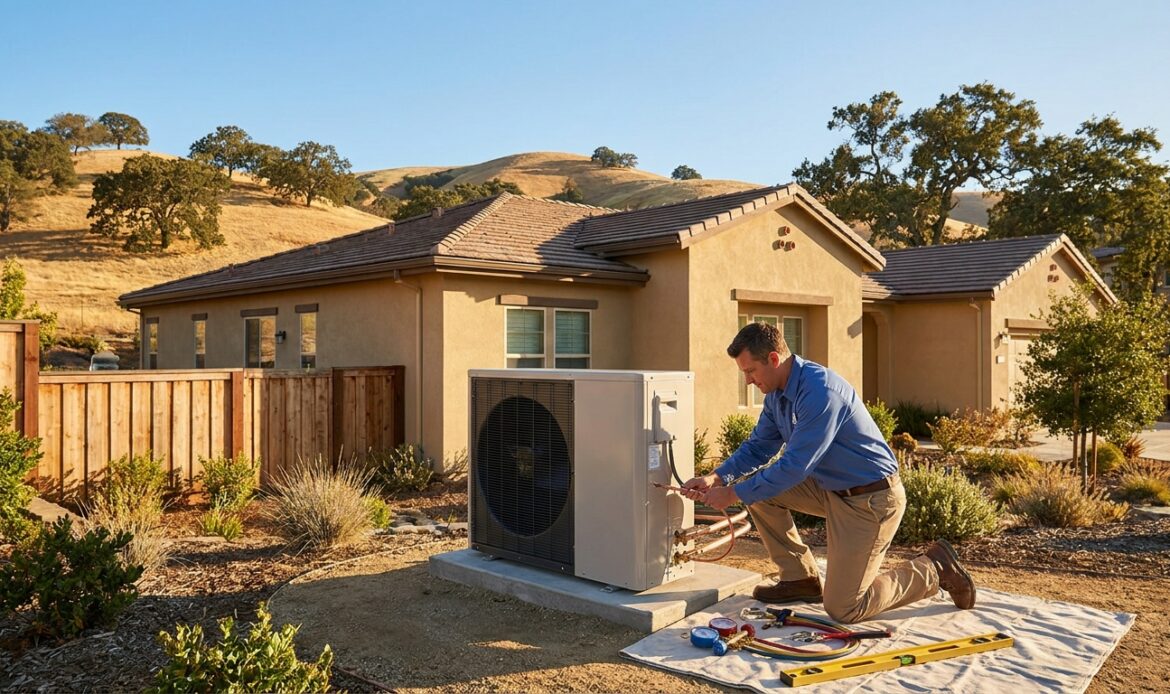
Contra Costa County runs hotter and drier than the rest of the Bay Area, which changes what the right heat pump actually means once you get past Walnut Creek and into Concord, Antioch, or Brentwood. This guide breaks down what to look for, which system types make sense for the inland climate, and what to skip.
TL;DR: For most Contra Costa County homes, a ducted heat pump installation with a SEER2 rating of 15 or higher is the right call in 2026 — it handles both the 100degF Concord summers and the 30s-degree nights in the Diablo foothills without a backup furnace. Ductless mini-splits are the better fit for additions or homes without existing ductwork. Skip anything sized without a Manual J load calculation. Verdict: Buy a properly sized ducted or ductless heat pump; skip the rule-of-thumb quote. Full HVAC services in Contra Costa County options cover both paths.
Why this matters
Contra Costa County homeowners deal with a wider temperature swing than San Francisco or Marin — Concord and Antioch regularly hit the high 90s and low 100s in July and August, then drop into the 40s overnight in winter. A heat pump sized for coastal Marin won't necessarily perform the same in Danville or Pittsburg. Getting the system type, sizing, and efficiency rating right in 2026 determines whether you're comfortable through August heat waves or running a backup furnace every time the mercury climbs.
Who this is for
This guide is for Contra Costa County homeowners — whether in Walnut Creek, Concord, Antioch, Pittsburg, Danville, San Ramon, Pleasant Hill, or Richmond — replacing an aging AC-and-furnace setup, converting from all-electric baseboard heat, or building an addition that needs standalone climate control. It's written for people comparing quotes and trying to figure out which system claims are real and which are sales talk.
What to look for in heat pump installation for Contra Costa County
Climate zone matching
Contra Costa spans several microclimates — the bay-adjacent western cities (Richmond, El Cerrito) stay milder, while inland cities like Antioch and Brentwood see far more extreme heat. A heat pump rated for coastal fog won't necessarily handle a 105degF Antioch afternoon at full capacity. Ask any installer how they're accounting for your specific city's design temperature, not just Bay Area in general.
SEER2 and HSPF2 ratings
SEER2 measures cooling efficiency, HSPF2 measures heating efficiency — both replaced the older SEER/HSPF standards. In 2026, a system rated SEER2 15 or higher and HSPF2 8.5+ is the baseline for a heat pump that's worth the upfront cost. Anything below that range performs closer to an old-style AC unit with a heat strip bolted on.
Manual J load calculation
A correctly sized heat pump is calculated room-by-room based on square footage, insulation, window orientation, and duct condition — not just tonnage-per-square-foot guesswork. Oversized units short-cycle and struggle with humidity; undersized units run constantly during a Concord heat wave and never quite catch up. This single step separates a comfortable install from a callback six months later.
Ducted vs. ductless compatibility
Older Contra Costa housing stock, especially homes built before the 1980s in Martinez or Pinole, often has undersized or leaky ductwork. A heat pump paired with bad ducts loses efficiency before the air even reaches a room. Ductless mini-split systems solve this by skipping ducts entirely — worth a serious look for additions, ADUs, or homes where duct replacement isn't in the budget.
Rebate and incentive eligibility
Heat pump rebates and utility incentives change year to year and vary by system efficiency tier and installer certification. Ask any contractor to confirm current 2026 eligibility in writing before you sign — verbal promises about rebate amounts aren't worth much if the paperwork doesn't match.
Installer licensing and local experience
A C-20 licensed contractor with actual install history in Contra Costa County will know the permit process for your specific city, since Walnut Creek, Concord, and Antioch don't all handle HVAC permits identically. That local track record matters more than a national franchise sticker on the truck.
Top picks for Contra Costa County homes
The safe pick: ducted whole-home heat pump
Best for homes with existing, sound ductwork that just need the AC-and-furnace combo replaced. Look for a SEER2 15+ system paired with a variable-speed air handler — it modulates output instead of blasting full power, which matters when Concord swings from 65degF mornings to 100degF afternoons in the same day. Verdict: Buy for most single-family homes with functional ducts.
The flexible pick: ductless mini-split zoning
Best for additions, converted garages, ADUs, or any room that runs hot or cold independent of the rest of the house. A single outdoor condenser can run up to four indoor zones, each controlled separately — no more fighting over the thermostat in a shared hallway. Verdict: Consider if you're missing ductwork or want room-by-room control; comfort-factor.com's ductless mini-split installation covers the same install approach used across the North Bay.
The cold-night hedge: hybrid dual-fuel system
Best for homeowners nervous about all-electric heat during a rare hard freeze in the Diablo foothills. This setup pairs a heat pump with a gas furnace that kicks in only below a set outdoor temperature, typically in the 30s. It costs more upfront than a heat-pump-only system but removes the worst-case-scenario worry entirely. Verdict: Consider if you already have a gas line and want a backup; Skip it if you're trying to go fully electric.
The regional comparison: what Marin homeowners are installing
Looking at what's working one county over is a useful gut check before you sign a contract. Heat pump installation in Marin County trends toward smaller, higher-efficiency ductless systems given the coastal climate — a useful contrast to the larger ducted systems that make more sense in Contra Costa's inland heat. Verdict: Buy the system sized for your actual climate, not your neighbor's county.
What to avoid
- Bargain systems under SEER2 14 — they look like a heat pump on paper but perform closer to a basic AC unit once summer hits triple digits in Antioch or Brentwood.
- Sizing by square footage alone — a 2,000-square-foot home in Danville with south-facing windows needs a different load calculation than the same footprint in Richmond near the bay breeze.
- Contractors skipping permits — Contra Costa County cities require permits and inspections for heat pump conversions; skipping this step can complicate resale and voids some manufacturer warranties.
Verdict comparison
| System type | Best for | Efficiency signal | Verdict |
|---|---|---|---|
| Ducted whole-home heat pump | Homes with sound ductwork | SEER2 15+ | Buy |
| Ductless mini-split | Additions, ADUs, no ductwork | Zoned, per-room control | Consider |
| Hybrid dual-fuel | Homes wanting a gas backup | Kicks in below ~35degF | Consider |
| Sub-SEER2 14 bargain unit | No one, really | Poor summer performance | Skip |
FAQ
What's the best heat pump for Contra Costa County homes in 2026?
A ducted system rated SEER2 15 or higher, sized with a room-by-room Manual J calculation, handles the county's wide temperature swing best. Ductless mini-splits are the better fit for additions or homes without usable ductwork.
Is a heat pump better than a furnace for Contra Costa County winters?
Yes, for most of the county — winter lows rarely drop below the mid-30s except in the Diablo foothills, well within a modern heat pump's efficient range. A hybrid dual-fuel setup is worth considering only if you're in a colder microclimate and want a gas backup.
How much does heat pump installation cost in Contra Costa County?
Cost varies by system size, ductwork condition, and whether it's a ducted or ductless install — get a quote based on your specific home rather than a countywide average.
Do heat pumps work well in Concord and Antioch's summer heat?
A properly sized SEER2 15+ system handles 100degF-plus afternoons without issue; undersized or bargain-tier units struggle to keep pace during extended heat waves.
Can I install a heat pump without replacing my ductwork?
If your ducts are sound, yes. If they're leaky or undersized — common in homes built before the 1980s — a ductless mini-split sidesteps the problem entirely.
Are there rebates for heat pump installation in 2026?
Rebate programs and eligibility change year to year and depend on system efficiency tier — confirm current terms in writing before signing a contract.
How long does a heat pump installation take?
A straightforward ducted swap typically takes a day; ductless multi-zone installs or jobs requiring duct work take longer depending on scope.
Do commercial properties in the county need a different approach?
Yes — commercial heat pump installs involve different load calculations and equipment tiers; commercial heat pump installation in Napa outlines how that differs from residential work.
One last thing
Most homeowners assume heat pumps struggle once temperatures drop below freezing — that was true a decade ago, but cold-climate compressor technology in 2026 keeps modern units running efficiently well into the 20s. The bigger risk in Contra Costa County isn't winter cold, it's summer sizing: an undersized system that can't keep up with a five-day Antioch heat wave will cost you more in comfort than any winter cold snap.