

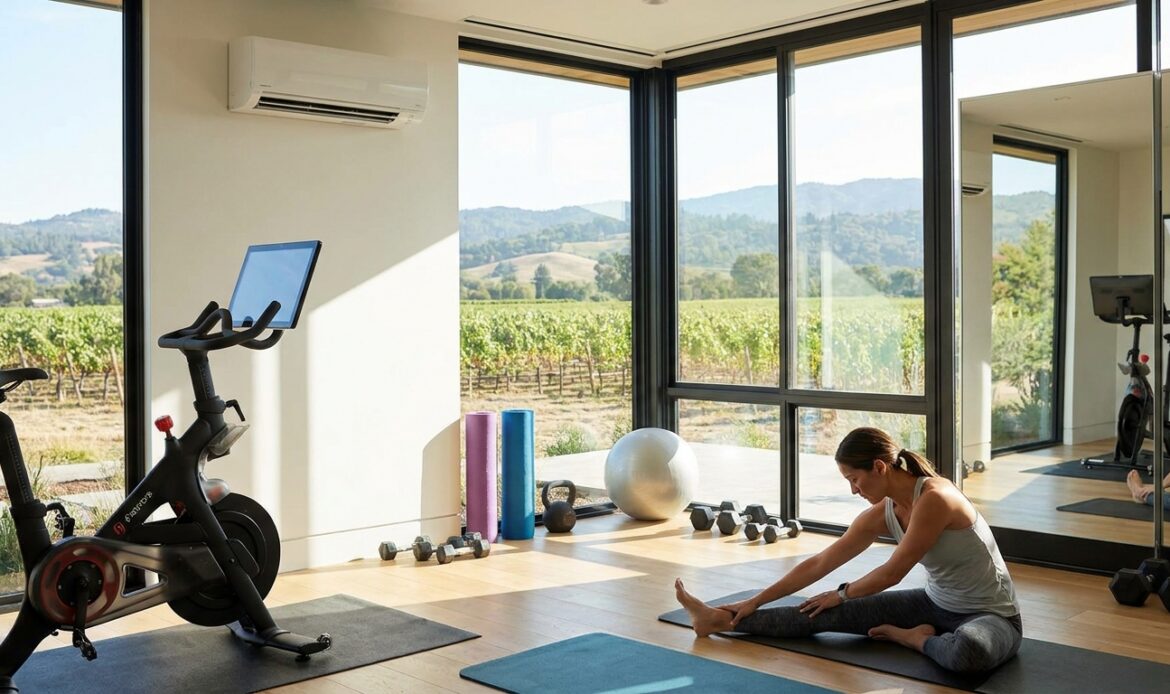
A home gym in Napa Valley needs a ductless mini-split sized for body heat and sweat, not just square footage — get that wrong and you're training in a 78-degree box by month two.
- A 12,000 BTU single-zone wall-mount system handles most 200-400 sq ft home gyms in Napa Valley garages and bonus rooms — Buy.
- Skip window units and 9,000 BTU systems; they can’t keep pace with sustained cardio heat load or Napa’s dry-summer humidity swings.
- Ceiling cassettes fit finished bonus rooms with limited wall space but cost more to install than wall-mount heads.
- Multi-zone systems make sense only when the gym shares a wall with a sauna, recovery room, or converted garage suite.
Who this is for
This guide is for Napa Valley homeowners converting a garage, bonus room, or detached structure into a dedicated workout space and need heating and cooling that doesn't run through the main house ductwork. If you're lifting, running intervals, or teaching a home spin class, the room generates far more heat than a bedroom or office the same size, and a mini-split sized like a normal living space will run constantly and still lose the battle against humidity from sweat and closed doors. Best fit: garage conversions, detached structures, and bonus rooms without existing ducts across Napa, St. Helena, Yountville, and Calistoga.
Why this matters
Napa Valley summers push into the 90s and low 100s with dry air, but a home gym traps heat and moisture regardless of what's happening outside. A ductless mini-split lets you condition one room precisely without extending ductwork into a garage or bonus space that was never built for it. Homeowners who go with the best ductless AC installers in the Bay Area for this kind of build typically size the system around workout intensity, not just floor area — that's the detail that separates a comfortable gym from an expensive space heater in reverse.
What to look for in a ductless mini-split for a home gym in Napa Valley
Cooling capacity matched to heat load
A resting body puts off roughly 400 BTU per hour; add cardio or weight training and that number climbs toward 1,000-1,200 BTU per person. A 200-300 sq ft garage gym with one or two people training needs closer to 12,000 BTU than the 9,000 BTU unit a bedroom of the same size would use. Undersizing here is the single most common mistake homeowners make when converting a garage.
Dehumidification performance
Napa Valley air runs dry outdoors, but a closed-door gym with sweat and heavy breathing builds humidity fast, especially during a 45-minute session. Look for a system with a dedicated dry mode rather than relying on cooling mode alone to pull moisture — cooling mode drops temperature but doesn't always manage humidity efficiently once the compressor short-cycles.
Noise rating in decibels
Most indoor mini-split heads run 19-26 dB on low fan speed, quiet enough to sit behind a treadmill or a squat rack without competing with music or a workout video. If a unit's spec sheet doesn't list indoor dB at low speed, that's a red flag for a room where you'll be breathing hard and want to hear your own pace.
Installation without existing ductwork
Garages and detached structures built before the 1990s in Napa County almost never have ducts run to them, and retrofitting duct work into a garage ceiling is expensive and eats headroom. Ductless systems solve this by running a 3-inch line set through a single wall penetration — how that process works for older construction is covered in how ductless mini-splits work in older Bay Area homes.
Filtration for wildfire smoke season
Napa Valley wildfire season typically runs August through October, and a home gym with a door propped open for airflow becomes a smoke intake point fast. A mini-split with a washable filter rated for fine particulate keeps a workout space usable even on a moderate-AQI day, which matters if your gym is the only cardio option during smoke events.
Rebate and permit eligibility for 2026
California utility rebate programs for heat pump-based mini-splits are active through 2026, but eligibility usually depends on the equipment's efficiency rating and whether a licensed contractor pulls the permit. A DIY install can disqualify the whole project from rebate money that would otherwise offset a meaningful chunk of the cost.
Get your gym sized right the first time
Free quote and second opinion on ductless mini-split sizing for Napa Valley.
Top picks for a Napa Valley home gym
The standard pick: single-zone wall-mount system
One 12,000 BTU wall-mount head handles a 250-350 sq ft converted garage or bonus room with one or two people training at a time. Indoor noise sits around 22 dB on low fan speed, quiet enough for a phone call between sets. This is the configuration most Napa Valley garage-to-gym conversions land on, and it's the setup covered in detail for local installs at ductless AC installation in Napa, CA. Verdict: Buy.
The low-profile pick: ceiling cassette system
A ceiling cassette mounts flush and distributes air in four directions, which matters in a finished bonus room where wall space is already taken by mirrors or a rack. It costs more to install than a wall-mount head because it needs ceiling access and a condensate pump, but it avoids the visual bulk of a wall unit above your squat rack. Verdict: Consider if the room is already finished and wall space is limited.
The retrofit pick: detached garage conversion
For a detached garage or barn structure with no ducts and no existing HVAC connection at all, a single-zone system routed through one wall penetration is the only realistic option short of a full mini-build. Older Napa Valley properties with detached structures built in the 1970s-80s are the most common candidates for this path. Verdict: Buy for detached structures without ductwork.
The scale-up pick: multi-zone system
If the gym shares a floor with a sauna, cold plunge, or recovery room, a multi-zone system with one outdoor condenser running two or three indoor heads can condition all of it without separate outdoor units cluttering the exterior wall. This costs more upfront than single-zone but avoids running multiple compressors for adjoining small rooms. Verdict: Consider only when a second room genuinely needs independent temperature control.
The undersized trap: 9,000 BTU compact unit
A 9,000 BTU head looks like the budget-friendly choice on a spec sheet, and for a bedroom it usually is. In a gym with sustained cardio and two or more people, it runs at full capacity nonstop and still loses ground on humidity. Verdict: Skip for anything beyond a single-person, low-intensity space under 150 sq ft.
What to avoid
- Window AC units — they can't dehumidify effectively and the seal around a garage window rarely holds up to wildfire smoke infiltration.
- Oversized single-stage systems — a mini-split too large for the room short-cycles, which spikes humidity instead of controlling it.
- DIY or unpermitted installs — beyond voiding manufacturer warranties, they typically disqualify the project from 2026 utility rebate programs entirely.
Verdict comparison
| Configuration | Capacity | Noise (low speed) | Best for | Verdict |
|---|---|---|---|---|
| Single-zone wall-mount | 12,000 BTU | ~22 dB | Garage/bonus room, 250-350 sq ft | Buy |
| Ceiling cassette | 12,000 BTU | ~24 dB | Finished room, limited wall space | Consider |
| Detached garage retrofit | 12,000 BTU | ~22 dB | Older structures, no ductwork | Buy |
| Multi-zone (2-3 heads) | 18,000-24,000 BTU combined | ~23 dB per head | Gym + adjoining room | Consider |
| 9,000 BTU compact | 9,000 BTU | ~20 dB | Single-person, low intensity only | Skip |
FAQ
What size ductless mini-split does a home gym need in Napa Valley?
Most 250-350 sq ft garage or bonus room gyms need a 12,000 BTU single-zone system in 2026, since sustained cardio and weight training generate significantly more heat than resting occupancy. Smaller 9,000 BTU units are only appropriate for low-intensity, single-person spaces under 150 sq ft.
Can a ductless mini-split handle humidity from sweat in a garage gym?
Yes, but only if the unit has a dedicated dry mode rather than relying on standard cooling mode. Napa Valley’s dry outdoor air doesn’t prevent indoor humidity buildup once a workout closes the door and traps moisture.
Is a ductless mini-split better than a window AC for a home gym?
A ductless mini-split wins on dehumidification, noise, and wildfire smoke filtration. A window unit costs less upfront but struggles to manage humidity during sustained exercise and offers weaker filtration during smoke season.
Do I need a permit to install a mini-split in a Napa Valley garage gym?
Yes, and skipping the permit process can disqualify the project from 2026 California utility rebate programs. A licensed contractor handles both the permit and the rebate paperwork as part of the install.
How loud is a mini-split indoor unit during a workout?
Most indoor heads run 19-26 decibels on low fan speed, quiet enough to hear music or a workout video without competing noise. Higher fan speeds during peak cooling will run louder but still below typical gym music volume.
Can one mini-split condition both a home gym and an adjoining sauna or recovery room?
A multi-zone system with one outdoor condenser and two or three indoor heads can handle a gym plus an adjoining room independently. This costs more upfront than a single-zone setup but avoids running separate outdoor units for small adjoining spaces.
Are ductless mini-splits eligible for heat pump rebates in California in 2026?
Many ductless mini-split systems qualify for 2026 utility rebate programs, but eligibility depends on the equipment’s efficiency rating and whether a licensed contractor pulls the permit. DIY installs typically don’t qualify.
What filtration do I need for a home gym mini-split during wildfire season?
Look for a washable filter rated for fine particulate matter, since Napa Valley wildfire season runs roughly August through October. A gym with the door propped open for airflow is more exposed to smoke infiltration than a sealed living room.
One last thing
The detail most homeowners miss: sizing by occupancy load, not floor area alone, is what separates a gym that stays comfortable through a full 2026 summer from one that runs its compressor nonstop by August. A 250 sq ft garage with two people doing intervals needs the same capacity as a 400 sq ft home office with one person sitting at a desk — the math isn't about square footage, it's about heat output.
Related guides