

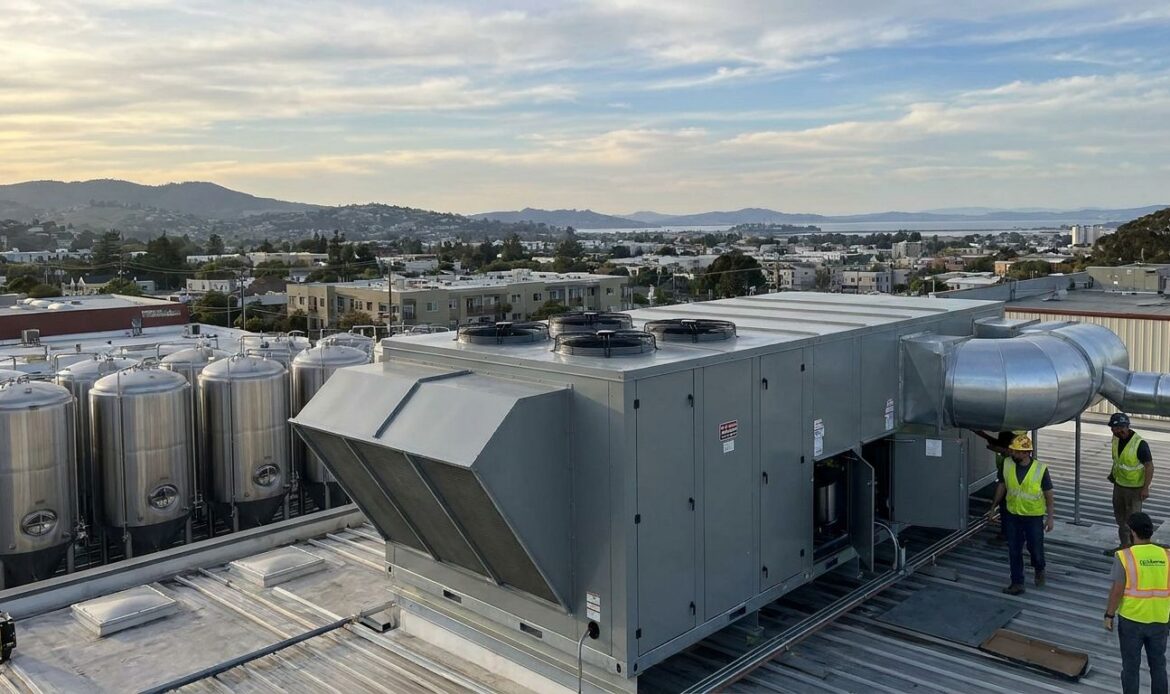
Bay Area breweries burn through cooling capacity fermentation tanks, glycol chillers, tasting rooms and walk-in coolers all pulling on the same electrical panel, and picking the wrong commercial HVAC unit means warped batches or a five-figure change order mid-buildout.
- Rooftop packaged units in the 10-25 ton range handle most Sonoma and Napa brewhouses — buy for production floors over 3,000 sq ft.
- Dedicated outdoor air systems (DOAS) are the best commercial HVAC units for Bay Area brewery humidity control near mash tuns.
- Glycol chillers stay separate from comfort cooling — never size fermentation chilling off a rooftop unit’s tonnage.
- Ductless mini-splits win for tasting rooms and taprooms where duct runs aren’t practical — verdict: buy for spaces under 1,500 sq ft.
- Skip standard residential-grade heat pumps for production areas — they can’t handle 2026-era brewery latent load.
How this list was ranked
This ranking weighs four factors specific to brewery operations in 2026: sensible cooling capacity per ton, latent (moisture) removal performance, tolerance for CO2 off-gassing and ambient heat from boil kettles, and installed cost relative to square footage. Every category below reflects equipment types actually installed across commercial buildouts in Sonoma, Napa, Marin, Solano, and Contra Costa counties, not spec-sheet claims from a single manufacturer. A commercial HVAC unit for a Bay Area brewery has to do more than cool air — it has to survive humidity swings from mash-in to knockout, which residential-grade systems aren't built for.
Comfort Factor has installed and serviced commercial HVAC systems for breweries in Sonoma County, and the pattern holds across the region: undersized latent capacity is the number one reason brewers call for emergency repairs during summer fermentation cycles.
Why this matters
A brewhouse generates heat and moisture that a standard office HVAC unit was never designed to remove. Mash tun steam alone can push relative humidity past 70% in an enclosed brewhouse, and glycol chiller loads for fermentation run independently of whatever keeps the taproom at 68°F. Get the equipment category wrong in 2026 and you're either retrofitting mid-lease or running a comfort system 24/7 just to keep condensation off stainless tanks. The right unit category, matched to square footage and process heat load, is the difference between a system that lasts 15 years and one that's replaced at year six.
The ranked list
1. Rooftop packaged units (10-25 ton) — the workhorse
Rooftop packaged units combine cooling, heating, and ventilation in one footprint, which matters when brewery floor space is already committed to tanks and kegging lines. A 15-ton unit typically covers 4,500-6,000 sq ft of open brewhouse space depending on ceiling height and kettle count. These units handle the bulk sensible load from boil kettles and compressor rooms without eating into usable production square footage. Verdict: Buy for any brewery over 3,000 sq ft with existing rooftop curb infrastructure.
2. Dedicated outdoor air systems (DOAS) — the humidity fix
A DOAS unit ventilates and dehumidifies incoming outdoor air before it ever mixes with the brewhouse, which is the single biggest lever for controlling condensation on stainless tanks. Where standard rooftop units struggle with latent load, a DOAS paired with a packaged unit can pull relative humidity down to the 50-55% range breweries need for mold prevention. This is a 2026 buildout standard for any new brewhouse permit in Sonoma or Napa county jurisdictions requiring ASHRAE 62.1 ventilation compliance. Verdict: Buy if your local permit requires dedicated ventilation, which most 2026 commercial kitchen and brewhouse permits do.
3. Glycol chillers — the non-negotiable
Glycol chillers handle fermentation and conditioning tank temperatures and run on a completely separate loop from comfort cooling. Sizing these off your rooftop tonnage is the most common mistake seen on Bay Area brewery buildouts — fermentation chilling needs its own load calculation based on tank volume and batch cycle, not square footage. A 20-barrel fermenter typically needs a chiller sized well beyond what a comfort-cooling contractor would spec by habit. Verdict: Buy, but only from a contractor running a dedicated fermentation load calc, not a generic HVAC quote.
4. Ductless mini-splits — the tasting room pick
Tasting rooms and taprooms rarely share duct runs with the production floor, and mini-splits let you zone comfort cooling to the customer-facing space without touching brewhouse humidity control. These systems install without major ductwork, which matters in older Sonoma and Petaluma buildings where retrofitting ducts adds real cost. Comfort Factor's guide to ductless AC installers in the Bay Area covers sizing for spaces under 1,500 sq ft, which is roughly where most taprooms land. Verdict: Buy for tasting rooms and office space; Skip for anything touching the brewhouse floor.
5. Standard split-system heat pumps — the office-only pick
Standard heat pumps work fine for administrative offices, break rooms, and storage — anywhere latent load isn't dominated by process heat. They're not built for a production environment where humidity swings 20 points in an afternoon brew cycle. A heat pump sized for a California home uses a load calculation method that doesn't account for kettle steam or fermentation off-gassing, so the math simply doesn't transfer. Verdict: Hold for office and admin space only; Skip for brewhouse or tank rooms.
6. Portable dehumidifiers — the stopgap, not the solution
Portable units show up as a quick fix during a hot batch cycle when condensation starts forming on tanks, but they're not a permanent commercial HVAC solution. They lack the continuous capacity a DOAS or properly sized rooftop unit delivers, and running several units simultaneously often costs more in electricity than one correctly sized system. Verdict: Wait — use temporarily while a permanent system is quoted, never as the long-term fix.
Comparison table
| Equipment type | Best for | Handles humidity? | Verdict |
|---|---|---|---|
| Rooftop packaged unit (10-25 ton) | Open brewhouse floor | Moderate | Buy |
| DOAS | Ventilation-required permits | Strong | Buy |
| Glycol chiller | Fermentation tanks | N/A (separate loop) | Buy |
| Ductless mini-split | Tasting room, offices | Low-moderate | Buy (non-production only) |
| Standard heat pump | Admin/office space | Low | Hold |
| Portable dehumidifier | Temporary condensation control | Moderate, short-term | Wait |
Get a brewery HVAC load calc
Talk to a Bay Area contractor before you size equipment off square footage alone.
Where to source these systems
- Get a load calculation before quoting equipment. Fermentation tank volume, kettle BTU output, and tasting room occupancy all change the math — a generic square-footage quote misses process heat every time.
- Confirm the contractor separates comfort cooling from glycol chilling. If one company is quoting both systems off the same tonnage number, that's a red flag for 2026 brewhouse projects.
- Check permit requirements for your county before finalizing DOAS sizing. Sonoma and Napa county commercial kitchen permits frequently mandate dedicated ventilation that a standard rooftop unit doesn't satisfy on its own.
Comfort Factor's maintenance plans for Bay Area commercial buildings cover scheduled inspections for rooftop units and glycol systems once installed, which matters since a missed refrigerant check during peak summer brewing is when most emergency calls come in.
FAQ
What is the best commercial HVAC unit for a Bay Area brewery?
A 10-25 ton rooftop packaged unit paired with a dedicated outdoor air system covers most brewhouse floors in 2026, with a separate glycol chiller handling fermentation tanks. No single unit does all three jobs.
Can a residential heat pump work in a brewery?
Residential and standard commercial heat pumps work fine for office and admin space but can’t handle the humidity swings from mash tun steam and fermentation off-gassing on the production floor.
How much cooling capacity does a brewhouse need?
Most Sonoma and Napa county brewhouses run 10-25 tons of rooftop capacity for 4,500-6,000 sq ft of open floor, though tank count and kettle size shift that number significantly.
Do breweries need a separate chiller from the comfort cooling system?
Yes. Glycol chillers for fermentation and conditioning run on an entirely separate loop from comfort cooling, sized off tank volume and batch cycle, not square footage.
Is ductless mini-split cooling good for a taproom?
Ductless mini-splits work well for tasting rooms under 1,500 sq ft since they zone comfort cooling without touching brewhouse humidity control or requiring major duct retrofits.
What humidity level should a brewery tank room stay at?
Most breweries target 50-55% relative humidity in tank rooms to limit condensation on stainless steel and reduce mold risk during fermentation cycles.
How often should brewery HVAC systems get maintenance?
Rooftop units and glycol chillers in continuous brewery use need inspection at minimum twice a year, with refrigerant and humidity checks scheduled before peak summer brewing season.
Does a brewery need a special HVAC permit in the Bay Area?
Many Sonoma and Napa county jurisdictions require dedicated outdoor air ventilation for commercial kitchen and brewhouse permits issued in 2026, which a standard rooftop unit alone won’t satisfy.
One last thing
The brewers who avoid emergency service calls in July aren't the ones with the biggest rooftop unit — they're the ones who separated glycol chilling from comfort cooling on day one. That single decision, made during initial load calculation, prevents more mid-season failures than any tonnage upgrade after the fact.
Related guides
- Commercial HVAC services in Sonoma County
- How to choose an HVAC contractor in the Bay Area
- Heat pump installation in Petaluma
- Best HVAC maintenance plans for Bay Area commercial buildings