

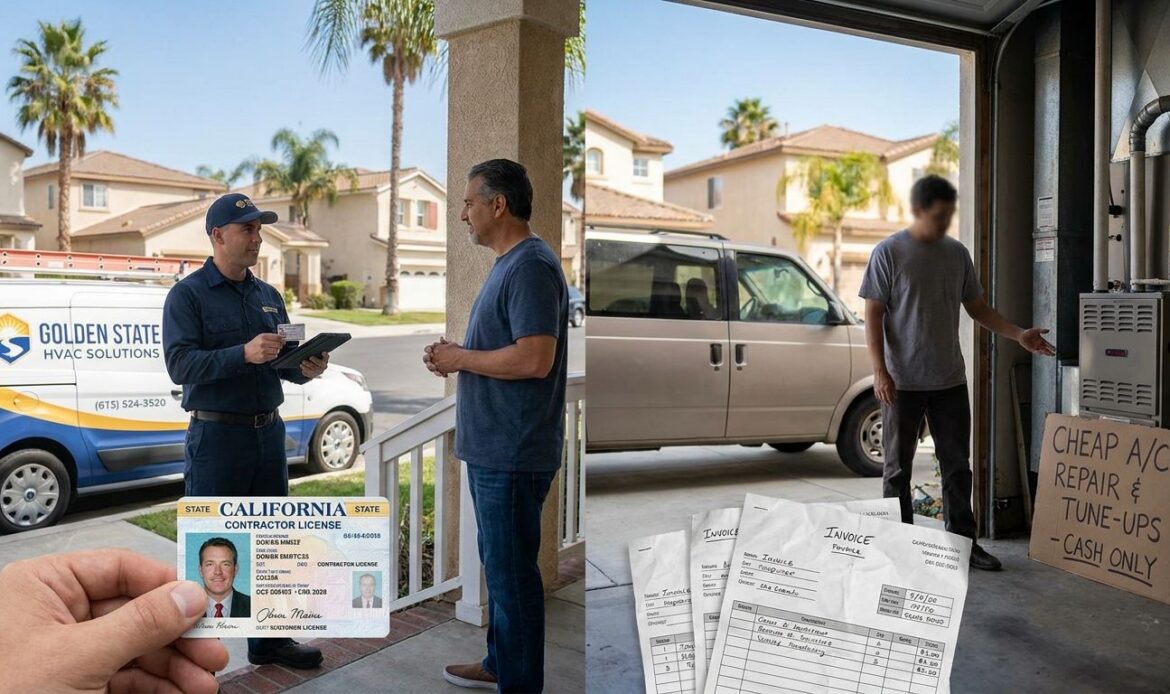
California's Contractors State License Board received more than 24,000 complaints last year, and unlicensed HVAC work is one of the most common categories flagged in that pile. If a stranger just quoted you a furnace replacement over the phone or knocked on your door claiming your AC "failed inspection," this guide walks through exactly how to check whether you're dealing with a licensed HVAC contractor or a scam artist in California in 2026.
- Verify any HVAC contractor’s C-20 license at cslb.ca.gov before signing anything in 2026 — no license number, no work.
- California caps home improvement deposits at 10% or $1,000, whichever is less — a bigger upfront ask is a scam signal.
- Jobs under $500 in labor and materials don’t legally require a license, but full system installs and repairs almost always do.
- Door-to-door ‘your system failed inspection’ pitches are a known unlicensed-contractor scam pattern in California — verdict: refuse and call a licensed shop.
Why this matters
An unlicensed HVAC installer can walk away with your deposit, leave a furnace half-wired, or skip the permit that your home insurer will ask for after a fire claim. California requires a C-20 license for any HVAC job over $500 in combined labor and materials, and the license comes with bonding and insurance requirements that protect you if something goes wrong.
Skip the verification step and you're the one holding the bill when a bad heat pump install trips a breaker every night in January 2026, or when the county red-tags an installation that never pulled a permit. The checks below take fifteen minutes and cost nothing.
What you'll need
- The contractor's full business name and license number (ask directly if it's not on the quote)
- A phone or laptop to search the CSLB license lookup
- The written estimate, not a verbal quote
- Ten minutes to call your local building department
- A second opinion from a licensed HVAC contractor if anything feels rushed
Before you get any of that, know what you're checking against. Comfort Factor's guide on how to choose an HVAC contractor in the Bay Area covers the baseline qualifications worth comparing every quote against.
The steps
1. Look up the license number on the CSLB database
This confirms the person standing in your driveway is legally allowed to touch your HVAC system. Go to cslb.ca.gov and search the exact license number they gave you — not just the company name, since scammers sometimes borrow a legitimate business name with a different license number attached.
A valid result shows an active C-20 classification, the license holder's name, and whether the license is current or has been suspended. If the search returns nothing, or the classification isn't C-20, stop the conversation there.
Common mistake: accepting a license number printed on a business card without checking it. Printed numbers can be fake, expired, or borrowed from a different contractor entirely.
2. Confirm the bond and workers' comp are active
California requires licensed contractors to carry a $25,000 contractor's bond and workers' compensation insurance. The CSLB lookup page shows bond status directly, so this is the same search as step one, just a different line on the results page.
A lapsed bond means there's no financial backstop if the job goes wrong. No workers' comp means you could be liable if someone gets hurt on your property during the install.
3. Get the estimate in writing before anyone starts work
A written estimate protects you from scope creep and lets you compare quotes apples-to-apples. It should list the equipment model, labor cost, permit fees, and total price — not a lump number scribbled on a notepad.
California's Business and Professions Code caps a home improvement deposit at 10% of the contract price or $1,000, whichever is less. Any HVAC contractor asking for more than that upfront, especially in cash, is violating state law.
4. Watch for high-pressure, one-day-only pricing
Legitimate HVAC contractors don't need to manufacture urgency to close a $6,000-$12,000 install. "This price is only good if you sign today" is a scripted line meant to stop you from getting a second quote.
Walk away from anyone who won't leave a written quote behind for you to review overnight. A real contractor expects you to compare bids — that's normal buying behavior in 2026, not an insult.
5. Insist on a permit for anything beyond a minor repair
Furnace and AC replacements, new ductwork, and heat pump installs typically require a permit from your county or city building department. Permits trigger an inspection that catches wiring and refrigerant line mistakes before they become a fire hazard or a warranty denial.
Ask directly: "Who's pulling the permit, and what's the number?" A legitimate contractor answers without hesitation. An unlicensed one will tell you permits "aren't necessary for this type of job" — that's false for nearly all full-system work.
6. Never pay the full balance before the work is inspected
Structure payment around milestones: deposit within the legal cap, a progress payment when equipment arrives, and the final balance after the system passes inspection and you've confirmed it's heating or cooling correctly. This gives you leverage if the installer disappears mid-job.
If your system already needs a repair verdict rather than a full swap, check how to know when to replace your HVAC system before agreeing to a replacement quote — pressure to replace a repairable unit is one of the more common upsell tactics.
7. Check reviews, complaint history, and how long the business has operated locally
A business with a real address, a multi-year local track record, and reviews mentioning specific jobs (furnace repair, ductless install, heat pump swap) is a different animal from a truck with a magnetic sign and a phone number that changes every season. Search the business name plus "complaint" and check the CSLB complaint history tied to the license number.
Rebate season brings out a specific scam pattern worth naming directly: someone claiming to process your California heat pump rebate for a fee upfront. Legitimate rebate paperwork is handled through your utility or the state program, not a contractor demanding a separate cash payment. Comfort Factor's breakdown of how to qualify for Bay Area heat pump rebates in 2026 lays out the real process.
Get a licensed second opinion first
Compare a verified Bay Area quote before you sign anything.
Troubleshooting
Problem: The license number they gave you doesn't match the CSLB record.
Fix: Ask for the exact legal business name tied to that license, and search again. If it still doesn't match, don't hire them — a mismatch is one of the clearest scam signals in California HVAC work.
Problem: A door-to-door "inspector" says your system failed and needs immediate replacement.
Fix: County inspectors and utility staff don't sell HVAC replacements door-to-door. Ask for ID and a callback number, then verify independently with your county building department before agreeing to anything.
Problem: The quote jumps significantly after they're already inside your attic or crawlspace.
Fix: Stop the job, get the revised scope in writing, and call a second licensed contractor for comparison before authorizing extra cost. A legitimate mid-job change still gets documented, not verbally inflated on the spot.
Problem: They only accept cash and won't provide a receipt.
Fix: Refuse. No paper trail means no recourse if the equipment fails or the deposit disappears. Licensed contractors invoice through the business, not a personal Venmo.
Problem: They pressure you to sign a contract with blank fields for price or equipment model.
Fix: Never sign an incomplete contract. Every field should be filled before you put your name on it, including model numbers and total price.
Problem: You already paid a deposit and the contractor has gone silent.
Fix: File a complaint with the CSLB immediately — the state's contractor bond exists specifically to cover situations like this, and unlicensed activity can also be reported to local law enforcement.
Tools and resources
- CSLB license lookup (cslb.ca.gov) — the single most important check in this whole process
- Your county or city building department's permit portal, for verifying pulled permits
- A written, itemized estimate from at least two contractors
- Comfort Factor's guide on hvac maintenance plans for Bay Area homeowners, useful for spotting inflated "maintenance contract" pitches that mirror scam patterns
- The contractor's Business and Professions Code disclosures, which should be part of any home improvement contract over $500
What to do next
Once a contractor clears the license, bond, and permit checks, the next decision is whether your system actually needs replacing or just repair. Comfort Factor's guide on how to know when to replace your HVAC system walks through the age, repair-cost, and efficiency thresholds that separate a real replacement case from an upsell.
FAQ
How do I verify an HVAC contractor’s license in California?
Search the exact license number on the CSLB database at cslb.ca.gov, which shows license status, classification, bond status, and any complaint history. Match the license to the legal business name on your quote, not just the name printed on a truck or business card.
Is it illegal to hire an unlicensed HVAC contractor in California?
Contracting without a license is illegal in California for any job over $500 in combined labor and materials. Hiring an unlicensed contractor for larger work leaves you with no bond protection and limited legal recourse if the job fails.
How much can an HVAC contractor legally ask for as a deposit in California?
California law caps home improvement deposits at 10% of the total contract price or $1,000, whichever is less. Any HVAC contractor demanding more than that upfront is violating state contracting law.
Do small HVAC repairs require a license in California?
Jobs under $500 in labor and materials combined are exempt from the licensing requirement, but this covers minor fixes only. Full repairs, replacements, and installations almost always exceed that threshold and require a licensed C-20 contractor.
What’s the biggest red flag for an HVAC scam in 2026?
Pressure to sign and pay the same day, combined with a license number that doesn’t match CSLB records, is the clearest combination of scam signals. Legitimate contractors expect you to compare quotes and never rush the paperwork.
Can I report an unlicensed HVAC contractor in California?
Yes, complaints against licensed or unlicensed HVAC contractors go through the CSLB, which investigates and can pursue penalties for unlicensed activity. Keep your written estimate, any payment records, and communication as documentation.
Do HVAC replacements always need a permit in California?
Most full system replacements, new ductwork, and heat pump installs require a permit from the local building department, which triggers an inspection. A contractor telling you a permit "isn’t necessary" for a full install is a warning sign, not standard practice.
Why do scammers target HVAC customers specifically?
HVAC failures feel urgent, especially during a Bay Area heat wave or cold snap, which pushes homeowners toward fast decisions without checking credentials. Scammers rely on that urgency to skip the license and permit conversation entirely.
One last thing
The fastest scam filter isn't a background check — it's asking for the license number out loud and watching how quickly and confidently it's given. A legitimate C-20 contractor in California recites that number without hesitation, because they check it themselves every renewal cycle. Hesitation, deflection, or "I'll text it to you later" is the answer you needed.
Related guides