

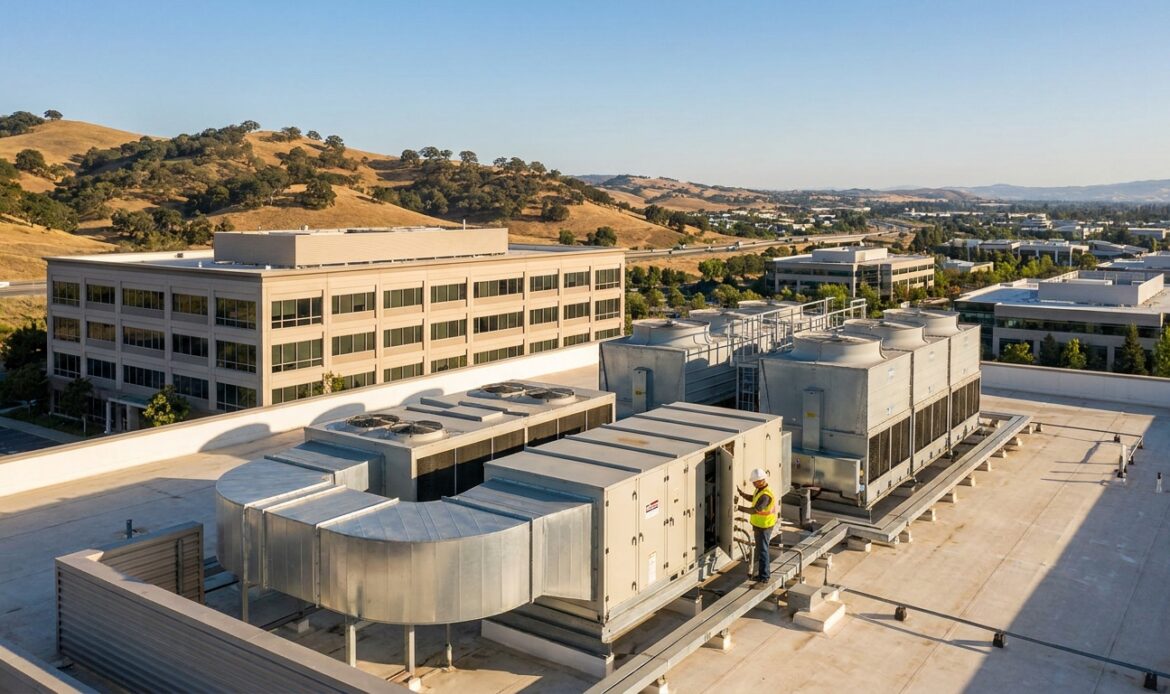
Contra Costa County office buildings hit 95-100°F for weeks at a stretch in Concord, Walnut Creek, and Antioch every summer, and a single undersized rooftop unit turns a 20,000 sq ft floor plate into a tenant-complaint machine by 2pm. This guide breaks down what commercial HVAC for an office building in Contra Costa County actually requires — sizing, zoning, maintenance cadence — and which system types are worth the spend in 2026.
- A packaged rooftop unit sized at 1 ton per 350-400 sq ft is the standard buy for commercial HVAC in an office building in Contra Costa County.
- VRF systems fit multi-tenant floors with mixed schedules — Consider it once you pass four distinct zones.
- Skip PTAC units in office settings; they’re built for hotel rooms, not shared floor plates.
- Two maintenance visits a year keep Title 24 compliance current and cut emergency repair calls.
Why this matters
Inland Contra Costa County runs hotter and drier than the coastal Bay Area, which means office buildings in Concord, Walnut Creek, San Ramon, and Antioch carry a heavier cooling load than a comparable building in Marin or coastal Sonoma. A lot of the office stock here dates to the 1980s and 1990s, which means original rooftop units are past the 15-20 year service window in 2026 and running on refrigerant blends that are getting harder to source.
An undersized or failing system doesn't just cost comfort — it costs lease renewals. Tenants track thermostat complaints, and property managers who let commercial HVAC slide end up funding emergency repairs at premium after-hours rates instead of budgeting for planned replacement.
Who this is for
This guide is built for property managers, facility managers, and building owners overseeing 5,000 to 100,000 sq ft of office space in Contra Costa County — single-tenant headquarters, multi-tenant Class B office parks, and mixed-use buildings with ground-floor retail. If you're managing a warehouse or a retail storefront, the load calculations and zoning logic below don't transfer directly; office HVAC sizing assumes desk density and conference-room spikes, not dock doors or foot traffic.
Getting commercial HVAC services in Contra Costa County dialed in early avoids the two most expensive outcomes: a system that's too small for August and a maintenance contract that's too thin to catch problems before they become five-figure repairs.
What to look for in commercial HVAC for an office building
Tonnage matched to your floor plate
Office cooling loads run roughly 1 ton per 350-400 sq ft, adjusted for glass exposure and occupant density. A building with floor-to-ceiling west-facing windows in Walnut Creek needs more tonnage per square foot than an interior floor with modest glazing — get a Manual N load calculation before you size anything, not a rule-of-thumb guess.
Rooftop access and structural load
Most office buildings in this county run packaged rooftop units, and roof structural capacity limits what you can install without reinforcement. A contractor who skips the structural check can spec a unit that looks right on paper but requires an expensive roof retrofit before it's ever mounted.
Zoning for tenant mix and after-hours use
A multi-tenant floor with a law firm running 7am-7pm and a co-working space running 24/7 can't share one thermostat zone without someone losing. Zoning dictates whether you need a simple split system or a variable-capacity system that can serve different schedules independently.
Maintenance contracts that keep code compliance
California's Title 24 ventilation and efficiency standards apply to commercial buildings, and a lapsed maintenance contract is the fastest way to fail an inspection during a tenant improvement permit. Twice-yearly maintenance — spring and fall — catches refrigerant leaks and failing capacitors before they become August emergencies.
Energy efficiency and utility rebates
Higher-SEER2 rooftop units and heat pump-based VRF systems cost more upfront but cut PG&E commercial demand charges, which scale with peak load in office buildings running cooling all afternoon. Rebate programs shift year to year, so confirm current incentives before locking a spec in 2026.
Response time for emergency repair
An office building with a failed system on a 98°F Tuesday needs a contractor who answers same-day, not a callback in 48 hours. Ask any commercial HVAC bidder for their guaranteed response window in writing before signing a service agreement.
Top picks for an office building HVAC system
Packaged rooftop units (RTU) — the workhorse pick
RTUs remain the default for office buildings because they keep mechanical equipment off the floor plate and centralize service access on the roof. A 10-ton unit handles roughly 3,500-4,000 sq ft of open office space, and SEER2 ratings on new units in 2026 run meaningfully higher than units installed a decade ago. Verdict: Buy for single-tenant or lightly-zoned multi-tenant buildings — see current HVAC services in Contra Costa County for current unit options.
Variable refrigerant flow (VRF) — the flexible pick
VRF systems use heat pump technology to serve multiple zones independently from one outdoor condensing unit, which matters once a building passes four or more distinct tenant schedules. Individual indoor units can heat one zone while cooling another simultaneously — a real advantage in buildings with a mix of interior and perimeter offices. Verdict: Consider for multi-tenant buildings over 15,000 sq ft; review heat pump installation in Contra Costa County specs before comparing bids.
Split system with ducted zones — the budget pick
A conventional split system with two or three ducted zones costs less to install than VRF and suits smaller office buildings under 10,000 sq ft with simple floor plans. It won't handle more than a few independent schedules gracefully, so it's the wrong call for a building with five different tenants on five different hours. Verdict: Consider for small single-tenant offices.
Ductless mini-splits for server rooms and small suites — the wildcard
Server closets and small IT rooms generate heat loads that the main building system wasn't designed to handle, and a dedicated ductless unit solves that without over-cooling the whole floor to compensate. These run independently of the main system, so a server room failure doesn't take down comfort for the rest of the building. Verdict: Buy as a supplemental system, not a replacement for main building HVAC.
PTAC units — the one to skip
Packaged terminal air conditioners are built for hotel rooms — one unit, one thermostat, one small space — and they show up in office buildings when a previous owner cut corners on a tenant improvement. They can't handle office-scale loads efficiently and they're loud enough to disrupt a conference call. Verdict: Skip for any office application beyond a single tiny standalone room.
What to avoid
- Single-stage RTUs on multi-tenant floors. A single-stage compressor runs full blast or not at all, which means over-cooling half the floor to satisfy the other half. Two-stage or variable-capacity units handle mixed loads far better.
- Skipping the load calculation. A contractor who quotes tonnage off square footage alone, without accounting for glazing and occupancy, is guessing. Insist on a Manual N calculation before signing.
- DIY zoning without a controls contractor. Adding thermostats to an existing ducted system without proper damper and controls work creates fighting zones where one area overrides another. This is a controls project, not a thermostat swap.
Get a commercial HVAC quote
Free second opinion on sizing, zoning, and maintenance contracts for your building.
Verdict comparison
| System type | Best for | Tonnage range | Maintenance need | Verdict |
|---|---|---|---|---|
| Packaged RTU | Single-tenant or light zoning | 5-25 tons | Twice yearly | Buy |
| VRF | Multi-tenant, mixed schedules | Modular, per-zone | Twice yearly + controls check | Consider |
| Ducted split system | Small offices under 10,000 sq ft | 3-10 tons | Twice yearly | Consider |
| Ductless mini-split | Server rooms, small suites | 0.5-2 tons | Annual | Buy (supplemental) |
| PTAC | Standalone small rooms only | Under 1 ton | Annual | Skip |
FAQ
What size HVAC system does an office building need in Contra Costa County?
Plan on roughly 1 ton of cooling per 350-400 sq ft of office space, adjusted upward for heavy window exposure or high occupant density. A Manual N load calculation confirms the exact number before you buy equipment in 2026.
Is VRF better than a rooftop unit for a multi-tenant office building?
VRF works better once a building has four or more distinct tenant zones with different schedules, since it can heat and cool separate zones at once. A single-tenant building with uniform hours does fine on a standard packaged rooftop unit.
How much does commercial HVAC maintenance cost for an office building?
Costs vary by building size and system type, so get a written quote based on your square footage and equipment count. Twice-yearly service contracts are the standard cadence for office buildings in Contra Costa County.
How often should a commercial HVAC system be serviced?
Twice a year — once before cooling season and once before heating season — catches refrigerant leaks, worn capacitors, and filter issues before they cause a mid-summer breakdown. Buildings that skip maintenance see more emergency repair calls.
Can a residential HVAC contractor handle a commercial office building?
Not reliably — commercial rooftop units, VRF controls, and Title 24 commercial compliance require different licensing and experience than residential furnace and AC work. Confirm commercial project history before hiring.
What’s the lifespan of a rooftop unit on an office building?
Packaged rooftop units typically run 15-20 years before efficiency drops enough to justify replacement. Units installed before 2010 are strong replacement candidates in 2026 given rising refrigerant costs on older systems.
Do PTAC units work for office buildings?
PTAC units are designed for single hotel-style rooms, not shared office floor plates, and they struggle with office-scale loads. Skip them for anything beyond one small standalone room.
Are there rebates for commercial heat pump installation in California?
Rebate programs for commercial heat pump and VRF installations shift year to year, so confirm current 2026 incentive availability with your contractor before finalizing a system spec.
One last thing
The building that skips the Manual N load calculation almost always ends up oversized, not undersized — bigger tonnage feels like a safer bet, but an oversized RTU short-cycles, wastes energy, and struggles with humidity control on the mild days that make up most of the Contra Costa calendar. Right-sizing based on an actual load calculation, not a square-footage guess, is the single decision that saves the most money over a 15-20 year system life.
Related guides