

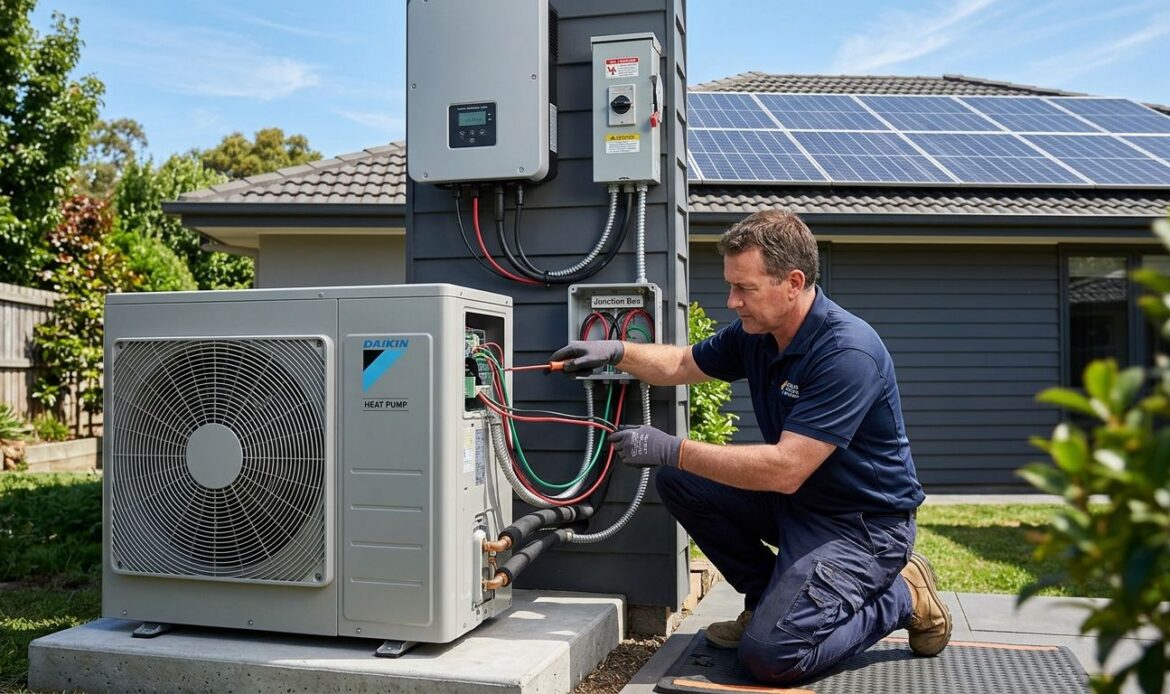
Running a heat pump straight off the grid means your compressor pulls peak power exactly when your solar panels are producing the least — during the coldest mornings and the hottest late afternoons. Instead of paying utility rates for that mismatch, connect your heat pump to a home solar power system so the compressor draws from panel output and battery storage first, and grid power only fills the gap.
- Connect a heat pump to a home solar power system by matching inverter output to compressor startup load, not just average draw.
- A correctly sized heat pump paired with solar can offset most daytime heating and cooling load in a Bay Area home in 2026.
- Load management settings on the inverter, not the heat pump thermostat, control how solar and grid power share the job.
- Skip battery backup and a heat pump still runs fine on solar during the day, but nights default fully to grid power.
Why this matters
A heat pump is the single largest continuous electrical load in most Bay Area homes once gas furnaces and window AC units get replaced. Pairing it with solar cuts the grid draw during exactly the hours utility demand pricing is highest, which is also when panel output peaks in Sonoma, Marin, Napa, Solano, and Contra Costa counties. Get the connection wrong — undersized inverter, no load-shedding logic, mismatched breaker sizing — and the heat pump either short cycles on cloudy days or trips the inverter's overload protection during compressor startup. Get it right, and the system runs quietly in the background for the life of both units.
Before you start
- Confirm your solar inverter's continuous output rating against the heat pump's rated load amps (RLA) plus locked rotor amps (LRA) — most residential inverters are sized for lighting and appliance loads, not a compressor's startup surge.
- Check whether your system has battery storage or is grid-tied only. A grid-tied-only system cannot run the heat pump after sunset without falling back to the utility, no matter how the wiring is configured.
- The non-obvious gotcha: many solar installers size inverters to net metering exports, not home consumption. If your inverter was sized before the heat pump was installed, it may not have headroom for compressor startup surge even though your monthly production numbers look fine — get the inverter's continuous and surge ratings in writing before wiring anything.
Set up your solar-to-heat pump electrical connection
- Locate your main electrical panel and confirm the heat pump's dedicated circuit breaker amperage matches the manufacturer's minimum circuit ampacity (MCA) listed on the unit's nameplate.
- In your solar system's monitoring app, open Load Management or Backup Loads (naming varies by inverter brand) and add the heat pump circuit to the critical loads panel if you have battery backup, or leave it on the main panel if grid-tied only.
- Set the load priority ranking so the heat pump sits below life-safety loads (refrigeration, medical equipment) but above discretionary loads like EV charging, so the system sheds EV charging first during a shortfall rather than cycling the heat pump off mid-cycle.
- Confirm the breaker interlock or automatic transfer switch is rated for the heat pump's LRA — this is the number that trips undersized transfer switches during compressor startup.
Expected result: the heat pump circuit shows up as an active load in your solar monitoring dashboard within one heating or cooling cycle, and amperage draw on the app should roughly track your outdoor unit's rated load amps during steady-state operation.
Configure the thermostat and inverter to talk to each other
- On a smart thermostat compatible with your heat pump, open Energy Settings or Utility Programs and enable Solar Optimization or Demand Response if the thermostat brand supports it.
- In the solar inverter's app, enable Time-of-Use Optimization so the system prioritizes running the heat pump during solar production hours (typically 10am to 4pm in the Bay Area) rather than at dusk when grid draw and utility rates both climb.
- If your inverter supports it, set a self-consumption mode rather than export-priority mode — export-priority pushes excess production back to the grid instead of using it to precool or preheat the home ahead of peak hours.
- Save settings and let the system run one full day-night cycle before checking the monitoring app for load overlap between solar production and heat pump runtime.
Expected result: the monitoring app shows heat pump runtime clustering during daylight production hours, with a visible drop in grid import compared to the same day before the changes.
Variant: precool or preheat ahead of a rate change
If your utility charges time-of-use rates, set up a second automation so the thermostat adjusts the setpoint 2-3 degrees whenever the solar inverter app flags peak production, effectively banking comfort ahead of the expensive hours. Configure this as a scheduled thermostat hold tied to your utility's published peak window rather than a fixed clock time, since peak windows shift seasonally. This variant matters more for cooling season, when afternoon peak production and afternoon peak rates overlap directly.
Troubleshooting
- Inverter shows an overload fault at compressor startup: the inverter's continuous rating is too close to the heat pump's LRA. This usually means the inverter was sized before the heat pump existed and needs a capacity review, not a wiring fix.
- Heat pump short cycles on partly cloudy days: the system is likely set to solar-priority without a grid fallback threshold. Set a minimum state-of-charge or minimum production floor below which the system defaults to grid power automatically.
- Thermostat shows "solar optimization unavailable": the thermostat and inverter are from different manufacturers without a shared API — check the thermostat's compatibility list before assuming the wiring is at fault. Comfort Factor's guide on smart thermostats for heat pump systems covers which brands actually talk to solar inverters.
- Grid import stays high despite full sun: check that the inverter isn't in export-priority mode, which sends production to the grid before the home load, including the heat pump, gets first pull.
- Breaker trips during defrost cycle in winter: defrost mode briefly runs the compressor and auxiliary heat strip together, spiking draw above steady-state numbers — confirm the breaker and MCA rating account for defrost, not just normal heating load.
Customize your workflow
Once the base connection is stable, most Bay Area homeowners layer in two more adjustments. First, Bay Area heat pump rebates in 2026 often require documentation of the solar pairing, so keep the inverter's load management screenshot on file before you apply. Second, if the home is adding an EV charger or a second heat pump zone later, oversizing the inverter now avoids a second capacity review — the same logic that applies to sizing a solar system for high electricity usage applies directly to a home layering solar onto an existing or planned heat pump load.
Homeowners on older wiring should also read up on short cycling in a heat pump before finalizing load priority settings, since a solar-priority mode that isn't tuned correctly is one of the more common causes of short cycling reported in 2026 service calls. If the heat pump itself was never sized for the home to begin with, no amount of inverter tuning fixes that — start with sizing a heat pump for a California home first.
Get a Solar-Ready Heat Pump Quote
Comfort Factor sizes the heat pump and reviews your inverter capacity together.
FAQ
Can any heat pump be connected to a home solar power system?
Most modern heat pumps can run on solar power, but the inverter must be sized for the compressor’s locked rotor amps, not just its steady-state draw. A heat pump installed before the solar system often needs an inverter capacity review before the connection is safe.
Do I need battery storage to run a heat pump on solar?
No, a grid-tied solar system without batteries can still power a heat pump during daylight hours when panels are producing. Without storage, the heat pump falls back to grid power automatically at night or on low-production days.
Will connecting a heat pump to solar lower my utility bill in 2026?
It reduces grid import during daylight heating and cooling hours, which typically overlaps with utility peak pricing windows. The actual savings depend on your utility’s rate structure and how much of the heat pump’s runtime shifts into solar production hours.
What size inverter does a heat pump need?
The inverter’s continuous output rating should exceed the heat pump’s rated load amps, and its surge rating should exceed the locked rotor amps listed on the unit’s nameplate. Undersized inverters trip overload faults specifically at compressor startup, not during steady running.
Can a smart thermostat control solar and heat pump together?
Some thermostat brands support solar optimization or demand response settings that coordinate directly with the inverter’s production data. Compatibility depends on both brands sharing an API, so check the thermostat’s supported integrations before assuming it will work with your inverter.
Why does my heat pump short cycle when running on solar?
Short cycling on solar usually means the system is set to solar-priority mode without a grid fallback threshold, so it cuts power the moment production dips below the load. Setting a minimum production floor that triggers automatic grid fallback usually resolves it.
Does a heat pump need a dedicated circuit for solar backup?
Yes, if the home has battery backup, the heat pump circuit needs to sit on the critical loads panel to stay powered during a grid outage. Without battery backup, the heat pump stays on the main panel and simply draws from whichever source, solar or grid, is available.
One last thing
The detail most homeowners miss isn't the wiring — it's the defrost cycle. A heat pump running its defrost mode in winter briefly fires the compressor and an auxiliary heat strip at the same time, and that combined draw is what actually trips undersized inverters, not normal heating operation. Size the connection for defrost, not for the number on the spec sheet under "typical load."
Related guides
- How to size a heat pump for a California home
- How to qualify for Bay Area heat pump rebates in 2026
- Best smart thermostats for heat pump systems in California
- How to prevent short cycling in a heat pump
- Heat pump installation in Sonoma County