

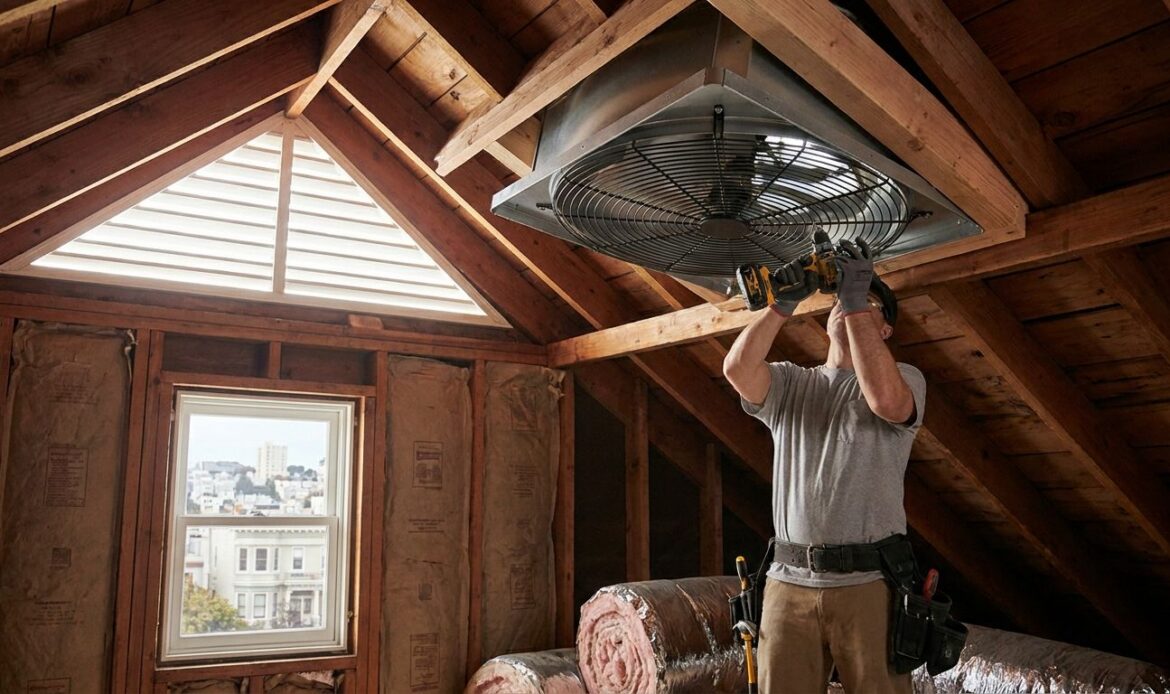
Nights cool off fast in Napa, Sonoma, and inland Contra Costa, and a whole house fan turns that free air into a cooling system that costs a fraction of running central AC. This guide covers sizing, attic ventilation requirements, and which fan type to install for a Bay Area home in 2026.
- Whole house fan installation works best for Bay Area homes with 20-30°F day-night swings — inland Sonoma, Napa, and Solano homeowners see the biggest payoff.
- Size the fan to your square footage first, then verify attic vent capacity before buying anything — undersized venting causes backdraft risk.
- Insulated, sealed-door fans are the 2026 default pick for tighter, newer homes; traditional attic-mounted units still work for well-vented older houses.
- Skip any installer who skips the attic vent calculation or a permit check — that’s the fastest way to end up with a noisy, unsafe system.
Why this matters
A whole house fan pulls cool outside air through open windows and pushes hot attic air out through roof or gable vents, dropping indoor temperature several degrees in under an hour on a typical summer night. For homeowners without central AC, or with AC they'd rather not run every evening, it's the cheapest cooling upgrade available in 2026.
The catch: sizing and attic ventilation matter more than brand. A fan that's too big for the attic's vent capacity pulls air from somewhere else in the house — sometimes down a water heater flue or furnace vent, which is a real combustion safety issue. Getting this installed correctly the first time means working with a licensed HVAC contractor in the Bay Area who checks vent area before mounting anything.
Who this is for
This guide is built for Bay Area homeowners in Sonoma, Napa, Marin, Solano, or Contra Costa counties with a home that doesn't run AC constantly and sees a real drop in nighttime temperatures. If your house holds heat into the evening and you're tired of paying to run a compressor for three or four hours after sunset, whole house fan installation solves that specific problem. It's not a replacement for AC on 100°F days with no overnight relief — it's a supplement that cuts AC runtime on the 60-70% of summer nights that actually cool off.
What to look for in whole house fan installation for Bay Area homes
CFM sized to your square footage
The standard contractor rule of thumb is roughly 2 to 3 times your home's square footage in CFM for a one-story house, adjusted down for two-story layouts with less open floor area per fan. A 1,800 sq ft ranch typically lands in the 3,600-4,500 CFM range. Undersizing means weak airflow that never really cools the house; oversizing wastes money and stresses the attic vents.
Attic net free vent area
Every whole house fan needs enough open attic venting to exhaust the air it pulls in — the common guideline is about 1 square foot of net free vent area for every 750 CFM of fan capacity. Most older Bay Area attics were built for passive ventilation, not fan-forced airflow, so this is the step installers skip most often. If your attic can't move that air out, you're better off pairing the fan install with attic ventilation upgrades before it ever runs.
Insulated, sealed fan doors
Older attic-mounted fans use a simple louvered shutter that leaks conditioned air into the attic all winter, undoing whatever insulation upgrades you've made. A sealed, insulated fan door closes tight when the fan's off, which matters in a state where Title 24 compliance increasingly expects tight building envelopes.
Noise level
Manufacturers publish sone ratings for a reason — a loud whole house fan gets turned off within a month and never used again. Older single-speed attic units are loud enough to hear through closed bedroom doors; newer insulated, ducted models run close to silent, which is the difference between a fan you actually use every night and one gathering dust by August.
Ductwork and attic insulation condition
A whole house fan pulling air through a poorly sealed attic or leaky ductwork wastes a chunk of its cooling capacity before it ever reaches your living space. If your attic insulation hasn't been checked in years, or your ducts leak, that's worth fixing alongside — not after — the fan install.
Backdraft safety with gas appliances
Any home with a naturally-vented gas water heater or furnace needs a combustion safety check before a whole house fan goes in. Negative pressure from an oversized or poorly vented fan can pull combustion gases back down a flue instead of letting them exhaust outside — a licensed contractor tests for this, a handyman install usually doesn't.
Top picks by fan type
Insulated ducted whole house fan — the safe pick for newer, tighter homes. Rated typically between 1,500 and 4,000 CFM with a sealed, insulated damper that closes when off. This is the standard fit for Title 24-era construction in Solano and Contra Costa where the building envelope is already tight. Buy for homes built after 2000 or any recent remodel with upgraded insulation.
Traditional attic-mounted fan — the budget pick for well-vented older homes. Airflow commonly runs 2,000 to 6,000 CFM on single-speed models, and installed cost is lower than ducted alternatives. Works fine if your attic already has generous vent area from a prior upgrade. Consider for older Sonoma or Napa farmhouses with big, open attics; Skip if your attic vents haven't been checked in over a decade.
Two-speed or variable-speed fan — the flexible pick for coastal swings. Marin and coastal Sonoma see milder, more variable overnight temperature drops than inland valleys, and a variable-speed unit lets you dial in low airflow on a 55°F night instead of blasting full CFM. Buy for coastal and hillside properties with inconsistent nightly cooling.
Smart, app-controlled fan — the convenience pick. Pairs with a schedule or smart thermostat so it kicks on automatically once outdoor temperature drops below indoor temperature. Consider if you already run a smart thermostat and want one less nightly decision; Skip if you're on a tight budget and comfortable using a manual timer instead.
Get your whole house fan sized right
A Comfort Factor technician checks attic vent capacity before you buy anything.
What to avoid
- Sizing by ceiling square footage alone. A contractor who quotes CFM without asking about attic vent area is guessing, and an undersized vent path turns into a backdraft risk with gas appliances.
- Installing before sealing existing ductwork. If your ducts leak into an unconditioned attic, a whole house fan pulls conditioned air out faster than it should. Fix duct leaks first — a duct sealing service pays for itself here.
- Skipping the permit. Whole house fans involve electrical work and sometimes structural attic access changes; skipping the permit can complicate things at resale inspection in 2026 and beyond.
Verdict comparison
| Fan Type | CFM Range | Best For | Verdict |
|---|---|---|---|
| Insulated ducted | 1,500-4,000 | Newer, tight-envelope homes | Buy |
| Traditional attic-mounted | 2,000-6,000 | Older homes with large vented attics | Consider |
| Two-speed / variable | Varies by model | Coastal, variable-swing climates | Buy |
| Smart app-controlled | Varies by model | Smart-thermostat households | Consider |
FAQ
What’s the best whole house fan for a Bay Area home in 2026?
An insulated ducted fan sized between 1,500 and 4,000 CFM is the best fit for most Bay Area homes built after 2000, since it closes tight when off and won’t leak conditioned air into the attic in winter. Older, well-vented homes can still use a traditional attic-mounted unit at a lower install cost.
Is a whole house fan better than running AC every night?
A whole house fan works better than AC on nights that cool below indoor temperature, which covers most Bay Area summer evenings, but it can’t replace AC on nights that stay hot. Most Bay Area homeowners run the fan on mild nights and AC only on the hottest stretches.
How much attic vent area do I need for a whole house fan?
The common guideline is about 1 square foot of net free vent area for every 750 CFM of fan capacity. A licensed HVAC contractor measures your existing attic vents before recommending fan size, since undersized venting creates backdraft risk.
Can a whole house fan cause problems with my gas water heater?
Yes, if the fan is oversized for the attic’s vent capacity, the negative pressure it creates can pull combustion gases back down a naturally-vented water heater flue instead of letting them exhaust outside. A combustion safety check during installation catches this before it becomes a hazard.
Do whole house fans work in coastal Marin and Sonoma homes?
Yes, though coastal homes see smaller day-night temperature swings than inland Napa or Solano, so a variable-speed model that runs at lower CFM on mild nights fits better than a single-speed unit. Homes closer to the coast should still expect strong results on warmer inland-influenced nights.
Do I need a permit for whole house fan installation?
Most Bay Area jurisdictions require an electrical permit for whole house fan installation, and some also require it for attic access modifications. Skipping the permit can create problems during a home sale inspection later on.
Will a whole house fan replace ductless mini-splits or central AC?
No, a whole house fan supplements cooling on nights that drop below indoor temperature but doesn’t provide cooling during hot, still afternoons. Most homes keep central AC or a mini-split system for peak heat and use the fan to cut nighttime runtime.
One last thing
The detail most homeowners miss: a whole house fan's real value shows up in the electric bill, not the temperature swing. Running a 3,600 CFM fan for four hours draws a fraction of what a central AC compressor pulls over the same stretch, which is why inland Sonoma and Napa homeowners with big overnight temperature drops see the fastest return on installation in 2026.
Related guides
- Best HVAC systems for wildfire smoke filtration in California
- How to maintain your AC in Northern California summers