

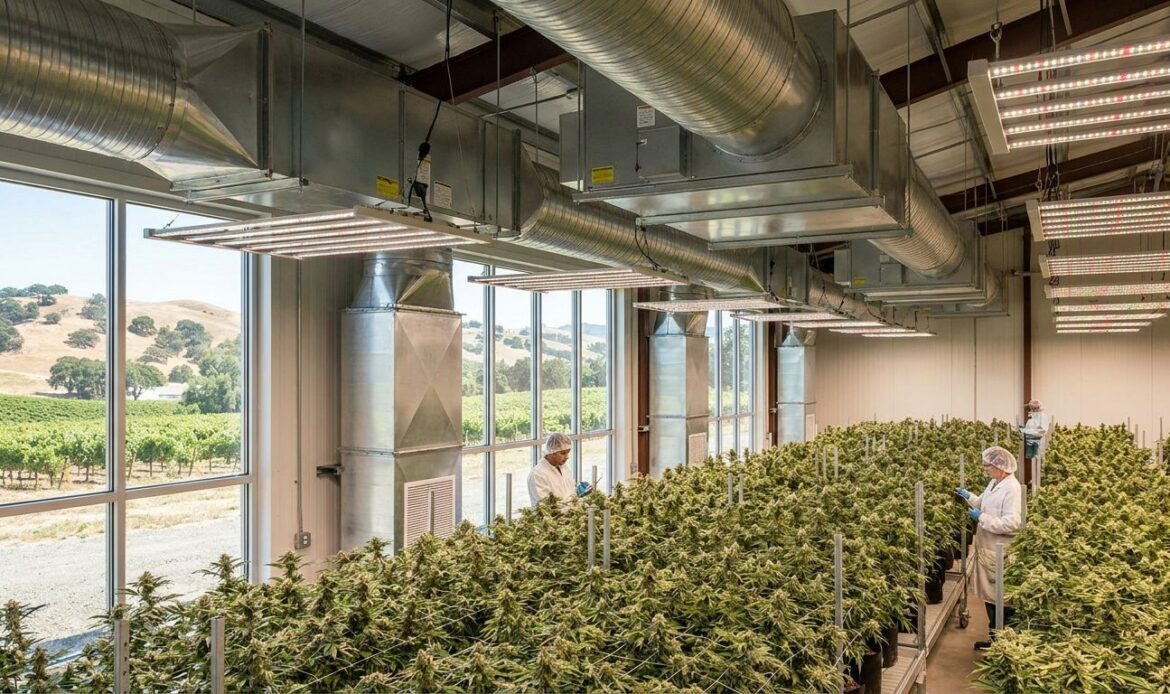
Sonoma County has more licensed cannabis cultivation square footage than almost anywhere else in California, and most of those grows are running HVAC systems that were designed for offices or warehouses, not for rooms holding 1,000-watt lights and irrigation lines. Getting HVAC for a cannabis cultivation facility right in Sonoma County means matching equipment to heat load, humidity swings, and local permitting rules that a standard commercial contractor may never have touched.
- Cultivation HVAC needs separate humidity control from cooling — a straight AC unit alone will not hold 45-55% RH in flower rooms.
- Every 1,000-watt HPS or LED grow light adds roughly 3,412 BTU/hr of heat load per kilowatt drawn, which stacks fast in a full flower room.
- Dedicated outdoor air systems (DOAS) paired with zoned ductless mini-splits are the Buy pick for most Sonoma County cultivators in 2026.
- Skip a single rooftop package unit sized for square footage alone — it ignores light-driven heat and odor control needs.
- Comfort Factor designs commercial HVAC for Sonoma County cultivation and processing spaces, not just retail and office buildings.
Why this matters
A cannabis grow room isn't a bedroom or a break room — it's a controlled-environment agriculture space where temperature and humidity mistakes show up as mold, stunted yield, or a failed county inspection. Sonoma County's permitting process already scrutinizes odor control and energy use for cultivation licenses, and an undersized or mismatched HVAC system is one of the most common reasons operators get flagged during compliance walkthroughs. Getting the mechanical design right the first time costs less than retrofitting a flowering room mid-cycle.
Who this is for
This guide is for licensed cultivators, processors, and property owners in Sonoma County running indoor or mixed-light grow operations — anywhere from a 2,000-square-foot converted barn in Sebastopol to a purpose-built facility near Santa Rosa. If you're managing veg and flower rooms with photoperiod lighting, CO2 enrichment, or drying and curing spaces, the equipment decisions below apply directly to your build-out or your next equipment replacement cycle.
What to look for in HVAC for a cannabis cultivation facility
Dedicated dehumidification, not just cooling
Standard AC coils remove some moisture as a byproduct of cooling, but they can't hold a steady 45-55% relative humidity once irrigation and plant transpiration ramp up. Cultivation rooms need a dehumidification system sized independently from the cooling system, or humidity spikes during lights-off periods will invite mold.
Heat load calculated from lighting, not square footage
A warehouse HVAC contractor will size equipment off square footage and occupancy. A cultivation room's real driver is lighting wattage — every kilowatt of grow lights adds roughly 3,412 BTU/hr of heat that has to leave the room. Skipping this calculation is the single most common undersizing mistake in Sonoma County grow builds.
Zoning between veg, flower, and dry rooms
Veg rooms typically run 68-77°F with higher humidity tolerance, while flower rooms need tighter humidity control to avoid bud rot, and dry rooms need slow, steady airflow at lower humidity. One shared system can't hold three different setpoints, so zoning with independent ductless or ducted mini-split zones matters more here than in almost any other commercial application.
Odor and exhaust integration
Sonoma County cultivation permits typically require odor mitigation as a condition of approval. HVAC and exhaust design need to work together — carbon filtration, negative pressure staging, and exhaust fan sizing all interact with how the cooling and dehumidification systems are laid out.
Redundancy for crop-critical equipment
A single compressor failure during a heat wave can wipe out a flowering room in 48 hours. Facilities running full production cycles should plan for redundant cooling or dehumidification capacity, not a single point of failure sized to exactly meet peak load.
Energy costs and incentive eligibility
Cultivation HVAC runs near-continuously, so equipment efficiency compounds over a full grow cycle. Commercial HVAC upgrades can qualify for federal and state tax incentives, and it's worth checking tax credits for commercial HVAC upgrades before finalizing equipment selection, since incentive eligibility can shift which system tier makes financial sense.
Top picks for cultivation HVAC configurations
The workhorse: Dedicated Outdoor Air System (DOAS) with independent dehumidification. A DOAS unit handles fresh air exchange separately from temperature control, which lets a cultivation room hit both its cooling setpoint and its 45-55% RH humidity target without one system fighting the other. This is the configuration most commercial cultivation designers in the Bay Area default to for rooms over 1,500 square feet. Verdict: Buy for any full-scale flower room.
The flexible pick: zoned ductless mini-splits per room. Ductless systems let veg, flower, and dry rooms run completely independent setpoints off separate indoor heads, which solves the zoning problem directly. Comfort Factor's work on best ductless mini-split systems for Bay Area ADUs and similar small-footprint zoning jobs translates directly to multi-room cultivation layouts. Verdict: Buy for facilities with more than two distinct room types.
The comparable case study: brewery-grade humidity control. Sonoma County breweries face a similar problem — high moisture load, temperature-sensitive product, continuous operation — and the mechanical approach for commercial HVAC for a brewery in Sonoma County uses the same dehumidification-first logic that cultivation rooms need. Verdict: Consider as a design reference when scoping equipment.
The wildcard: single rooftop package unit sized to square footage. This is the cheapest upfront option and the one most general contractors default to, because it's familiar and fast to install. It ignores lighting-driven heat load and typically can't hold flower-stage humidity targets without a separate dehumidifier bolted on afterward. Verdict: Skip for any room running more than a handful of 1,000-watt fixtures.
The maintenance layer: a commercial service plan built for continuous-run equipment. Cultivation HVAC runs far more hours per year than office or retail systems, which accelerates wear on compressors and coils. A commercial HVAC maintenance plan for Bay Area buildings built around quarterly inspections catches refrigerant loss and coil fouling before a crop cycle is affected. Verdict: Buy once equipment is installed and running production.
What to avoid
- Residential-grade split systems — they're not built for near-continuous run cycles and typically lack the dehumidification capacity a flower room needs.
- A single humidity setpoint for the whole building — veg, flower, and dry rooms need independent control, and a shared thermostat forces compromises that hurt yield in at least one room.
- Contractors without commercial cultivation experience — before signing a contract, confirm the contractor has actually sized equipment against lighting heat load; see how to choose an HVAC contractor in the Bay Area for the questions to ask.
Verdict comparison
| Configuration | Handles humidity independently | Zoning flexibility | Best for | Verdict |
|---|---|---|---|---|
| DOAS + dehumidification | Yes | Moderate | Rooms over 1,500 sq ft | Buy |
| Zoned ductless mini-splits | Partial (needs add-on dehumidifier) | High | Multi-room facilities | Buy |
| Brewery-style dehumidification design | Yes | Moderate | Reference for humidity-heavy builds | Consider |
| Single rooftop package unit | No | Low | Small non-flowering storage only | Skip |
Get a Sonoma County cultivation HVAC quote
Comfort Factor scopes heat load, humidity control, and zoning for grow rooms.
FAQ
What’s the best HVAC setup for a cannabis cultivation facility in Sonoma County?
A dedicated outdoor air system paired with independent dehumidification is the strongest setup for most Sonoma County flower rooms in 2026, because it separates temperature control from humidity control instead of relying on cooling alone to manage moisture.
How much heat does grow lighting add to an HVAC load calculation?
Every kilowatt of lighting adds roughly 3,412 BTU/hr of heat that the HVAC system has to remove. A room running several 1,000-watt fixtures can add tens of thousands of BTUs of cooling demand beyond what square footage alone would suggest.
Is a rooftop package unit enough for a small grow room?
A rooftop package unit sized only for square footage typically can’t hold flower-stage humidity targets on its own. It works better for storage or non-flowering support rooms than for active cultivation spaces.
What humidity range should a flower room maintain?
Most cultivation guidance targets 45-55% relative humidity during flowering to limit powdery mildew and bud rot risk. Veg rooms tolerate a wider range, typically alongside a 68-77°F temperature target.
Can commercial HVAC upgrades for a cultivation facility qualify for tax incentives?
Commercial HVAC equipment upgrades can qualify for federal and state incentives depending on the equipment type and efficiency rating. Checking current eligibility before finalizing equipment selection can change which system tier makes financial sense.
Do veg and flower rooms need separate HVAC zones?
Yes — veg and flower stages need different temperature and humidity setpoints, and a single shared zone forces a compromise that hurts one growth stage. Zoned ductless mini-splits or multi-zone ducted systems solve this directly.
How often should cultivation HVAC equipment be serviced?
Cultivation HVAC runs far more hours per year than typical commercial systems, so quarterly inspections catch refrigerant loss and coil fouling before it affects a crop cycle. Annual-only service intervals common in office buildings aren’t frequent enough for continuous-run grow equipment.
What’s the biggest HVAC mistake in cannabis cultivation builds?
Sizing equipment off square footage instead of lighting heat load is the most common and most expensive mistake. It leads to systems that run constantly but still can’t hold humidity or temperature setpoints once lights and irrigation are fully operational.
One last thing
Most cultivation HVAC failures don't happen from equipment breaking — they happen from equipment that was never sized for the actual heat and moisture load in the first place, and the symptoms don't show up until the first full flower cycle. Get the load calculation checked against your lighting plan before equipment goes in, not after the first mold outbreak.
Related guides
- Commercial HVAC services in Sonoma County
- Best commercial HVAC units for Bay Area breweries
- How to prepare your HVAC for Sonoma County wildfire season
- Best HVAC zoning systems for multi-story Bay Area homes