

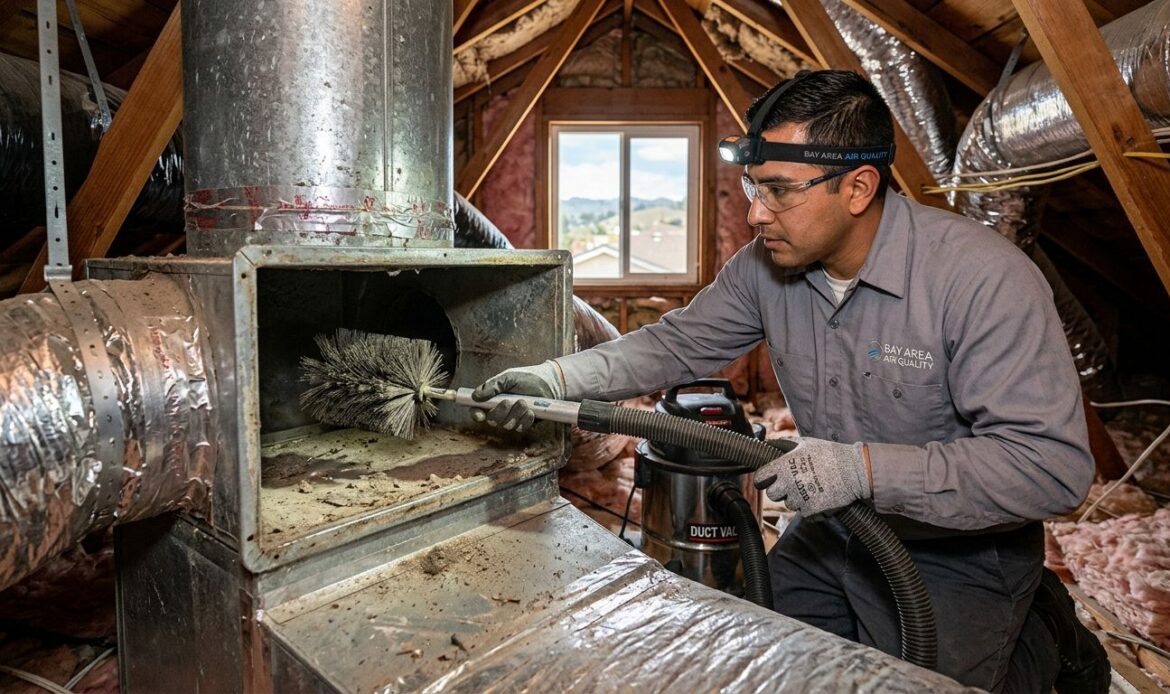
Most Bay Area homes need air duct cleaning every 3 to 5 years, but wildfire smoke, pets, and older duct systems in Sonoma, Marin, Napa, Solano, and Contra Costa counties push that timeline much tighter for a lot of households. The number that gets left out of most answers: a schedule means nothing if your ducts are leaking air into the attic, because sealing problems waste energy every single day a cleaning schedule never touches.
- Typical Bay Area homes need air duct cleaning every 3 to 5 years, per general industry guidance.
- Pets, smokers, and allergy sufferers should shorten that to every 2 to 3 years.
- Major wildfire smoke events call for an inspection regardless of your last cleaning date.
- Visible mold, dust streaks at vents, or rodent activity mean clean now, not on a schedule.
- Duct cleaning and duct sealing solve different problems and homeowners often need both.
Why this matters
Bay Area homes sit in a specific set of conditions that most national duct-cleaning advice ignores: wildfire smoke seasons that push fine particulate into HVAC systems, older housing stock in Marin and Sonoma counties with ductwork that's never been resealed, and mild winters that mean ducts run less often but collect dust just as fast. A generic "clean every 3 years" answer doesn't account for a Napa County home that just went through a smoke-heavy September, or a Contra Costa County house with three cats and forced-air heat running six months a year.
The frequency question also gets confused with a separate question: does your ductwork leak? Duct cleaning removes built-up dust and debris from inside the duct run. It does not fix a torn seam or a disconnected joint pushing conditioned air into your attic. Both matter, but they're not the same fix.
How often should you clean air ducts in a Bay Area home?
The honest answer depends on what's happening inside your specific system, not just the calendar. Here's the breakdown industry guidance and household conditions point to for 2026:
| Household situation | Recommended cleaning interval |
|---|---|
| Average home, no pets, no smokers | Every 3 to 5 years |
| Homes with pets or someone with allergies/asthma | Every 2 to 3 years |
| Homes with a smoker | Annually |
| After a remodel or new construction | Within a few months of work finishing |
| After heavy wildfire smoke exposure | Inspect after the event, clean if needed |
| Visible mold, dust puffs from vents, or rodent activity | Immediately, regardless of last cleaning |
The U.S. EPA's long-standing position is that duct cleaning isn't needed on a fixed schedule for most homes — it's needed when there's evidence of contamination. That's the standard Comfort Factor technicians use during inspections: look first, then recommend a service, instead of selling a cleaning nobody needs.
Average Bay Area home: every 3 to 5 years
A typical single-family home in Petaluma, Novato, or Walnut Creek with central forced-air heating and cooling collects enough dust in three to five years of regular use to justify a cleaning. This is the baseline number most HVAC contractors and duct-cleaning associations point to for households without extra risk factors.
Homes with pets or allergy sufferers: every 2 to 3 years
Pet dander and shed hair get pulled into return vents constantly, and that buildup accelerates dust accumulation well past the average-home timeline. If anyone in the house has asthma or seasonal allergies that seem to spike indoors, shortening the interval to every 2 to 3 years is the more conservative call.
Homes with a smoker: annually
Tobacco residue coats duct interiors and gets recirculated every time the system runs. Annual cleaning is the standard recommendation here, and it's one of the few situations where a fixed yearly schedule makes more sense than a condition-based approach.
After a renovation: within a few months
Drywall dust, sawdust, and insulation particles from remodeling work settle directly into open duct runs and registers. Homes that just finished a kitchen remodel, an attic project, or new flooring installation should schedule cleaning within a few months of the work wrapping up, before that debris circulates through the whole house.
After wildfire smoke exposure: inspect, then decide
Sonoma and Napa counties in particular deal with smoke events that push fine particulate matter deep into HVAC systems, sometimes coating ductwork and filters within days. After a significant smoke event, an inspection tells you whether cleaning is warranted this year — preparing your HVAC for Sonoma County wildfire season covers filtration steps that reduce how much smoke residue reaches your ducts in the first place.
Why duct cleaning frequency varies
A handful of household-specific factors push the interval shorter or longer than the 3-to-5-year baseline:
- Pets shedding into return vents — hair and dander build up faster than dust alone
- Smoking indoors — residue coats ducts and shortens the safe interval to yearly
- Recent renovation work — construction dust settles directly into open duct runs
- Wildfire smoke seasons — fine particulate gets pulled through the system during heavy smoke events
- Visible mold or moisture — a sign the ducts need attention now, not on a schedule
- Rodent or pest activity in ductwork — droppings and nesting material require immediate cleaning
Verdict: if none of these apply, stick to 3-5 years — if two or more apply, cut that interval in half.
“A cleaning schedule doesn’t fix a leaking duct — sealing does, and most homeowners never check for the difference.”
Duct cleaning addresses what's inside the ducts. It doesn't touch seams, joints, or connections that leak conditioned air into an attic or crawlspace. Older homes across Marin and Sonoma counties commonly lose 20-30% of heated or cooled air to leaky ductwork before it ever reaches a vent — that's an efficiency problem no cleaning service resolves. Duct sealing for Bay Area homes is the separate fix for that issue, and it's worth checking alongside any cleaning inspection since a technician is already looking at the same ductwork.
Get your ducts inspected
A technician checks for buildup, leaks, and smoke residue in one visit.
Related questions
Does duct cleaning improve indoor air quality?
Duct cleaning removes dust, pet dander, and debris that would otherwise recirculate every time the system runs, but it's one piece of an air quality picture, not the whole solution. Testing indoor air separately shows whether particulate, humidity, or other issues need a different fix — indoor air quality testing for Bay Area homes is the way to confirm what's actually in the air before assuming duct cleaning alone solves it.
How do I know if my ducts need cleaning now instead of waiting?
Visible dust streaks around vent covers, a musty smell when the system kicks on, or actual dust puffing out when the blower starts are the clearest signs cleaning shouldn't wait for a scheduled interval. Mold growth or evidence of rodents in the ductwork also means clean immediately, regardless of when the last service happened.
Is duct cleaning worth it for a home that's never had it done?
For a home with unknown duct history — especially older housing stock common across Sonoma and Marin counties — an inspection first tells you whether cleaning is worth the visit before assuming yes. Homes that have never had ducts cleaned sometimes have decades of buildup, and other times the ductwork is clean but leaking air, which changes the recommended fix entirely.
FAQ
How often should you clean air ducts in a Bay Area home?
Most Bay Area homes need duct cleaning every 3 to 5 years. Homes with pets, smokers, or recent wildfire smoke exposure should shorten that to every 1 to 3 years.
Does the EPA recommend a fixed duct cleaning schedule?
No, the EPA’s position is that duct cleaning isn’t needed on a set schedule for most homes unless there’s visible mold, pest activity, or excessive dust buildup. Condition-based cleaning is the recommended approach over a fixed calendar date.
Is duct cleaning worth it in California?
Duct cleaning is worth it when there’s visible contamination, pet dander buildup, or post-wildfire smoke residue in the system. For a home with no symptoms and ducts inspected within the last few years, it’s not an automatic yearly expense.
Can dirty air ducts make allergies worse?
Yes, ducts that circulate dust, pet dander, and debris every time the system runs can aggravate allergy and asthma symptoms indoors. Households with allergy sufferers should clean every 2 to 3 years instead of the standard 3-to-5-year interval.
Should I clean or seal my ducts first?
Clean first if there’s visible dust, mold, or debris inside the ducts, then check for leaks separately since sealing addresses a different problem. A technician can inspect for both in one visit rather than treating them as sequential jobs.
Does wildfire smoke require duct cleaning every year?
Not automatically, but a significant smoke event in Sonoma or Napa County warrants an inspection to check for particulate buildup in the ductwork and filters. Cleaning is only necessary if that inspection shows residue beyond what a filter change resolves.
How long does duct cleaning take?
Duct cleaning timing depends on the size of the home and the duct layout, and a technician can give a specific estimate during an inspection. Homes with more extensive ductwork or heavier buildup take longer than a straightforward single-story layout.
One last thing
The detail most homeowners miss: a duct system can look fine from the vent cover and still be leaking 20% or more of conditioned air into an unconditioned attic. Cleaning schedules get all the attention because they're visible and easy to explain, but sealing is the fix that actually shows up on a utility bill. If it's been more than five years since anyone looked at your ductwork in 2026, ask for both a cleaning inspection and a leak check in the same visit — it's the same appointment either way.
Related guides