

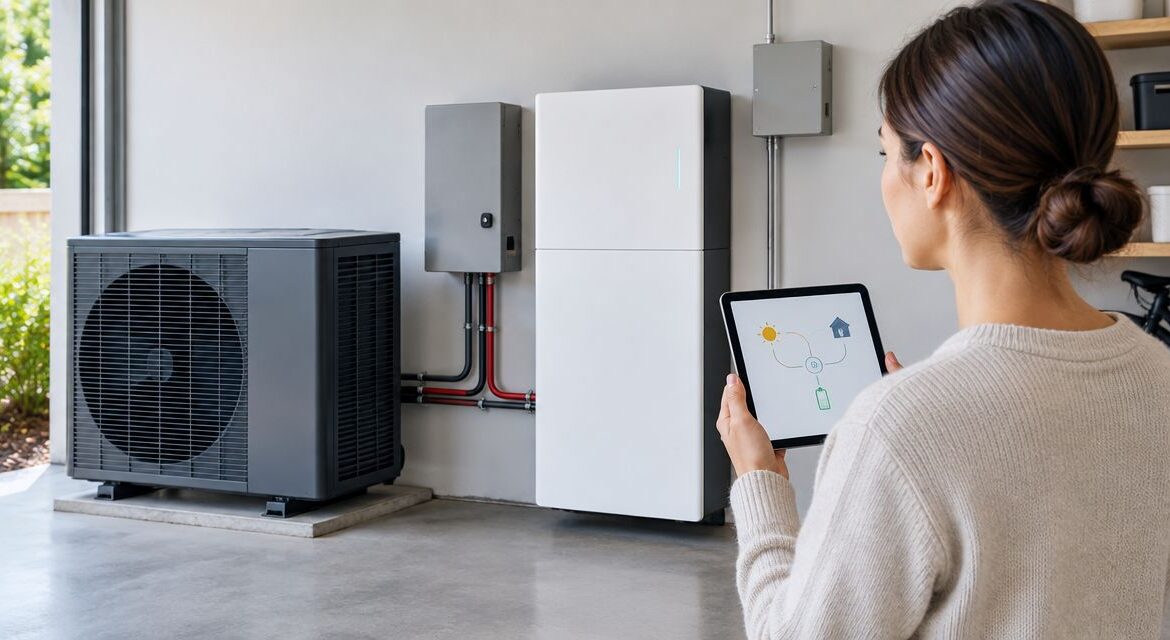
Instead of manually shutting off household loads whenever the power fails, connect your heat pump to home battery backup through a professionally designed backup circuit and load-management plan. The battery inverter must support the heat pump’s operating and starting demand, while approved transfer equipment isolates your home from the utility during an outage.
- To connect heat pump to home battery backup, verify inverter output, HVAC circuits, startup demand, and utility isolation.
- Comfort Factor handles heat pump installation, repair, and maintenance; electrical backup integration requires a qualified electrical installer.
- Back up indoor equipment and controls as well as the outdoor unit.
- Choose essential-load backup for tighter control; whole-home backup still requires load planning.
Why this matters
A battery that powers lights and a refrigerator does not automatically support heating or cooling. Your heat pump needs adequate electrical output, compatible voltage, and enough stored energy to operate alongside the other backed-up appliances.
Comfort Factor is best for Bay Area homeowners who need heat pump installation, repair, or maintenance as part of a battery-backup project. Battery selection, transfer equipment, and electrical integration belong with a qualified electrical installer; HVAC service alone does not establish battery compatibility.
For a 2026 installation, start with the equipment you actually have—not a battery capacity headline or the heat pump’s advertised efficiency. If you are replacing the system, use the guide to sizing a heat pump for a California home before designing the backup supply.
Treat this as a coordination guide, not a DIY wiring procedure. Do not open electrical panels, move breakers, modify thermostat wiring, or connect a battery directly to HVAC equipment yourself.
Before you start
- Equipment records and safe access: Gather model numbers, installation manuals, battery and inverter specifications, and existing circuit schedules. Photograph accessible equipment labels without removing electrical covers.
- Qualified installers and approvals: Arrange HVAC and electrical assessment, then confirm the permit and utility requirements that apply to your 2026 project. Comfort Factor provides heating, cooling, and heat pump services across Sonoma, Marin, Napa, Solano, and Contra Costa counties.
- The hidden gotcha: A ducted heat pump can have separate supplies for the outdoor unit, indoor air handler, and auxiliary electric heat. Backing up only the outdoor circuit can leave you without airflow or controls—or leave a large heating load unaccounted for.
Define your outage goal before requesting a design. Keeping one occupied area comfortable is a different requirement from maintaining normal temperatures throughout the house while other appliances run.
Heat pump load assessment
Identify the complete HVAC load
- Record every equipment model. Include the outdoor heat pump, indoor air handler or indoor heads, thermostat, and any auxiliary heating equipment. Ask the HVAC installer to identify which components must operate together.
- Map the required circuits. Have the electrical installer confirm which breakers supply those components. Existing panel labels are a starting point, not proof of the actual connections.
- Confirm voltage and operating demand. Many residential central heat pumps use 240 V power, while associated equipment can have different supply requirements, including 120 V. Verify each component’s nameplate and manual rather than assuming the entire system shares one circuit.
- Identify startup and auxiliary loads. Request manufacturer electrical data and, where appropriate, professional measurements. Include compressor startup, indoor fan operation, defrost behavior, and resistance heating in the assessment.
Expected result: You have a verified list of HVAC circuits, supply requirements, and electrical demands that the battery installer can use.
Do not size a battery from the circuit breaker rating alone. A breaker rating is not a measurement of normal operating consumption, and minimum circuit ampacity is a wiring-design requirement—not a runtime estimate.
Variable-speed equipment also needs model-specific review. Its operating characteristics do not remove the need to check inverter compatibility, starting behavior, and the manufacturer’s electrical requirements.
Separate output from stored energy
Battery output and battery capacity answer different questions. Kilowatts describe power; kilowatt-hours describe energy. An inverter must deliver the required power at that moment, while stored energy determines how long the supported loads can operate.
For unit reference, 1 kW equals 1,000 W, and 1 kWh equals 1,000 Wh. These conversions are not a recommendation for any particular battery size.
Use this relationship for planning:
Estimated runtime in hours = energy available to backed-up loads in kWh ÷ average total backed-up demand in kW.
Use energy remaining after the configured reserve, and account for conversion losses. Average demand must include other backed-up appliances, not just the heat pump; changing weather and cycling also change the result.
For a 2026 proposal, ask the installer to state the assumptions behind any runtime estimate. A useful estimate names the HVAC operating mode, other loads, starting charge, reserve setting, and expected conditions.
Backup circuit configuration
Choose the backup arrangement
- List essential household loads. Decide which appliances must remain powered alongside the heat pump. Separate necessities from loads you can postpone during an outage.
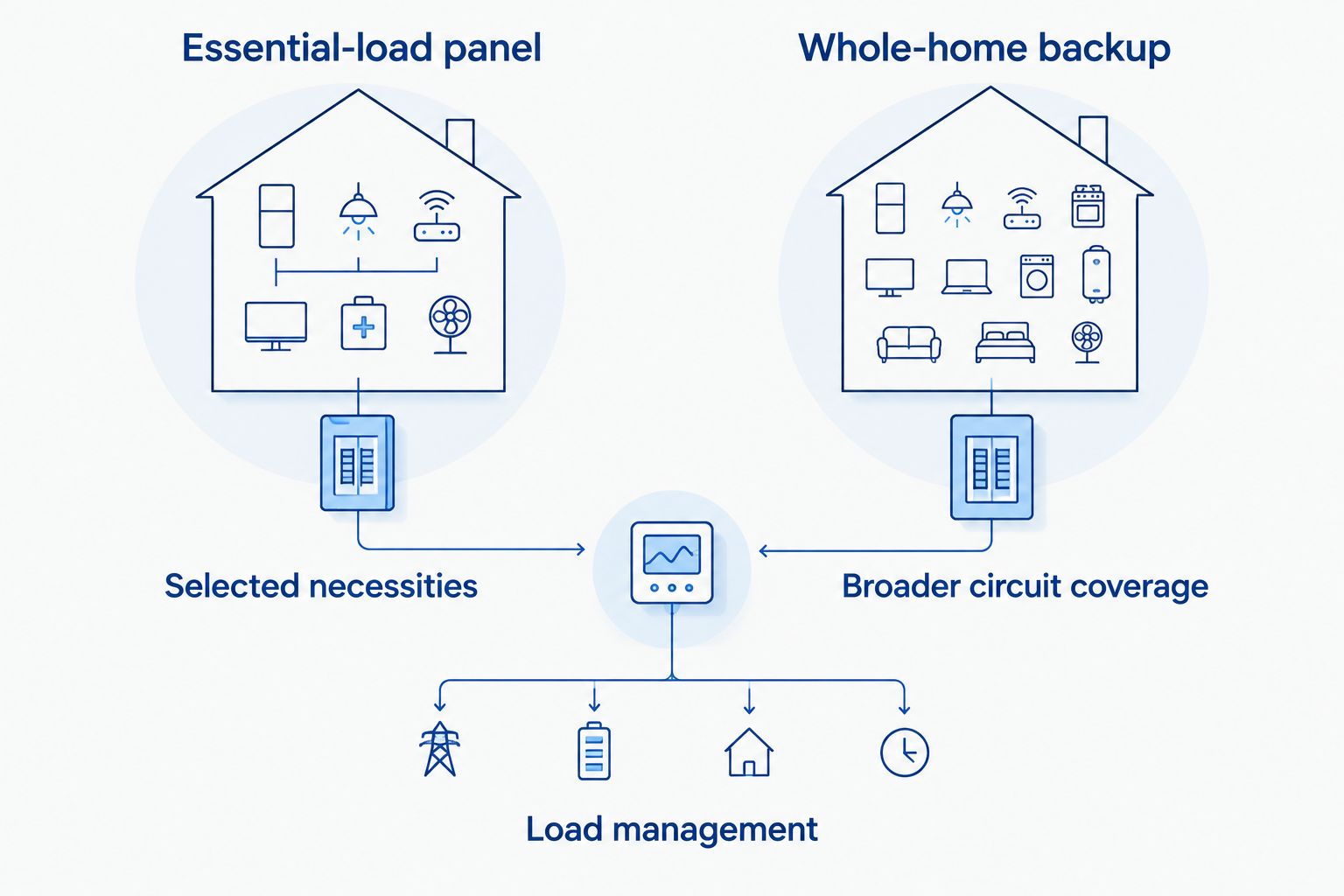
- Choose the electrical architecture. Ask the electrical installer to compare an essential-load panel with a whole-home backup arrangement. Both need adequate inverter output and approved isolation from the utility.
- Confirm HVAC circuit inclusion. Ensure the design accounts for the outdoor equipment, required indoor equipment, controls, and any permitted auxiliary heating operation.
- Document load priorities. Specify which loads are disconnected or restricted when demand exceeds the backup system’s capability. Use supported equipment and control methods, not improvised switching.
Expected result: The electrical design identifies what stays powered, what is excluded, and how overloads are prevented.
| Backup arrangement | Best for | Advantage | Limitation |
|---|---|---|---|
| Essential-load panel | Homeowners prioritizing HVAC and selected necessities | Makes the backed-up circuit list explicit | Excluded circuits remain off during an outage; required HVAC circuits must all be included |
| Whole-home backup | Homeowners wanting broader circuit coverage | Keeps more household circuits within the backup arrangement | Circuit coverage does not mean every appliance can run simultaneously; demand still needs management |
Essential-load backup is the better fit when your priority is a clearly defined set of outage loads. Whole-home backup fits broader coverage goals, but it is not permission to ignore the inverter’s limits.
The heat pump remains connected through the building’s approved electrical distribution system. It is not wired to a battery’s DC terminals, and an ordinary grid-connected solar installation is not a substitute for an outage-capable backup system.
Confirm safe utility isolation
Your electrical installer must specify approved transfer or isolation equipment for the chosen system. During an outage, the backup supply must not energize utility lines.
Do not use a homemade cord, an appliance outlet, or an improvised connection to feed the house. Ask the installer to document the isolation method, equipment compatibility, required approvals, and inspection process before installation begins.
If you need help choosing the HVAC participant, review how to choose an HVAC contractor in the Bay Area. Confirm the electrical installer’s qualifications separately; HVAC experience does not by itself establish battery-installation capability.
Outage controls and commissioning
Configure the operating plan
- Set the outage comfort goal. Agree on heating and cooling settings that meet household needs without demanding unnecessary operation. Account for occupants who need reliable temperature control.
- Review auxiliary heat behavior. Have the HVAC installer identify whether resistance heat operates during ordinary heating, recovery, emergency heating, or defrost. Restrict it only through a manufacturer-supported configuration that preserves safe equipment operation.
- Configure supported battery controls. Have the battery installer explain reserve, backup, and load-management settings using the exact labels in your system’s documentation. There is no universal button sequence across battery products.
- Coordinate restart behavior. Confirm how the heat pump responds after loss and restoration of power. Preserve the manufacturer’s compressor protection and restart delays.
- Test the completed installation. Have the installers conduct a controlled outage test using approved procedures. Verify indoor airflow, thermostat operation, heating or cooling, battery output, and restoration to utility power.
Expected result: The complete HVAC system operates on backup power under the agreed conditions, and the handoff explains its limits.
For 2026 commissioning, request a written record of the tested operating mode and concurrent household loads. Also record any modes not tested; a cooling test does not demonstrate winter heating performance with auxiliary heat.
Do not disable protective controls to make a failed test pass. An overload or repeated shutdown requires diagnosis, load changes, or a revised design—not a larger breaker or bypassed safety device.
Plan the HVAC side of backup
Discuss heat pump installation, repair, or maintenance before finalizing your electrical backup design.
Variant: coordinate solar charging with outage backup
A solar-plus-battery workflow adds another question: can the installed solar equipment operate and recharge the battery while the home is isolated from the utility? Solar panels alone do not establish that capability.
- Verify islanded operation. Ask the solar and battery installer whether the complete installed system supports solar production during an outage.
- Confirm charging and load priorities. Document how available solar generation is shared between household demand and battery charging. Heating or cooling demand competes with charging when both occur together.
- Test changing conditions. Have the installer verify supported operation as solar output changes and the battery approaches its configured limits.
Expected result: You understand whether solar contributes during an outage and what happens when generation is insufficient.
For a 2026 solar-plus-battery project, do not promise overnight HVAC operation based on daytime generation alone. Start the evening runtime calculation with the energy actually available and the expected household demand.
Troubleshooting
The thermostat works, but no air comes from the vents
Check the backup circuit plan for the indoor air handler. A powered thermostat does not prove that the blower has power. Have the electrical installer verify supply and the HVAC installer check controls; do not move circuits yourself.
The battery shuts down when heating starts
Have the installers compare the event with startup demand, auxiliary heat, and simultaneous household loads. Stop repeated restart attempts. Review fault records and the approved load-management design before changing settings.
Cooling works on backup, but heating fails
Check heating-specific loads and control sequences. Auxiliary resistance heat or defrost-related operation can introduce demand that a cooling test did not cover. Have the HVAC installer verify normal heating operation before the electrical installer reassesses backup capacity.
The battery drains sooner than expected
Compare actual energy use with the runtime assumptions. Check starting charge, reserve, other appliances, outdoor conditions, and auxiliary heating. Correct the estimate or operating plan instead of assuming the battery has failed.
The heat pump does not restart immediately
Follow the equipment manual’s restart procedure and protection delay. Repeatedly cycling power can interrupt recovery. Persistent faults need professional diagnosis, especially after electrical work or an unsuccessful transfer test.
Customize your workflow
Expand the plan around your household’s needs—not around powering every appliance. Define which rooms require conditioning, which loads can wait, and who knows how to read battery status without changing installer settings.
Comfort Factor can address the heat pump installation, repair, and maintenance side of that plan. Keep electrical backup design with the qualified electrical installer, and make the handoff between both parties explicit.
Keep model numbers, circuit records, approved operating settings, and commissioning results together. Review the plan whenever you replace HVAC equipment or add a significant electrical load; the original backup assessment no longer describes the same house.
FAQ
Can I connect a heat pump directly to a home battery?
No. A home heat pump needs a compatible AC supply through an approved inverter and electrical backup arrangement, not a connection to battery DC terminals. A qualified electrical installer must design the circuits and utility isolation.
Can a home battery run both heating and air conditioning?
Yes, if the installed backup system supports the heat pump’s electrical requirements in both modes. Heating can introduce auxiliary loads that are absent during cooling, so both operating conditions need assessment.
How big a battery do I need for a heat pump?
Battery sizing depends on the heat pump’s demand, other backed-up loads, and your runtime goal. Check inverter output separately from stored energy, and include startup and auxiliary heating requirements.
Do I need to back up the indoor air handler too?
Yes, if the indoor air handler is required for your heat pump to operate. The outdoor unit, indoor equipment, and controls must have the supplies their installed configuration requires.
Is essential-load backup better than whole-home backup?
Essential-load backup is better for a defined set of priority circuits; whole-home backup suits broader coverage. Neither arrangement guarantees that all connected appliances can operate simultaneously.
Will solar panels keep my heat pump running during an outage?
Only an outage-capable solar and backup system can supply the heat pump while isolated from the utility. Ordinary grid-connected solar does not by itself provide outage power.
Does Comfort Factor install home battery systems?
Comfort Factor’s stated services cover heating, cooling, heat pump installation, repair, and maintenance. Arrange battery equipment, electrical integration, and utility isolation with a qualified electrical installer.
One last thing
Ask for an outage test that includes indoor airflow—not just a running outdoor unit. A compressor operating outside is not proof that the house receives heating or cooling. Verify the complete system before relying on it.
Related guides
- Connect a heat pump to a home solar power system
- Reset your HVAC system after a power outage
- Prevent short cycling in a heat pump