

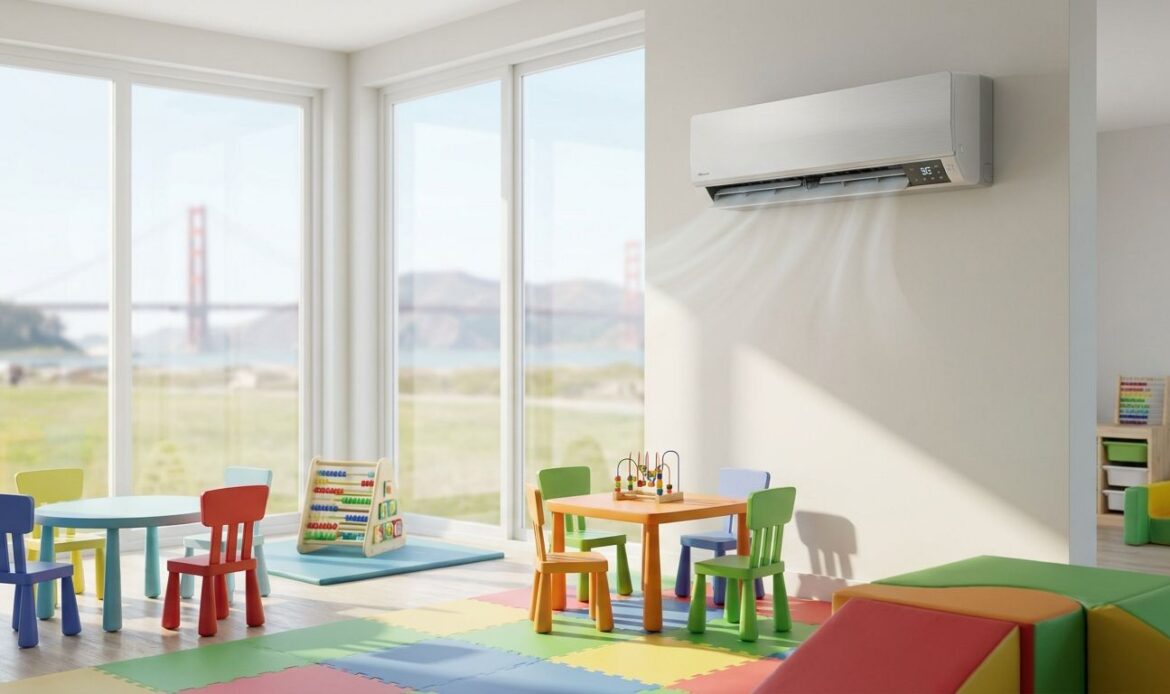
Daycare centers run on tight schedules, strict licensing requirements, and rooms full of kids whose lungs and comfort tolerances are more sensitive than an adult's. HVAC for daycare centers in the Bay Area has to hit ventilation, filtration, noise, and zoning targets that a typical office build never has to think about.
- Ductless mini-split zoning is the safest pick for HVAC for daycare centers with mixed-age classrooms in 2026 — buy it.
- MERV 13 filtration is the practical minimum for Bay Area daycare HVAC during wildfire season, not an upgrade option.
- Rooftop packaged units work for single-story centers over 3,000 square feet but need noise checks before install.
- Skip window units and portable ACs as anything but a short-term stopgap in a licensed childcare facility.
Why this matters
A daycare isn't a residence and it isn't a standard office. Licensing inspectors, parents, and staff all expect stable temperatures, clean air, and quiet equipment in spaces where naptime and noise-sensitive activities happen back to back. Get the HVAC wrong and you're not just dealing with an uncomfortable room — you're dealing with complaint calls, air quality flags during wildfire season, and equipment that can't keep up with a building full of doors opening every 20 minutes.
Comfort Factor sees this gap most often in converted spaces: a daycare center that took over a former retail unit or a church annex, running HVAC sized for a different occupancy load entirely. That mismatch shows up fast in California's Bay Area, where wildfire smoke and shoulder-season temperature swings punish undersized or poorly filtered systems every year.
Who this is for
This guide is for daycare center owners, directors, and facility managers operating licensed childcare spaces across Sonoma, Marin, Napa, Solano, and Contra Costa counties — whether you're running a single classroom in a converted storefront or a multi-room center with 40+ enrolled children. If you're evaluating a new build, a lease renovation, or an aging system that can't keep pace with today's group sizes, the criteria below apply directly. For a broader look at commercial HVAC in a comparable multi-room setting, commercial HVAC for an office building in Contra Costa County covers similar zoning and ventilation logic.
What to look for in HVAC for daycare centers
Fresh air ventilation rates
Childcare spaces need higher outdoor air exchange than a typical office because more bodies occupy less square footage per room. Systems designed for standard commercial occupancy often undersize the fresh-air component, leaving rooms stuffy by mid-morning even when the thermostat reads comfortable.
Filtration built for wildfire smoke
Bay Area wildfire season runs roughly June through October most years, and daycare centers can't just close windows and wait it out — kids are indoors all day regardless. MERV 13-rated filtration is the practical floor for capturing fine particulate matter down to 0.3 microns, and a system that can't accommodate that filter density without choking airflow is the wrong system for this use case.
Noise levels near nap and quiet time
A rooftop unit that runs at 65 decibels next to a nap room defeats the purpose of naptime. Ductless indoor units typically run quieter than ducted forced-air registers cycling on and off, which matters more in a daycare than almost any other commercial setting.
Zoning for mixed-age classrooms
Infant rooms, toddler rooms, and preschool activity rooms all run different temperature and activity levels throughout the day. A single-zone system forces one setpoint across every room, which means someone is always uncomfortable. Zoned systems let you set each room independently and adjust for activity level, occupancy, and nap schedules without touching every thermostat in the building.
Maintenance contracts and uptime guarantees
A daycare can't operate without functioning heat or cooling — licensing rules and parent expectations don't allow for a multi-day outage while parts get ordered. A maintenance contract with priority response for commercial accounts matters more here than in a typical retail space, where a slow HVAC fix is an inconvenience rather than a shutdown risk.
Commercial-grade equipment sized to actual occupancy
Residential-grade units get installed in converted daycare spaces more often than they should, usually because a previous tenant left equipment behind. Occupancy loads, door-opening frequency, and continuous daytime use in a daycare exceed what residential equipment is built to handle over a multi-year lifespan.
Top picks for daycare center HVAC
Ductless mini-split zoning — the flexible pick. Each classroom gets its own indoor head and independent thermostat, so an infant room can run warmer than a preschool activity room without a single duct run tying them together. Systems typically install with minimal disruption to a leased space, which matters if you don't own the building. Verdict: Buy for centers with mixed-age classrooms or converted retail/office spaces where ductwork isn't already in place.
Rooftop packaged units — the workhorse pick. These handle larger single-story centers efficiently and keep equipment off the classroom floor entirely, which is a real advantage when floor space is already tight with cribs and play equipment. The tradeoff is less room-by-room control and a noise profile that needs checking against nap schedules before installation. Verdict: Consider for centers over roughly 3,000 square feet with a single open floor plan and no strong need for independent room zoning.
Commercial-grade heat pump systems — the efficient pick. Heat pumps handle both heating and cooling from one system, which simplifies maintenance contracts to a single piece of equipment instead of separate furnace and AC service calls. Bay Area rebate programs have made heat pump installs more cost-competitive for commercial accounts heading into 2026 than they were even two years ago. Verdict: Buy for centers planning a full system replacement rather than a patch repair.
A commercial maintenance plan — the non-negotiable. Daycare HVAC downtime isn't a minor inconvenience, it's a licensing and operations problem, so a maintenance contract with priority scheduling matters as much as the equipment itself. Commercial HVAC maintenance plans for Bay Area buildings outline what a realistic service cadence looks like for a facility that can't afford a multi-day outage. Verdict: Buy regardless of which equipment path you choose.
Portable AC units or window units — the stopgap. These show up in daycare centers mid-renovation or while waiting on permits, and they're fine for exactly that window of time. They're not built for continuous daytime use across a full enrollment year, and licensing inspectors don't love seeing them as a permanent fixture. Verdict: Skip as anything beyond a temporary bridge.
Get a daycare HVAC assessment
A walkthrough tells you what your space actually needs before you spend on equipment.
What to avoid
- Residential-grade equipment left over from a previous tenant. It looks like a working system on day one, but it wasn't built for continuous daytime occupancy loads and tends to fail earlier than commercial-rated equipment.
- Single-zone systems in multi-age facilities. One thermostat controlling an infant room and a preschool activity room guarantees someone is uncomfortable every day, all year.
- Contractors without commercial licensing experience. Daycare HVAC work often intersects with licensing inspections, and a contractor unfamiliar with commercial permitting can slow down your approval timeline. How to choose an HVAC contractor in the Bay Area covers the licensing and vetting questions worth asking before signing a contract.
Verdict comparison
| Option | Best for | Noise profile | Verdict |
|---|---|---|---|
| Ductless mini-split zoning | Mixed-age, multi-room centers | Low | Buy |
| Rooftop packaged unit | Large single-story, open floor plan | Moderate | Consider |
| Commercial heat pump system | Full system replacement | Low to moderate | Buy |
| Maintenance contract | Every daycare facility | N/A | Buy |
| Window/portable AC | Temporary bridge only | High | Skip |
FAQ
What’s the best HVAC system for a daycare center in the Bay Area?
Ductless mini-split zoning is the best fit for most daycare centers in 2026 because it gives each classroom independent temperature control without major ductwork. Larger single-story centers with open floor plans can also work well with a commercial rooftop packaged unit.
Is a heat pump better than a furnace for a daycare center?
A commercial heat pump handles both heating and cooling from a single system, which simplifies maintenance compared to running separate furnace and AC equipment. For Bay Area daycare centers replacing an aging system in 2026, heat pumps are generally the more efficient long-term choice.
How much air filtration does a daycare center need?
MERV 13 filtration is the practical minimum for daycare centers in wildfire-prone regions like the Bay Area. It captures fine particulate matter down to 0.3 microns, which matters during the June through October wildfire season.
Can residential HVAC equipment be used in a licensed daycare?
Residential-grade equipment is not built for the continuous daytime occupancy loads a licensed daycare puts on a system. Commercial-grade equipment sized to actual room occupancy holds up longer and passes licensing inspections more reliably.
How often should daycare HVAC systems get serviced?
Daycare HVAC systems need more frequent service than a typical office because downtime directly affects licensing compliance and daily operations. A commercial maintenance contract with priority scheduling is standard for facilities that can’t tolerate a multi-day outage.
Do zoned HVAC systems cost more to install in a daycare?
Zoned systems typically cost more upfront than a single-zone setup because each room gets its own indoor unit and control. The tradeoff is lower long-term energy waste since empty or low-activity rooms don’t run at the same setpoint as active classrooms.
What noise level is acceptable for HVAC near a nap room?
Ductless indoor units generally run quieter than ducted registers cycling on and off, which matters directly next to a nap or quiet-time room. Noise level should be checked against the manufacturer’s rated decibel output before installation, not assumed.
One last thing
The single most overlooked detail in daycare HVAC isn't the equipment — it's the filter housing. A system rated for MERV 13 filters does nothing during wildfire season if the housing was never upgraded to handle the thicker filter media, and that's a five-minute check most facilities never make until smoke rolls in.
Related guides