

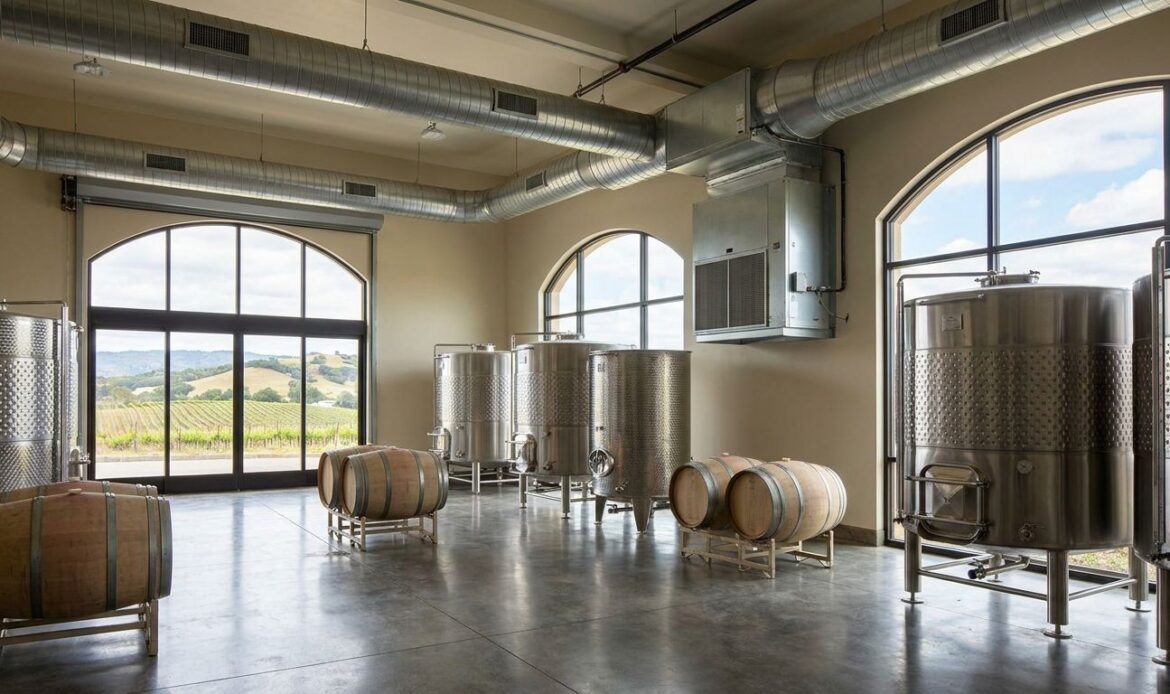
Fermentation tanks don't care about your thermostat setting, but they will punish you if the room around them swings more than a few degrees. Winery production facilities in Napa Valley need HVAC systems built for tank rooms, barrel storage, and crush pad operations — not the office-park package unit a generic contractor defaults to.
- Rooftop packaged units with dedicated process cooling handle Napa Valley tank rooms best in 2026 — Buy for facilities over 5,000 sq ft.
- Ductless mini-splits win for barrel rooms and wine cellars needing tight humidity control without ductwork runs.
- Standard commercial RTUs sized for offices, not fermentation loads, are the most common HVAC mistake at Napa production facilities.
- Federal and state tax incentives can offset commercial HVAC upgrade costs in 2026 — check eligibility before you sign a contract.
Why this matters
A winery production facility runs three distinct microclimates under one roof: a crush pad that spikes with outdoor heat during harvest, a fermentation and tank room that needs to hold 45-55°F for reds and whites, and a barrel room that needs 60-70% relative humidity to keep wine from over-evaporating through the wood. One HVAC system trying to serve all three zones is the single biggest reason Napa Valley wineries call for emergency repairs mid-crush.
Get commercial HVAC installation in Napa matched to actual production zones instead of square footage alone, and you cut both energy waste and the risk of a fermentation batch going sideways because the tank room hit 62°F overnight.
Who this is for
This guide is for winery owners, cellar masters, and facility managers running production operations in Napa, Sonoma, or the surrounding counties — not tasting rooms or retail spaces, which have entirely different load profiles. If your building houses stainless tanks, oak barrels, a crush pad, or a bottling line, the HVAC decisions here apply directly to you.
What to look for in HVAC for a winery production facility
Zone-specific temperature control
Fermentation rooms, barrel storage, and administrative areas each need independent thermostat zones because their tolerances don't overlap. A single-zone system forces you to compromise — usually by overcooling the tank room to protect the office space, which wastes energy and stresses the compressor.
Humidity management, not just cooling
Barrel rooms lose wine to evaporation ($$ per barrel per year in lost volume, aka "the angels' share") faster when relative humidity drops below 60%. Standard AC systems dehumidify as a side effect of cooling; a production facility needs a system engineered to hold humidity independent of temperature, especially through Napa's dry summer months.
Redundancy during crush season
Harvest runs roughly six to ten weeks a year and it's the worst possible time for a tank room to lose cooling. Facilities running near capacity during crush should specify N+1 redundancy — one backup unit sized to cover the load if the primary system fails — rather than a single unit with no fallback.
Corrosion and airborne particulate resistance
Crush pads generate must, dust, and acidic vapor that eats through standard coil coatings faster than a typical commercial kitchen. Equipment rated for corrosive or particulate-heavy environments lasts measurably longer in a working winery than off-the-shelf commercial units.
Energy efficiency at scale
Production facilities run cooling systems near-continuously for weeks during fermentation, which means efficiency differences compound fast. A unit with a few points higher SEER2 rating pays back the difference within a couple of crush seasons for a facility running multiple tank rooms.
Local code and permitting familiarity
Napa County commercial HVAC installs for food and beverage production facilities go through different permitting than a standard office retrofit. A contractor who's pulled those permits before saves weeks compared to one learning the process on your project.
Get a winery HVAC quote
Free assessment of your Napa Valley production facility’s zones.
Top picks for winery production facility HVAC
The workhorse: rooftop packaged units with dedicated process cooling. Spec that matters: independent zoning for tank rooms versus office/admin space. For a facility running 10-20 fermentation tanks, a packaged system split into at least two zones keeps the tank room at a steady 45-55°F without overcooling the rest of the building. Buy for any production facility over 5,000 square feet running active fermentation.
The humidity specialist: ductless mini-splits for barrel rooms and wine cellars. Spec that matters: independent humidity control separate from temperature. A ductless mini-split for a wine cellar in Napa Valley holds barrel storage at 60-70% RH without the ductwork runs a packaged system needs, which matters in older stone or converted-barn cellar spaces common across Napa Valley. Buy for barrel rooms under 2,000 square feet.
The production-floor fix: brewery-grade commercial HVAC units repurposed for wineries. Spec that matters: corrosion-resistant coils rated for high-particulate environments. Systems built for commercial HVAC units at Bay Area breweries share the same production-floor challenges as wineries — steam, must, and acidic vapor — and hold up longer than standard commercial units on the crush pad. Consider if your production floor runs heavy crush-season particulate exposure.
The overkill pick: full redundant chiller plant for a single small tank room. Spec that matters: N+1 backup capacity. A dedicated chiller plant makes sense for a facility running 50+ tanks, but for a boutique winery with under ten tanks, it's capital tied up in capacity you'll never use during a normal crush. Skip unless your production volume is scaling past a few thousand cases a year.
The financing angle: tax-credit-eligible efficient equipment upgrades. Spec that matters: qualifying SEER2 or heat pump equipment can offset installation costs through 2026 incentive programs. Reviewing how to claim tax credits for commercial HVAC upgrades before signing a contract can change which equipment tier makes financial sense. Consider running this check before finalizing any production facility HVAC budget for 2026.
What to avoid
- Standard office-grade RTUs sized only by square footage. They ignore the latent heat load from fermentation and the humidity swing barrel rooms need, and they're the single most common misfit equipment call in Napa Valley winery retrofits.
- Single-zone systems covering tank rooms and tasting or admin space together. This forces a temperature compromise that either overcools your public-facing space or undercools your fermentation zone.
- Contractors without commercial food/beverage production experience. A residential HVAC background doesn't translate to understanding why a 55°F tank room setpoint matters during malolactic fermentation. Vet this before you sign — how to choose an HVAC contractor in the Bay Area covers the specific questions to ask.
Verdict comparison
| System type | Best for | Temp/humidity control | Verdict |
|---|---|---|---|
| Zoned rooftop packaged unit | Tank rooms 5,000+ sq ft | Independent zone temp | Buy |
| Ductless mini-split | Barrel rooms, wine cellars | Humidity + temp, no ductwork | Buy |
| Brewery-grade production HVAC | Crush pad, high-particulate floors | Corrosion-resistant | Consider |
| Full redundant chiller plant | 50+ tank facilities | N+1 redundancy | Consider |
| Standard office RTU | Nothing in a winery | None | Skip |
FAQ
What temperature should a winery fermentation room be kept at?
Most winery fermentation rooms hold 45-55°F depending on whether the tank is running reds or whites. HVAC systems zoned specifically for tank rooms hold this range far more consistently than a shared building-wide system.
What humidity level is needed for a wine barrel room?
Barrel rooms need 60-70% relative humidity to limit evaporation loss through the oak. Dropping below that range accelerates the angels’ share and can dry out barrel staves over a single aging cycle.
Is ductless HVAC good for a wine cellar in Napa Valley?
Yes, ductless mini-splits work well for wine cellars and barrel rooms because they control humidity and temperature independently without running new ductwork through stone or converted-barn structures common in Napa Valley.
How often should HVAC be serviced at a winery production facility?
Production facilities running near-continuous cooling during crush season should schedule maintenance before harvest starts, typically late summer, and again post-crush. Facilities pushing equipment hard for six to ten weeks straight need pre-season checks more than a standard commercial building does.
Are there tax credits for commercial HVAC upgrades in 2026?
Qualifying efficient equipment, including certain heat pump and SEER2-rated systems, can be eligible for federal and state incentives in 2026. Confirm current eligibility before finalizing equipment selection since programs and thresholds change year to year.
What size HVAC system does a winery production facility need?
Sizing depends on tank count, room volume, and whether barrel storage is on-site, not just square footage. A facility with 10-20 active fermentation tanks needs a materially different load calculation than an equivalent-size building without process cooling.
Can one HVAC system serve both the tasting room and production floor?
Technically yes, but it’s not recommended. Tasting rooms need comfort-cooling for guests while production floors need process cooling for fermentation, and combining them into one zone usually means one space is always out of range.
One last thing
Crush season is the worst time to discover your tank room HVAC can't hold setpoint — plan any equipment upgrade for spring or early summer, months before the 2026 harvest starts, not during it.
Related guides
- Best ductless AC systems for wine cellars in Napa Valley
- Commercial HVAC services in Napa, CA
- Best HVAC maintenance plans for Bay Area commercial buildings
- Emergency HVAC repair in Napa, CA